
Updated October 2026 · Reviewed by Billy Forte
A judge can waive the parenting course Florida law requires, but only for good cause: section 61.21(4)(b) lets the court excuse a parent from the course, or from finishing it on time. The statute does not define good cause, and the Ninth Circuit’s order says waivers “shall not be liberally provided.” Parents cannot waive the course by agreement, so ask the court or a family law attorney about your own case.
Key Facts
- Who decides: only the court can excuse a parent. See what the statute says.
- Two kinds: excusal from the course, or from the deadline. See two kinds of excusal.
- Good cause: the statute does not define it or list examples. See good cause.
- Local orders: the Ninth Circuit wants it in writing; the Seventh wants a proper motion. See local orders.
- Other options: the rules already allow separate attendance and lower fees. See what the rules already allow.
Can the Parenting Course Florida Requires Be Waived?
Yes, but not by the parents and not without a reason. The rule is in section 61.21, Florida Statutes. It requires the course for all parties to a divorce with minor children and for parties to a paternity case about parental responsibility.
The same section gives the court a way to make an exception. That exception belongs to the judge alone. The rest of this guide explains how it works.
What Section 61.21(4)(b) Says
The statute’s words are short: “The court may excuse a party from attending the parenting course, or from completing the course within the required time, for good cause.”
Three parts of that sentence matter:
- “The court.” The power sits with the judge, not the parents, the clerk or the provider.
- “May.” The court is allowed to excuse a party, but it does not have to.
- “For good cause.” There must be a reason the court accepts.
The statute uses the word “excuse.” Local orders and parents say “waive.” Both refer to the same idea.
Two Kinds of Excusal
The statute names two things a court can excuse. They lead to different results:
| Excusal | What it covers | What the parent still does |
|---|---|---|
| From attending the course | The course itself | Follows any other order the court enters |
| From completing on time | The 45-day deadline | Still finishes the course and files proof |
The second kind is narrower. It forgives lateness, not the course. A parent excused from the deadline still needs the certificate before the final judgment.
Good Cause Is Not Defined
Section 61.21 does not say what good cause means. It gives no list of reasons and no examples. DCF’s rules for the course do not define it either.
That leaves the decision to the judge in each case. So no article can tell you whether your reason will count. Be wary of any source that promises a waiver for a set reason.
What Local Orders Say
Some circuits describe how they handle waivers. Two official orders show the range:
| Circuit | Order | Waiver wording |
|---|---|---|
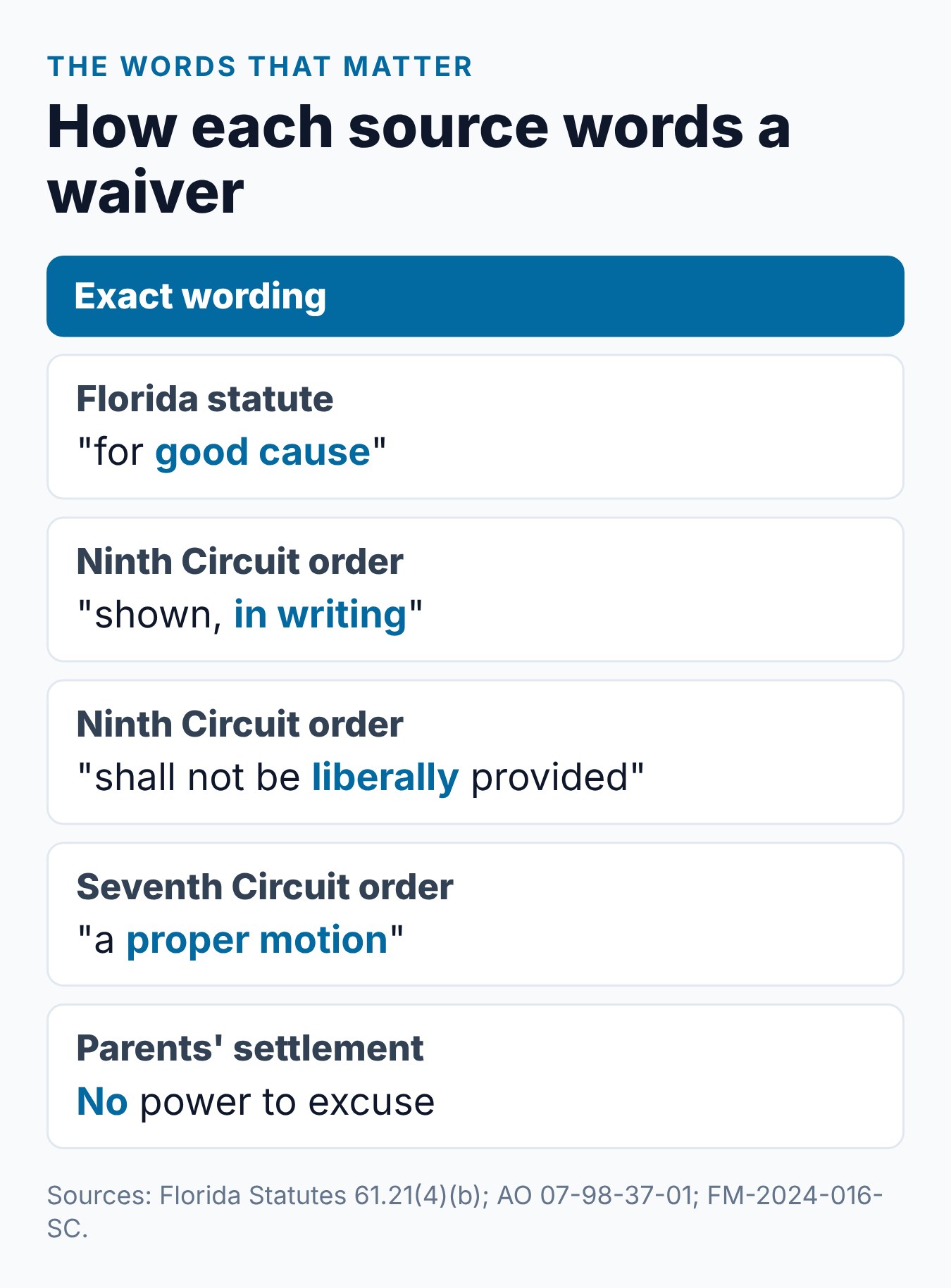
| Ninth (Orange, Osceola) | 07-98-37-01 | “upon good cause shown, in writing”; waivers “shall not be liberally provided” |
| Seventh (Flagler, Putnam, St. Johns, Volusia) | FM-2024-016-SC | Judges may waive “upon presentation of a proper motion in individual cases” |
You can read the Ninth Circuit’s order 07-98-37-01 and the Seventh Circuit’s order FM-2024-016-SC. Both treat a waiver as a formal request to the judge.
The Ninth Circuit’s words are the strongest. “Shall not be liberally provided” means the court does not grant waivers easily.
A Prior Course Is a Different Rule
The Seventh Circuit’s order has a separate exemption. Parties who “have previously completed a parenting education course” and filed certificates are exempt in that circuit.
That is not a good-cause waiver. It is a local rule for parents who already took a course. Other circuits may not follow it, so ask your court if you took the course in an earlier case.
One Parent at a Time
The statute speaks of excusing “a party.” That points to a decision about one parent, not the whole case. An excusal for one parent does not, on its face, excuse the other.
So if both parents want an excusal, each one needs the court’s decision. If only one parent is excused, the other parent still finishes the course and files proof.
Parents Cannot Waive It
The statute gives the parents no power to excuse each other. Each party carries the duty, and each party files proof. A clause in a settlement does not count as an excusal.
The Ninth Circuit’s order backs this up by requiring a written showing of good cause to the court. Our guide on parents who agree covers this in depth.
What the Rules Already Allow
Before asking to skip the course, it helps to know what the rules already provide. These are not waivers. They are options built into the law and DCF rules:
- Separate attendance. Section 61.21(10) says parents do not have to attend together.
- Safety. With a history of domestic violence, the court may bar the parents from attending together.
- Distance formats. Florida law requires at least one statewide internet course and one correspondence course, though not every court accepts them.
- Lower fees. DCF must list at least one sliding-fee site per circuit, if available.
- Indigent options. Under DCF rule 65C-32.005, providers report options such as scholarships, court fee waivers and sliding fees.
- Retakes. DCF rule 65C-32.004 gives unlimited test attempts with no extra fee.
DCF rule 65C-32.001 defines “indigent” as a determination of civil indigent status made by the clerk of the circuit court.
Special Needs Change the Course, Not the Duty
A child’s special needs are not a waiver. Section 61.21(4)(a) says that when children have identified special needs or emotional concerns, the parties must select a course built for those needs.
DCF keeps a list of special-needs courses. The court may also add extra courses on these needs under section 61.21(12). So special needs can add to the requirement rather than remove it.
Modification Cases Work Differently
In a case that changes a parenting plan or time-sharing schedule, the course is not automatic. Section 61.21(6) says the parties “may be required” to take a parenting course.
That means the judge first decides whether to order it at all. The waiver question only comes up once the court has ordered the course. Read your modification papers to see what the court said.
Help From the Course Itself
Some parents worry about getting help while they take the course. DCF rule 65C-32.002 requires online and correspondence providers to let parents contact the instructor. Content questions must be answered within one business day.
The DCF provider list also shows each course’s languages and delivery method. Those columns can help you find a course that fits before you consider asking for an excusal.
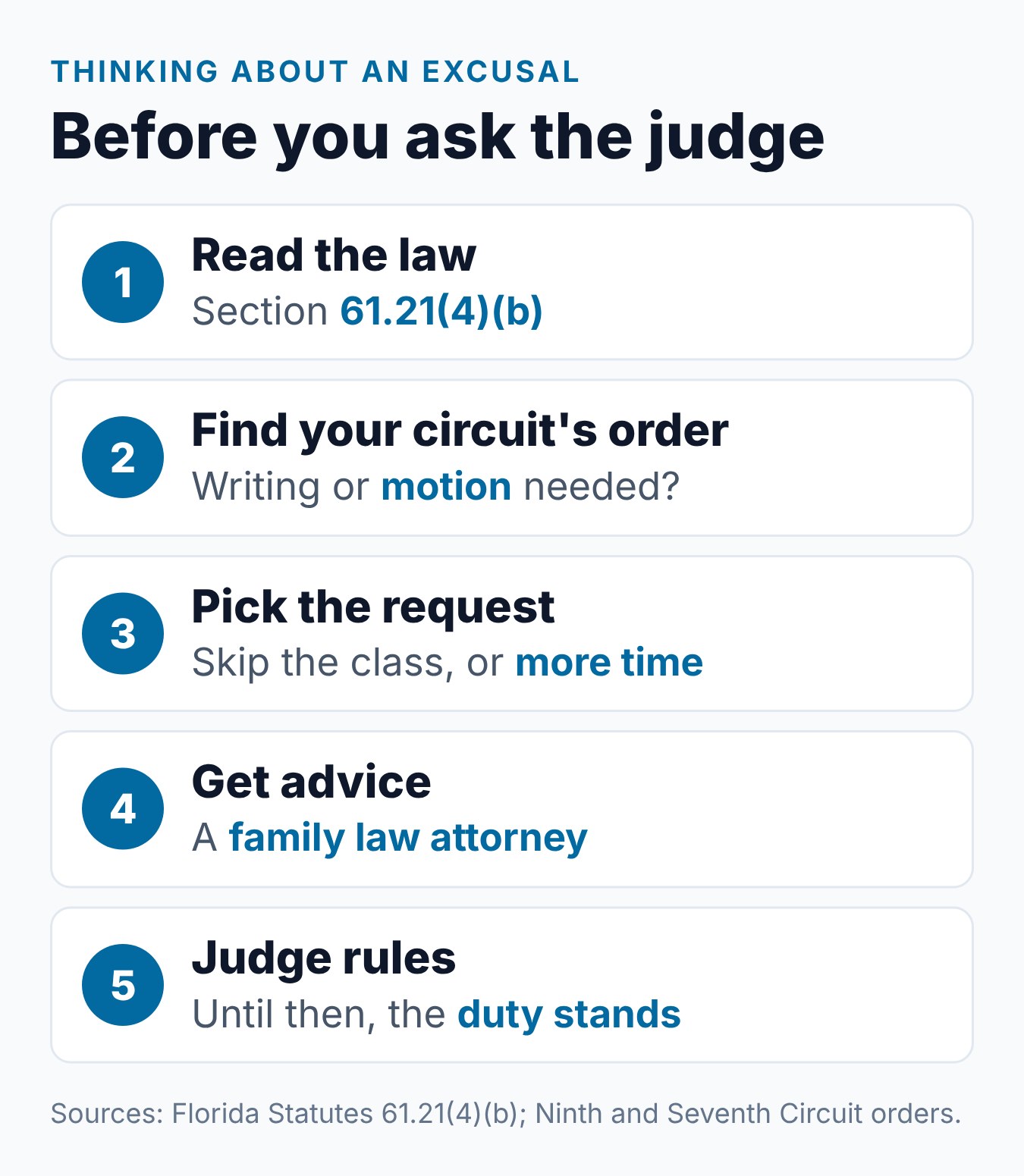
Before You Ask the Court
The statute does not describe a form or a filing method for this request. Local practice controls that. These questions can help when you talk to a family law attorney or the clerk:
- Does my circuit have an order on waiving the course?
- Does the court want the request in writing or by motion?
- Am I asking to skip the course or only to extend the deadline?
- What happens to my deadline while the court decides?
The clerk can explain local steps but cannot give legal advice. The attorney can tell you whether to make a request at all.
If the Court Says No
If the court does not excuse you, the normal rules apply. You finish a DCF-approved course and file proof before the final judgment.
A parent who fails to attend can face sanctions under section 61.21(9). Those include contempt and denial of shared parental responsibility or time-sharing. Our guide on what happens if you skip the course covers them.
Why the Course Is the Default
Section 61.21(1) explains why the Legislature created the course. It finds that children of divorcing parents can suffer lasting harm, especially when conflict goes on for a long time. It also finds that parents benefit from early, general education about the court process and how families adjust.
The statute does not link these findings to waivers. Still, they show why the course applies unless the court finds good cause. Our guide on why the class is required explains the findings.
What We Found on the Official Pages
On the court pages checked on October 26, 2026, the Ninth and Seventh Circuit orders were the only ones in this review that described a waiver request. Neither one listed reasons that count as good cause.
The Ninth Circuit’s order was signed July 31, 2007, and was still posted in January 2026. The Seventh Circuit’s order is dated April 3, 2024.
Common Mistakes to Avoid
Each item is based on section 61.21, a DCF rule or a circuit order:
- Assuming the parents can waive it. Only the court can excuse a party.
- Expecting a set list of reasons. The statute does not define good cause.
- Skipping the course while waiting. Without an excusal, the requirement stands.
- Mixing up the two kinds. A deadline excusal still requires the course.
- Ignoring local orders. Some circuits want a written showing or a proper motion.
- Missing the built-in options. Sliding fees and separate attendance exist already.
How Requirements Can Vary
Section 61.21 of the Florida Statutes sets the course requirement for the whole state, and DCF approves the courses. Each judicial circuit can still add its own steps, such as how to file the certificate or which class formats it accepts. The Fourth Circuit (Duval, Clay and Nassau counties), for example, requires an in-person class.
Laws, court orders and local rules can change. Check your court’s instructions, your county clerk’s website and DCF’s provider list before you enroll or file.
Frequently Asked Questions
Can a judge waive the Florida parenting course?
Yes, for good cause. Section 61.21(4)(b) lets the court excuse a party from the course or from finishing within the required time.
What counts as good cause?
The statute does not say. It gives no list or examples, so the judge decides in each case. Ask a family law attorney about your situation.
Can my ex and I agree to waive it?
No. Only the court can excuse a party. A settlement clause between parents does not count as an excusal.
Does my child’s special need excuse me from the course?
No. It changes which course you take. The statute requires a course built for children with special needs or emotional concerns, and DCF keeps a separate list of them.
Can the clerk or the provider waive it?
No. The statute gives the power to excuse a party to the court. The clerk and the provider cannot excuse anyone from the course.
Do I have to ask in writing?
It depends on your circuit. The Ninth Circuit requires good cause shown in writing, and the Seventh Circuit requires a proper motion. Check your court’s rules.
Can the court give me more time instead?
The statute allows the court to excuse a party from finishing within the required time, for good cause. You would still finish the course and file proof.
I took the course in an earlier case. Do I take it again?
The statute does not say. The Seventh Circuit exempts parents who already completed a course and filed certificates. Ask your court how it treats an earlier course.
Conclusion
The parenting course Florida law requires can be waived only by a judge, only for good cause, and some circuits want the request in writing or by motion. If a waiver is unlikely, the built-in options, such as sliding fees and separate attendance, may help you finish on time. You can take DivorceParentingClass.net’s online Florida parent education course, but first confirm that your court accepts an online course.
Related Articles
- Florida Parenting Class Requirement: Who Takes It and When
- Florida Parenting Course: Still Required If Parents Agree?
- Skipping the Parenting Class Florida Divorce Courts Require
Sources
- Florida Statutes § 61.21 — Parenting course
- Fla. Admin. Code R. 65C-32.001 — Definitions
- Fla. Admin. Code R. 65C-32.002 — Course length and delivery
- Fla. Admin. Code R. 65C-32.004 — Test and certificate
- Fla. Admin. Code R. 65C-32.005 — Provider approval
- Florida DCF — Approved course provider list
- Florida DCF — Courses for children with special needs or emotional concerns
- Ninth Judicial Circuit — Administrative Order 07-98-37-01 (PDF)
- Seventh Judicial Circuit — Order FM-2024-016-SC
Billy Forte is the owner of DivorceParentingClass.net.
This article is general information, not legal advice. Court rules, local practice, and case facts can differ by county, judge, and case type in Florida. Use official court and state sources, and consult a qualified Florida family law attorney for legal guidance specific to your case.