
Updated October 2026 · Reviewed by Billy Forte
The right time to take a parenting class for divorce in Florida is early in the case, because section 61.21 tells each parent to begin “as expeditiously as possible.” The parent who files has 45 days after filing, the other parent has 45 days after being served, and proof must reach the court before the final judgment. Whether a course taken before filing counts is a local question, so check your circuit’s instructions.
Key Facts
- Start: the statute says to begin “as expeditiously as possible.” See the start rule.
- Petitioner: finish within 45 days after filing the petition. See the petitioner’s clock.
- Other parent: finish within 45 days after service. See the other parent’s clock.
- Before filing: the statute is silent, and circuits differ. See before filing.
- End point: proof is filed before the final judgment. See the final judgment.
When to Take a Parenting Class for Divorce in Florida
Timing comes from subsection (5) of section 61.21, Florida Statutes. It sets three points in time:
- A start rule. Each party “shall begin the course as expeditiously as possible.”
- A deadline. Each party finishes within 45 days, counted from filing or from service.
- An end point. Each party files proof of completion before the court enters the final judgment.
So the short answer is after the case begins, and well before 45 days pass. Your circuit may add its own timing steps, which this guide covers below.
“As Expeditiously as Possible”
“Expeditiously” means promptly. The statute does not wait for the 45th day. It asks each parent to begin right away, then gives a deadline as the outer limit.
The law does not explain why it wants an early start. Its findings in subsection (1) do say parents benefit from early, general education about the court process and how families adjust. A prompt start fits that goal.
The Petitioner’s 45 Days
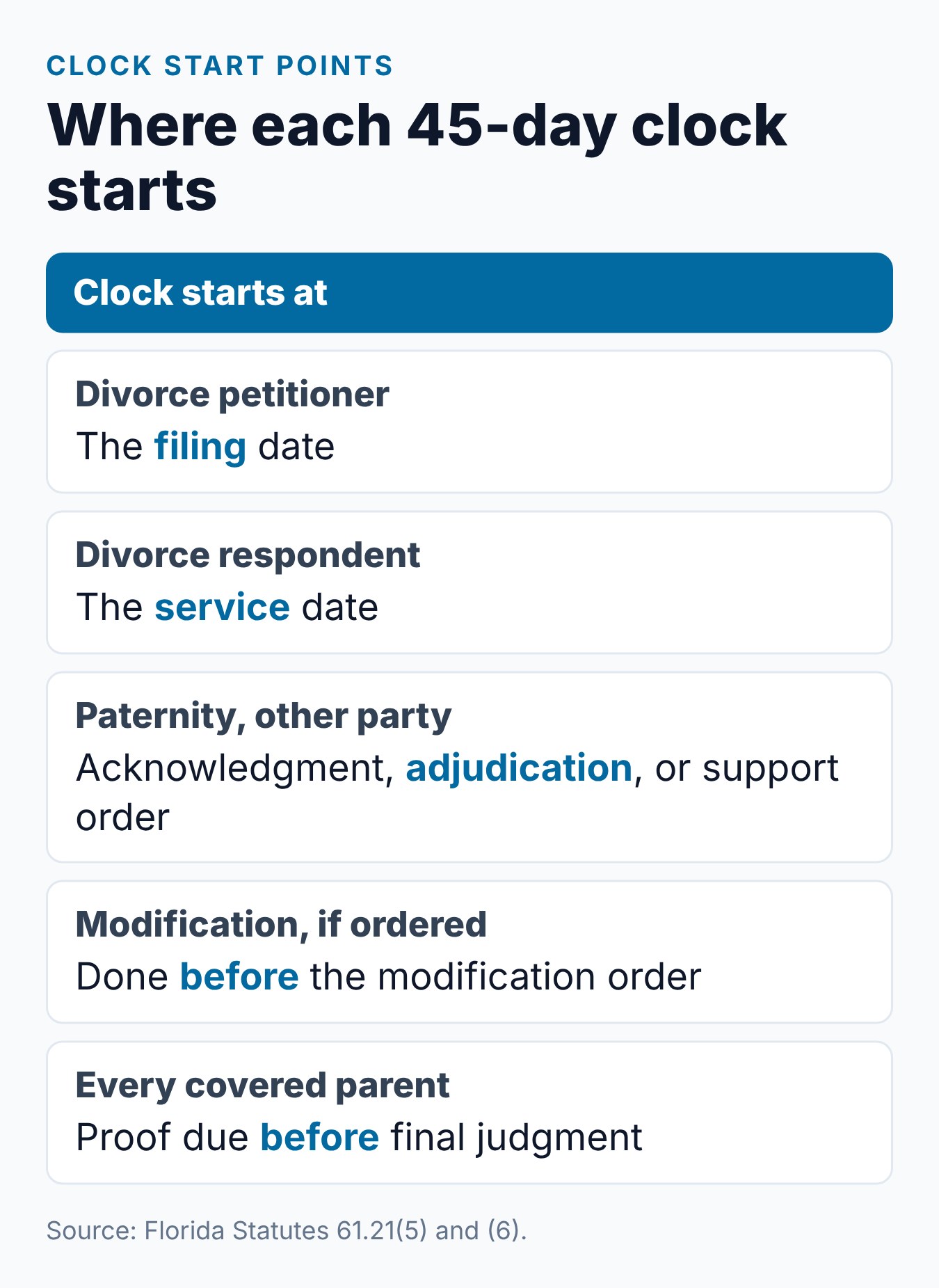
The petitioner is the parent who files the petition for divorce. The statute says “the petitioner must complete the course within 45 days after the filing of the petition.”
The clock starts on the filing date, not on the date of a hearing. It does not wait for the other parent to be served. So the petitioner’s window can open and close before the other side has been notified.
The Other Parent’s 45 Days
The respondent is the parent who receives the petition. The statute says “all other parties must complete the course within 45 days after service of the petition.”
Service is the formal delivery of the court papers. Because service comes after filing, the two parents can have different deadline dates. Each parent should note their own date.
Counting the Days: Two Examples
Here is plain calendar math. It only shows how the window works, so ask the clerk how your court counts days.
- Filing example. A petition filed on March 2 gives the petitioner until April 16, which is 45 days later.
- Service example. If the respondent is served on March 20, 45 days later is May 4.
Write your date on a calendar the day the clock starts. Then plan the course for the first weeks, not the last days.
Separate Parents, Separate Clocks
Parents do not have to take the course together. Section 61.21(10) says the parties are not required to attend as a pair. So one parent’s progress does not move the other parent’s deadline.
That also means one parent cannot finish for both. Each parent takes the course, earns a certificate, and files proof. If there is a history of domestic violence, the court may stop the parents from taking it together.
Paternity Cases Start Differently
In a paternity case about parental responsibility, the petitioner still has 45 days after filing. The other party’s 45 days start after an acknowledgment of paternity, an adjudication of paternity, or an order granting time-sharing or support.
These triggers can fall at different points in the case. The paternity and time-sharing guide explains each one.
Before Filing: The Statute Is Silent
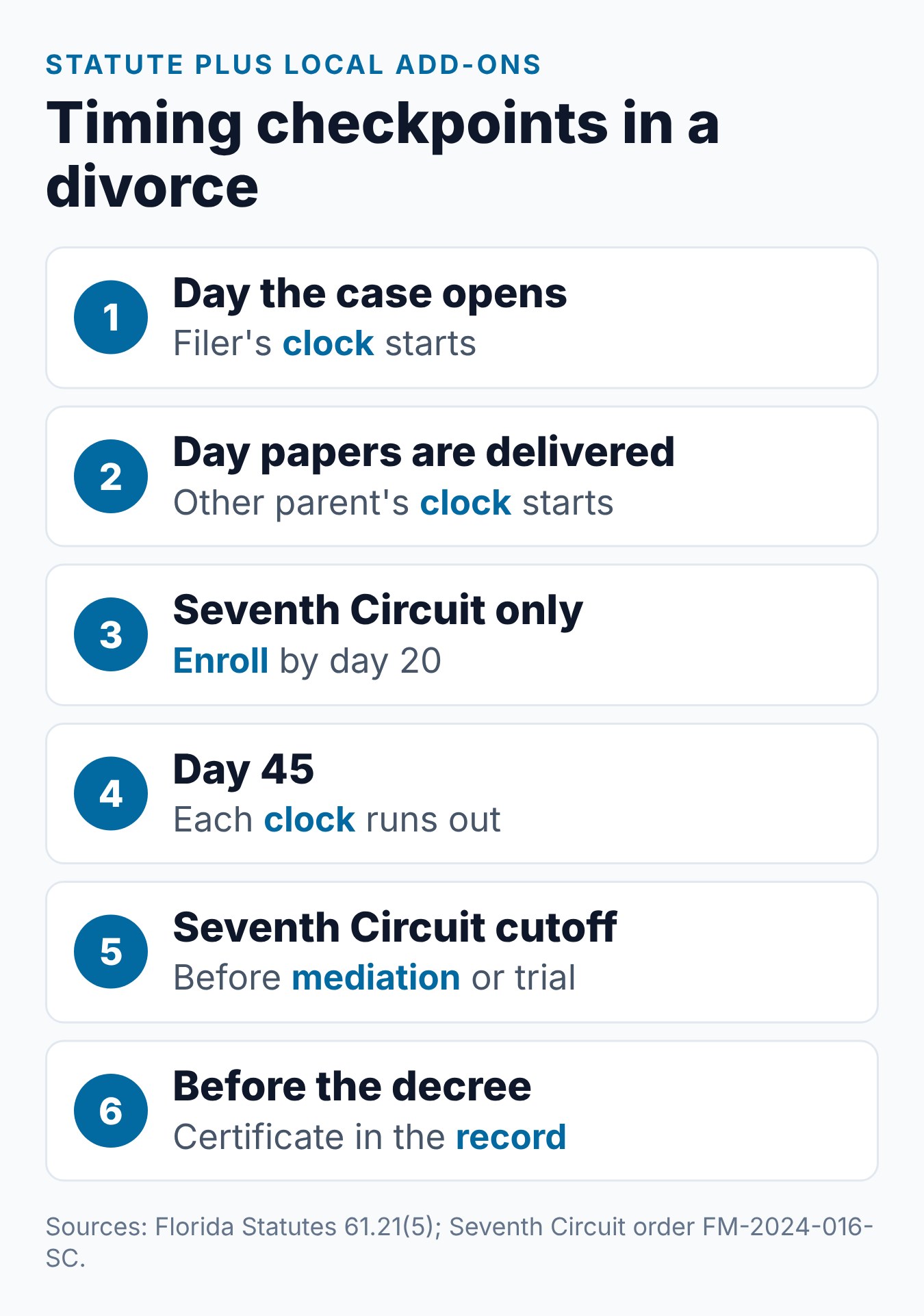
Section 61.21 starts its clocks at filing and service. It does not say whether a course finished before the case was filed counts. Two official sources touch on it:
- Fourth Circuit (Duval, Clay, Nassau). Its Family Court Services FAQ says, “When you have your case number you may register for one of the following classes.”
- Seventh Circuit (Flagler, Putnam, St. Johns, Volusia). Its order FM-2024-016-SC exempts parties who “have previously completed a parenting education course and have filed Certificates of Completion.” It does not say whether a course taken before you file counts.
Neither source answers the before-filing question directly. So check your own circuit before you take the course early. Our guide on taking the class before filing covers this question in depth.
Modification Cases: Before the Order
A case that changes a parenting plan or time-sharing schedule has a different timing rule. Section 61.21(6) says the court may require a parenting course in that case. If it does, the course comes before the court enters the modification order.
The statute sets no 45-day clock for modifications. So read the order or notice from your court for its timing, and ask the clerk if it is unclear.
Local Orders That Add Timing Steps
Some circuits add timing steps to the statute. Each row below comes from an official order or court page:
| Circuit | Added timing step | Official source |
|---|---|---|
| Fourth (Duval, Clay, Nassau) | Finish within 45 days of filing or service; file the certificate “promptly” | Standing family-law order |
| Fourth (Duval, Clay, Nassau) | Register once you have a case number | Family Court Services FAQ |
| Seventh (Flagler, Putnam, St. Johns, Volusia) | Enroll within 20 days of filing or service | Order FM-2024-016-SC |
| Seventh (Flagler, Putnam, St. Johns, Volusia) | Finish before court-ordered mediation or trial, whichever is sooner | Order FM-2024-016-SC |
| Ninth (Orange, Osceola) | No judgment on parental responsibility without proof | Order 07-98-37-01 |
The Fourth Circuit’s standing family-law order also requires an in-person class. The Ninth Circuit’s order 07-98-37-01 uses the same 45-day deadlines as the statute.
The Last Point: Before the Final Judgment
The statute’s end point is the final judgment. “Each party … shall file proof of compliance … with the court prior to the entry of the final judgment.”
That is a separate step from finishing. You finish the course, get the certificate, and then file proof with the court. Miami-Dade’s divorce education page says parents “must complete parenting education courses before a divorce is granted.”
Some courts want the proof sooner than the judgment date. The Broward County Clerk says each party is responsible for “immediately filing” the Certificate of Attendance in the court file. The Fourth Circuit’s order says to file the certificate “promptly.” So treat filing as part of finishing, not as a last-minute task.
Planning the 4 Hours
The course itself takes time, so build it into your plan. DCF rule 65C-32.002 sets a minimum of 4 hours. That time includes instruction, exercises and the end-of-course test.
A few rules affect your schedule:
- Online minimum. Online courses must stop anyone from finishing in less than 4 hours.
- Instructor questions. Online and correspondence instructors must answer content questions within one business day.
- Retakes. Under rule 65C-32.004, a score below 70 percent means reviewing the missed material before you retake the test.
No DCF rule sets a daily time limit. In-person classes run on the provider’s schedule, so book a date that leaves room before your deadline.
Your First Two Weeks
An early start is easier with a short plan. These steps come from the statute, DCF rules and the court pages above:
- Mark your start date. Use the filing date if you filed, or the service date if you were served.
- Read your circuit’s order. Look for enrollment dates, format rules and filing steps.
- Check for special needs. If your child has special needs or emotional concerns, the law calls for a special-needs course.
- Pick a course on DCF’s list. DCF approves the courses, providers and sites.
- Set aside at least 4 hours. Leave extra time in case you need to retake the test.
In Miami-Dade, also plan for the children’s class. The court’s page says a child aged 6 to 17 must attend a 3½-hour class.
If the Deadline Is Close or Past
Only the court can excuse a parent from finishing on time. Section 61.21(4)(b) allows that “for good cause.” Our waiver guide explains the rule.
Missing the deadline can bring sanctions. The guide on not completing the class lists them. If you are late, finish the course as soon as you can and ask the court or a family law attorney about next steps.
What We Found on the Official Pages
On the court pages checked on October 26, 2026, the Seventh Circuit’s order set an enrollment step of 20 days after filing or service. None of the other pages in this review set an enrollment date.
The Fourth Circuit’s FAQ tied registration to having a case number. The Ninth Circuit’s order, signed July 31, 2007, was still posted, with the file dated January 2026.
Common Mistakes to Avoid
Each item is based on section 61.21 or a court order:
- Waiting for the 45th day. The statute says to begin “as expeditiously as possible.”
- Using the other parent’s date. Filing and service start two different clocks.
- Taking it before filing without checking. The statute is silent, and circuits differ.
- Finishing but not filing. Proof must be filed before the final judgment.
- Forgetting a local step. The Seventh Circuit requires enrollment within 20 days.
- Planning for less than 4 hours. The rule sets a 4-hour minimum, test included.
How Requirements Can Vary
Section 61.21 of the Florida Statutes sets the course requirement for the whole state, and DCF approves the courses. Each judicial circuit can still add its own steps, such as how to file the certificate or which class formats it accepts. The Fourth Circuit (Duval, Clay and Nassau counties), for example, requires an in-person class.
Laws, court orders and local rules can change. Check your court’s instructions, your county clerk’s website and DCF’s provider list before you enroll or file.
Frequently Asked Questions
How soon after filing should I take the class?
As soon as you can. The statute says to begin “as expeditiously as possible,” and the petitioner must finish within 45 days after filing.
When does the respondent’s deadline start?
At service of the petition. The respondent must finish within 45 days after service, so the two parents can have different dates.
Can I take the class before I file for divorce?
The statute does not say. The Fourth Circuit says to register once you have a case number, and the Seventh Circuit exempts parents who already completed a course and filed a certificate. Neither says whether a course taken before filing counts, so check with your court first.
Is finishing the course enough?
No. Each parent must also file proof of completion with the court before the final judgment. Follow your clerk’s instructions for filing.
Does mediation affect the timing?
In the Seventh Circuit, yes. Its order says to finish before court-ordered mediation or the trial date, whichever is sooner.
Do both parents have the same deadline?
Not always. The petitioner’s 45 days run from filing, and the respondent’s run from service. If service happens later, the respondent’s date is later.
Is there a daily time limit on the course?
No DCF rule sets one. The rules set a 4-hour minimum, and online courses must block finishing in less time than that.
What if I cannot finish within 45 days?
Only the court can excuse a late finish, for good cause. Talk to the court or a family law attorney, and finish the course as soon as you can.
Conclusion
Take the parenting class for divorce in Florida early, finish within 45 days of filing or service, and file proof before the final judgment. If your circuit adds steps, such as enrolling within 20 days, follow its order. You can start with DivorceParentingClass.net’s online Florida parent education course, but first confirm that your court accepts an online course.
Related Articles
- Florida Parenting Class Requirement: Who Takes It and When
- Skipping the Parenting Class Florida Divorce Courts Require
- Can the Parenting Course Florida Requires Be Waived?
- Divorce in Florida With Children: Parent Course Checklist
Sources
- Florida Statutes § 61.21 — Parenting course
- Fla. Admin. Code R. 65C-32.002 — Course length and delivery
- Fla. Admin. Code R. 65C-32.004 — Test and certificate
- Fourth Judicial Circuit — Standing Family Law Order (PDF)
- Fourth Judicial Circuit — Family Court Services FAQ
- Ninth Judicial Circuit — Administrative Order 07-98-37-01 (PDF)
- Seventh Judicial Circuit — Order FM-2024-016-SC
- Eleventh Judicial Circuit — Divorce Education Program for Parents
- Broward County Clerk of Courts — Family
Billy Forte is the owner of DivorceParentingClass.net.
This article is general information, not legal advice. Court rules, local practice, and case facts can differ by county, judge, and case type in Florida. Use official court and state sources, and consult a qualified Florida family law attorney for legal guidance specific to your case.