
Updated October 2026 · Reviewed by Billy Forte
You can finish a 4 hour parenting class online Florida courses offer in one day if the course allows it, because no official rule sets a daily limit. What you cannot do is finish in under four hours, since DCF rules require online courses to block that. Getting the certificate and filing it with the court are separate steps, and no rule says how fast a provider must issue it.
Key Facts
- Minimum time: online courses must stop anyone finishing in under 4 hours. See the four-hour floor.
- Daily limit: no official rule sets one. See one day or several.
- Retakes: a missed test sends you back to review, which adds time. See the test.
- Certificate timing: no rule sets how fast it is issued. See when the certificate arrives.
- Filing: proof goes to the court before the final judgment, as its own step. See filing.
The Four-Hour Floor
Four hours is the least time any course can take. Section 61.21(2), Florida Statutes, says the course “must be a minimum of 4 hours.”
DCF’s rule 65C-32.002 adds a lock for online courses. They “shall have a mechanism that prevents participants from completing the course in less than four (4) hours.”
So an online course cannot be done in two or three hours, however you study. The four hours include instruction, participant exercises and the end-of-course test.
No Daily Limit in the Rules
The rules set a floor, not a schedule. Neither the statute nor the DCF rules say how many hours you may study in a day.
They also do not require more than one session or set breaks. That means finishing in one day is possible, as long as the course you pick allows it.
You may also spread the course out over several days. The rules allow that too. The 45-day deadline is the limit that matters most.
Why the Time Floor Exists
The statute explains the purpose of the course. Section 61.21(1) finds that divorce can harm children for a long time, and more so when parents keep fighting.
It also finds that parents gain from early lessons about the court process, coping and help in the community. The statute and DCF’s rule set the 4-hour minimum for every format, online or in person.
What Fills the Four Hours
The time is not empty. DCF rule 65C-32.003 lists eight parts every course must cover, and state law requires abuse information and a list of local help agencies.
You will also complete exercises, which count toward the time. For the full list, see what the 4-hour course includes.
The Test Can Add Time
The day ends with a test. Under rule 65C-32.004, you need at least 70 percent to pass.
If you score lower, an online course must send you back. The rule says “missed questions shall refer the participant to the appropriate section requiring review.” You review that part, then retake the test.
Attempts are unlimited. Providers also “shall not require additional fees for any additional time or instruction.” So a retake costs time, not money.
Questions Take Up to One Business Day
Instructors in online courses have up to one business day to answer a content question, under rule 65C-32.002.
That rule can affect a one-day plan. If you send a question at night or on a weekend, the answer may come later. Plan to keep going while you wait, or schedule your day early in the week.
Identity Checks Along the Way
Rule 65C-32.002 requires every course to have a way to confirm who is taking it. It does not say which method or how often.
Keep your sign-in details ready for the whole session. A check you cannot pass can stop your progress until you sort it out with the provider.
A Checklist for the Day
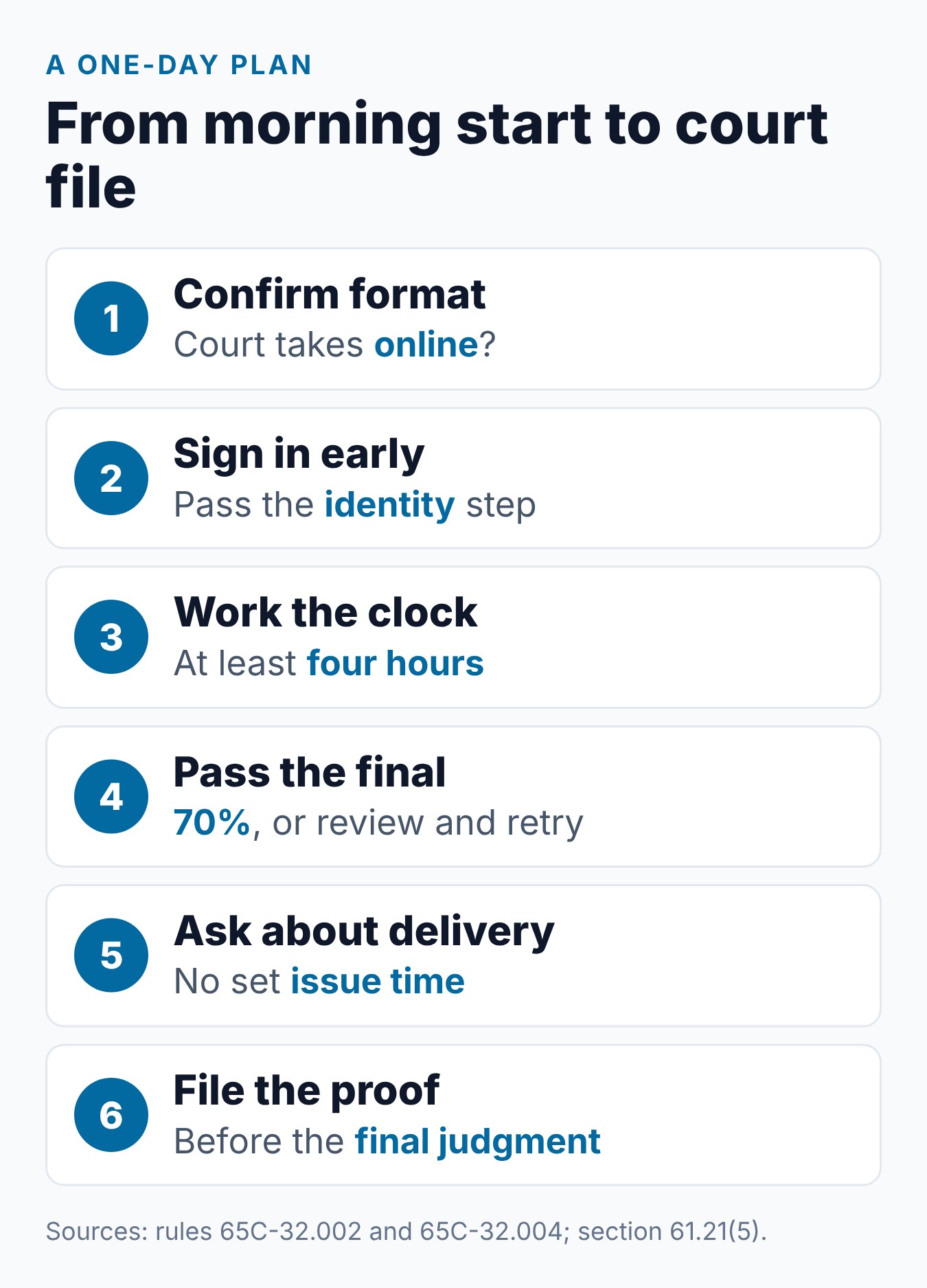
A one-day plan works best with some setup. Before you begin:
- Confirm the format. Make sure your court takes an online class.
- Check approval. Find the course on DCF’s list with a current date.
- Ask about progress. Find out whether the course saves your place if you stop.
- Ask about delivery. Learn how the provider sends the certificate.
- Leave extra time. Plan for more than four hours in case you need a retake.
- Have your sign-in ready. You will need it for the identity check.
When the Certificate Arrives
A certificate goes to each parent who finishes the four-hour minimum and scores at least 70 percent. That is the rule in 65C-32.004.
The rule does not set a deadline for issuing it. No official source says it must arrive the same day. Ask the provider how and when it sends certificates before you enroll.
The certificate shows the date you began and the date you finished. It also shows the course name and the provider’s name and contact information.
If you finish in one day, both dates may be the same. See how to get your certificate.
Filing Is a Separate Step
Finishing the course does not finish the requirement. Section 61.21(5) says each party “shall file proof of compliance” with the court before the final judgment.
Local pages describe the filing step in their own words:
- Broward. The Clerk says each party is responsible for “immediately filing” the Certificate of Attendance.
- Orange and Osceola. The Ninth Circuit order says each party provides the certificate to the Clerk.
- Duval, Clay and Nassau. The standing order says to file it “promptly.”
A same-day finish helps only once the proof is in the court file.
4 Hour Parenting Class Online Florida Rules on Timing
Here are common timing questions and what the official sources say:
| Your question | What the official sources say |
|---|---|
| Can I finish in under 4 hours? | No. Online courses must block it. |
| Is there a daily maximum? | No rule sets one. |
| Must I take breaks or sessions? | No rule requires them. |
| Will the certificate come the same day? | No rule sets an issue time. |
| Does a retake cost more? | No. Extra fees for added time are barred. |
| Is finishing the same as filing? | No. Proof is filed with the court. |
Planning Around the 45-Day Deadline
The real clock is in the statute. In a divorce, the petitioner must finish within 45 days after filing the petition. The other parent must finish within 45 days after service.
For example, if you were served on June 1, day 45 falls on July 16. The statute also says to begin “as expeditiously as possible,” so starting early gives you room for retakes and filing.
Paternity cases use other starting points for the other party. Only the court can excuse a party from the deadline, for good cause. See deadlines for divorce with kids.
Mail and Classroom Courses Run on Other Clocks
Online is not the only format. The statute requires DCF to approve at least one statewide correspondence course, taken by mail, and DCF lists classroom sites in each circuit.
The four-hour minimum applies to every format. A mail course also has to let you reach an instructor, with answers to content questions within one business day. Mailing work back and forth takes its own time, so a one-day finish is an online question.
If a Deadline Is Missed
The statute treats the course as required. Under section 61.21(9), the court may hold a parent who fails to attend “in contempt.”
The court may also deny that parent shared parental responsibility or time-sharing, or impose other sanctions. See what happens if you do not complete the class.
Each Parent Sets Their Own Day
Each parent studies on their own schedule. Section 61.21(10) does not require a joint class, so the two of you can finish on different days.
The court can bar parents from taking it together if there is a history of domestic violence. Each parent earns a separate certificate and files separate proof.
If the children have special needs or emotional concerns, parents must pick a course made for that, from DCF’s separate list. Check how that course runs before you plan a single day.
Check That Your Court Takes Online Classes
A one-day online plan only works where online classes are allowed. The Fourth Judicial Circuit (Duval, Clay and Nassau) requires an in-person class from a local list.
The circuit’s standing family law order calls for “a similar qualified inperson program.” Its Family Court Services FAQ says parents must register for one of its in-class courses. Read your circuit’s page or ask the clerk before you enroll.
The same FAQ answer also points parents to DCF’s list of local and online providers. So ask the circuit’s Family Court Services which class applies to your case.
Pick a course from DCF’s provider list too. Its Delivery Method column shows how each course is given.
What We Found on the Official Pages
On the DCF and court pages we checked on October 26, 2026, none set a daily limit on study time. None set a deadline for issuing the certificate.
Rule 65C-32.002 still required the four-hour lock for online courses. DCF’s parent page still said, “The courses are a minimum of 4 hours.”
The Broward Clerk still asked parties to file the Certificate of Attendance “immediately.” The Fourth Circuit FAQ still required an in-class course for Duval, Clay and Nassau.
Common Mistakes to Avoid
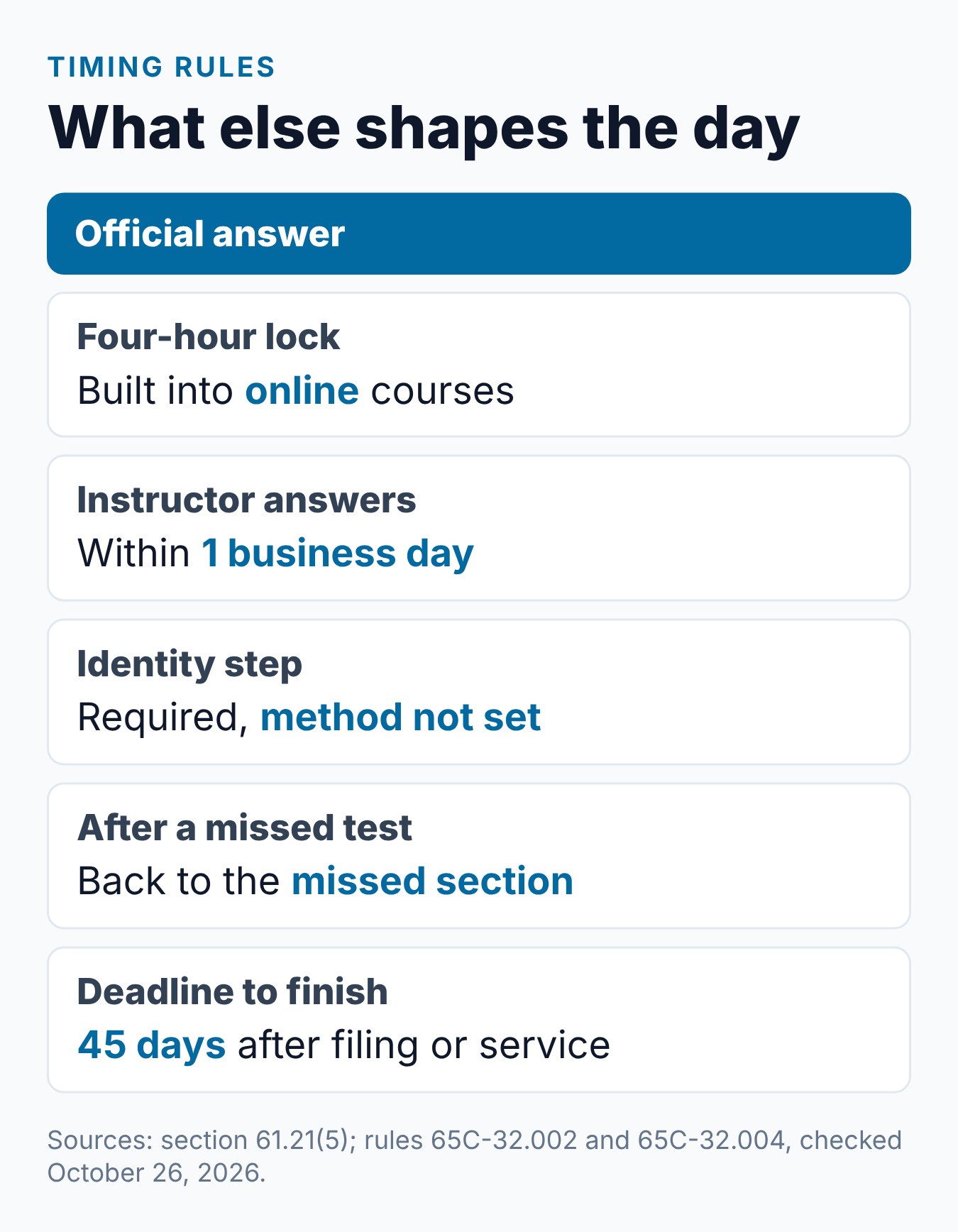
Each item comes from Florida law, a DCF rule or an official court page:
- Planning on less than four hours. Online courses must block it.
- Counting on a same-day certificate. No rule sets an issue time.
- Skipping the review after a missed test. The course sends you back first.
- Expecting instant answers. Instructors have one business day.
- Stopping at the certificate. Proof must be filed with the court.
- Enrolling online in the Fourth Circuit. It requires an in-class course.
How Requirements Can Vary
Section 61.21 of the Florida Statutes sets the course requirement for the whole state, and DCF approves the courses. Each judicial circuit can still add its own steps, such as how to file the certificate or which class formats it accepts. The Fourth Circuit (Duval, Clay and Nassau counties), for example, requires an in-person class.
Laws, court orders and local rules can change. Check your court’s instructions, your county clerk’s website and DCF’s provider list before you enroll or file.
Frequently Asked Questions
Can I finish the Florida parenting class in one day?
Yes, if the course allows it. No rule sets a daily limit, but online courses must take at least four hours.
Can I finish in less than four hours?
No. DCF rule 65C-32.002 requires online courses to stop anyone from finishing in under four hours.
Will I get my certificate the same day?
No official rule says. The certificate goes to parents who finish and score at least 70 percent, but no rule sets how fast it is issued.
What if I fail the test at the end of the day?
You review the missed sections and try again. Attempts are unlimited, and providers may not charge extra fees for added time.
Do I have to finish in one sitting?
No rule requires it. Ask the provider whether its course saves your progress between sessions.
Can both parents finish on the same day?
They can, on their own. The law does not require parents to take the course together, and each parent gets a separate certificate.
Is there a time limit once I start?
No DCF rule sets one. The limit that matters is the statute’s 45 days after filing or service, so start early.
Is finishing the course enough for the court?
No. Each party must file proof with the court before the final judgment.
Conclusion
A 4-hour online Florida parenting class can be done in one day if the course allows it, but never in under four hours. No rule sets how fast the certificate arrives, and filing proof with the court is its own step. If you plan to use DivorceParentingClass.net’s online Florida parent education course, first confirm that your court accepts an online course.
Related Articles
- Online Parenting Classes for Florida Divorce: DCF Rules
- Florida Parenting Course Online: Can You Use Your Phone?
- How to Finish a Florida Online Parenting Class on Time
- Divorce in Florida With Kids: Deadlines, Course, and Certificate
Sources
- Florida Statutes § 61.21 — Parenting course
- Fla. Admin. Code R. 65C-32.002 — Course length and delivery
- Fla. Admin. Code R. 65C-32.004 — Test and certificate
- Florida DCF — Parent Education and Family Stabilization Course
- Florida DCF — Approved course provider list
- Broward County Clerk of Courts — Family
- Ninth Judicial Circuit — Administrative Order 07-98-37-01 (PDF)
- Fourth Judicial Circuit — Standing Family Law Order (PDF)
- Fourth Judicial Circuit — Family Court Services FAQ
Billy Forte is the owner of DivorceParentingClass.net.
This article is general information, not legal advice. Court rules, local practice, and case facts can differ by county, judge, and case type in Florida. Use official court and state sources, and consult a qualified Florida family law attorney for legal guidance specific to your case.