
Updated October 2026 · Reviewed by Billy Forte
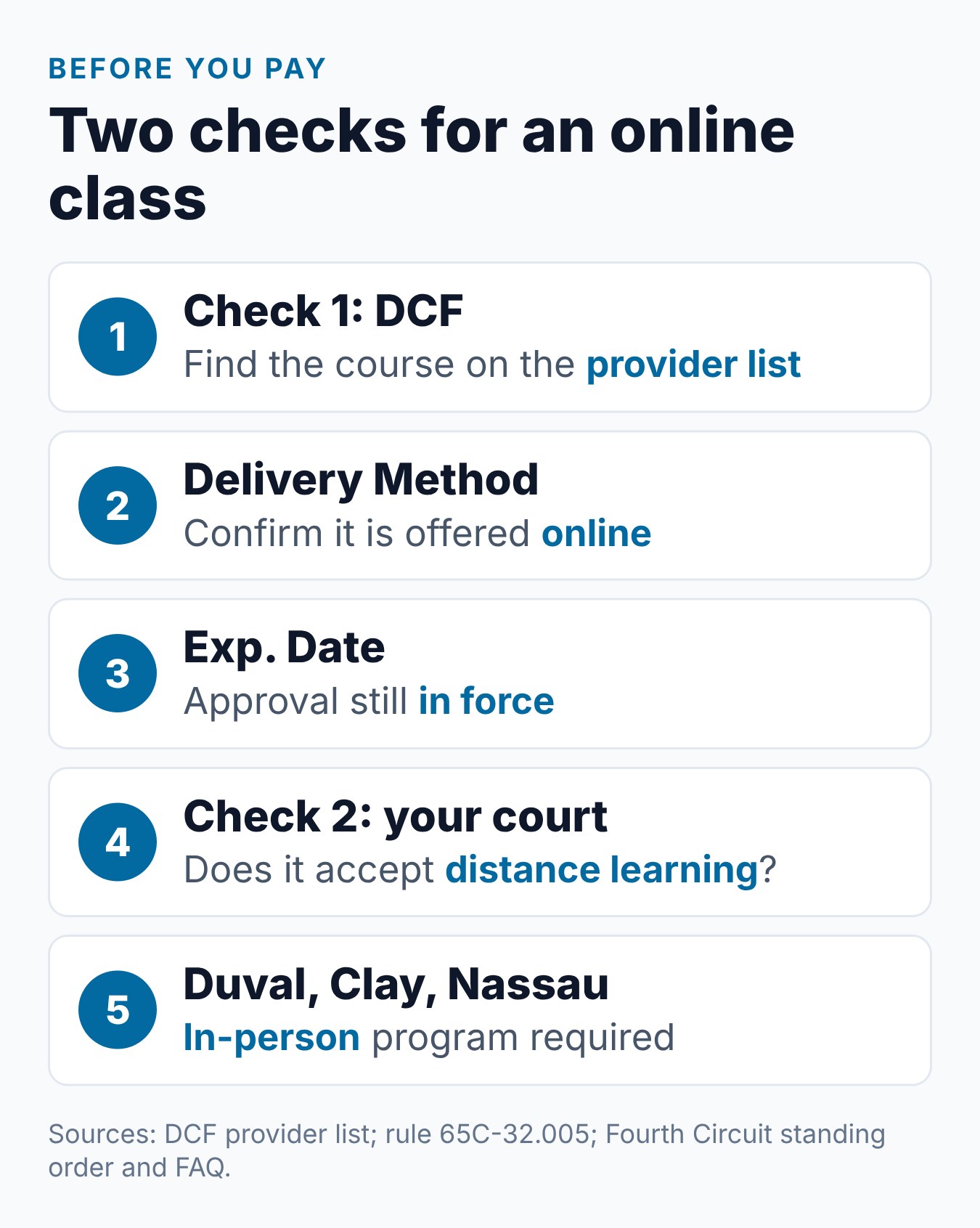
Court ordered parenting classes online count in a Florida divorce only if the course is approved by the Florida Department of Children and Families (DCF), the state agency named in section 61.21. Even an approved online course must also be one your court accepts, and the Fourth Circuit requires in-person classes. So check two things before you enroll: DCF’s list and your court’s rules.
Key Facts
- State approval: DCF approves the course, its providers and its sites. See what state approval means.
- Online option: Florida law requires at least one statewide internet course. See the online option.
- Online rules: a 4-hour lock, identity checks and fast instructor replies. See what DCF requires.
- Checking it: DCF’s list shows delivery method and an expiration date. See checking DCF’s list.
- Court acceptance: approval does not bind every court. See approval vs acceptance.
Court Ordered Parenting Classes Online: What State Approval Means
In Florida, “state approval” for this course means DCF approval. Section 61.21(2) has DCF approve the Parent Education and Family Stabilization Course. Section 61.21(3) has DCF give each circuit a list of approved providers and sites.
Circuit courts once approved courses themselves. The Sixth Circuit’s Administrative Order 2003-039 explains that a 2003 change to section 61.21 removed the circuit’s role in approving parenting courses. That is why DCF, not a judge, is the approver now.
So a class labeled “court-ordered” only meets the statute if DCF approved it. The label alone does not count.
Why the Statute Still Says “Court-Approved”
You may see the phrase in the law itself. Subsections (6) and (10) of section 61.21 refer to a “court-approved parenting course.” Even so, subsection (2) gives DCF the job of approving the course, and DCF’s list is where approval shows.
Florida Law Requires an Online Option
Online courses are part of the statewide system. Section 61.21(3) says DCF shall approve “a minimum of one statewide approved course to be provided through the Internet.” It must also approve one course by correspondence.
DCF rule 65C-32.001 calls both formats “distance learning.” It defines that as “instruction provided through correspondence or via the Internet.”
Online and Correspondence Courses
Both formats follow the same core rules. DCF rule 65C-32.002 applies the instructor-contact rule to “online and correspondence” providers alike. Both must meet the 4-hour minimum and verify who is taking the course.
The difference is how the material reaches you. An online course runs on the internet, while a correspondence course is given by mail. Your court may treat them differently, so ask about the exact format.
What DCF Requires of Online Courses
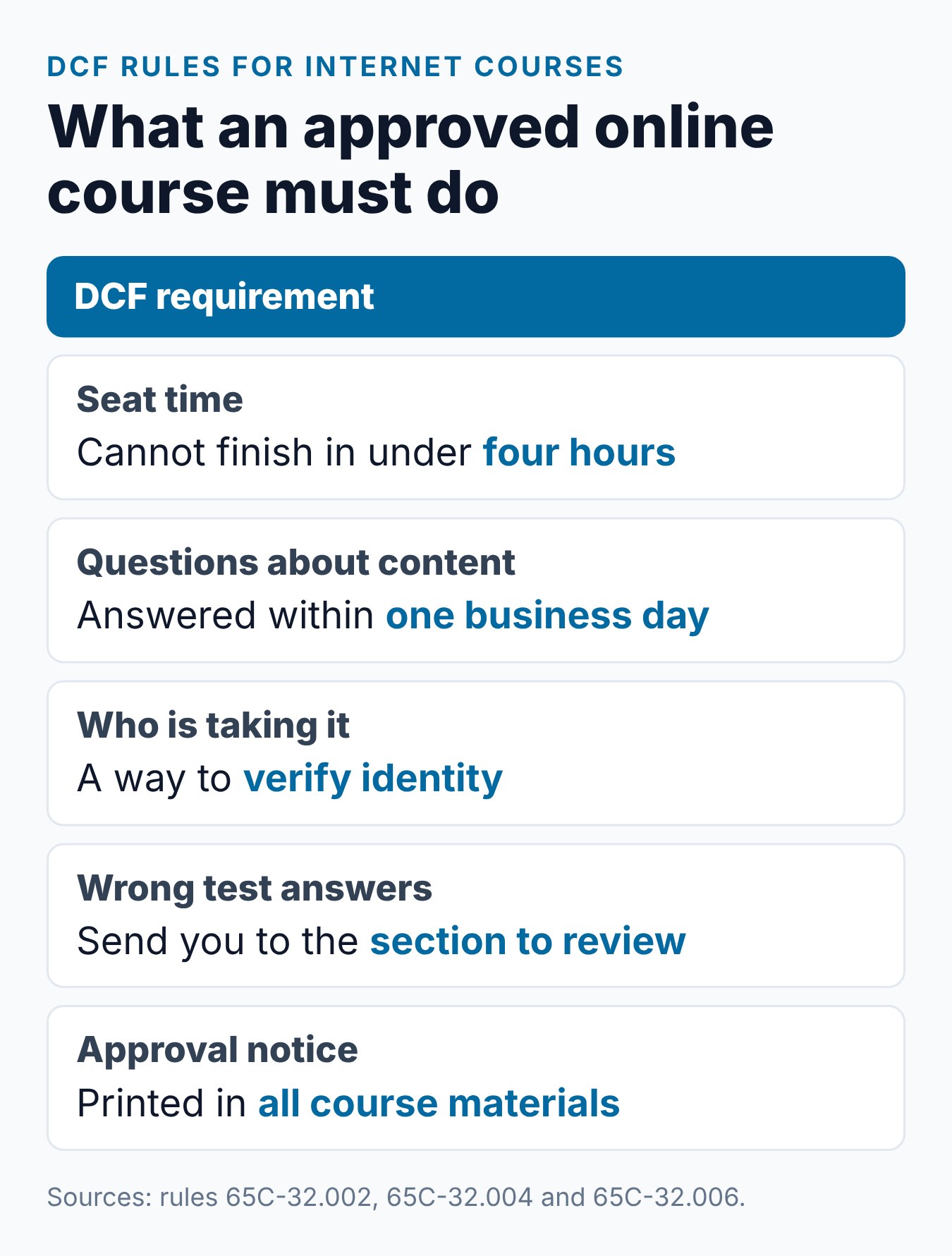
DCF rule 65C-32.002 sets rules that apply to approved online courses:
- A time lock. Online courses “shall have a mechanism that prevents participants from completing the course in less than four (4) hours.”
- Instructor contact. Parents must be able to reach the instructor. Content questions must be answered within one business day.
- Identity checks. “All courses shall include a means of verifying the identity of participants.”
- Qualified instructors. A related bachelor’s degree plus 2 years of experience, or 4 years of related experience.
The test has an online rule too. Under DCF rule 65C-32.004, missed questions in an online course must point the parent to the section to review. Attempts are unlimited, and 70 percent passes.
Why the Approver Matters to You
State approval is not just a label. It brings rules you can rely on:
- A certificate with set contents. DCF rule 65C-32.004 lists what it must show: the course name, the provider’s name and contact information, the curriculum name if any, and your start and finish dates.
- A way to verify it. Providers “must have a means of verifying certificate authenticity.”
- Records that last. Providers keep copies of all certificates for five years.
- No retake charges. Providers may not charge more for the extra time needed to pass.
- A place to complain. DCF takes complaints about approved providers.
A class without DCF approval offers none of these rules. See what goes on the certificate.
What an Online Course Must Teach
Online delivery does not shrink the content. DCF rule 65C-32.003 sets the same eight required parts for every approved course, whatever the format.
Section 61.21(2)(b) also requires information on spousal and child abuse and neglect, plus a list of local agencies that help. See what the 4-hour course includes.
How DCF Approves a Course
Providers apply to DCF. Under DCF rule 65C-32.005, the application covers items such as the languages offered, “the amount charged to participants,” and indigent options. Approval “is valid for three (3) years.”
DCF rule 65C-32.006 says DCF must approve every application that meets section 61.21 and its rules. It also says the notice of DCF approval “shall be included in all course materials.” DCF’s provider page adds that approvals must be renewed.
Checking DCF’s List
Use DCF’s provider list to check an online class. Work through it like this:
- Find the course name and the provider.
- Read the “Delivery Method” column to see how the course is given.
- Read the “Exp. Date” column and make sure it has not passed.
- Match the phone and website to the class you plan to buy.
- Look for the DCF approval notice in the course materials.
If the class is not on the list, it is not a DCF-approved course.
Keep a note of what you found and the date you checked. Approval can lapse after three years, so a course that was listed last year may need a fresh look. If something on the list does not match the class you are about to buy, ask the provider before you pay.
Approval Is Not Court Acceptance
DCF decides which courses are approved. Your court decides which formats it accepts for your case. Those are two separate questions.
The Fourth Circuit (Duval, Clay and Nassau) shows the gap. Its standing order calls for “a similar qualified inperson program.” Its FAQ says parents must register for one of three in-class programs.
The same FAQ answer also points parents to DCF’s list of local and online providers. So ask the circuit’s Family Court Services which class applies to your case.
Other circuits are silent on format. The Ninth Circuit’s order 07-98-37-01 for Orange and Osceola does not address online versus in-person classes. It does say certificates from out-of-state providers “may be accepted by the Court.” Silence is not a promise, so ask.
A 2014 DCF provider list noted that “Some Florida counties have Administrative Orders requiring parents to take the Course in a live-classroom setting.” It advised calling the local Family Court Office before taking a distance course. That list is old, but the advice still fits.
Special-Needs Courses Online
If the children have special needs or emotional concerns, section 61.21(4)(a) says the parties must select a course made for that. DCF keeps a separate list for those courses.
When we checked, that list showed two courses. One was an online correspondence course, and the other was offered in person and virtually. Check the list for current entries before you choose.
What to Ask Your Clerk About Online Classes
The clerk’s office can tell you how your court handles online certificates. Useful questions:
- Does this court accept a DCF-approved online course?
- Does it accept a correspondence course?
- Is there a local order that requires classroom attendance?
- How do I file the certificate from an online course?
Who Answers Which Question
| Question | Who answers it |
|---|---|
| Is the course approved? | DCF, on its provider list |
| Is the approval current? | DCF’s “Exp. Date” column |
| Is the course at least 4 hours, with a lock? | DCF rule 65C-32.002 requires it |
| Does my court accept online courses? | Your court or clerk |
| How do I file proof? | Your court or clerk |
| Is a certificate from another state accepted? | Your court; the Ninth Circuit says it “may be” |
If the Online Class Is Not DCF-Approved
A class that DCF did not approve does not meet section 61.21. The deadline keeps running: 45 days after filing for the petitioner, and 45 days after service for the other party.
The risks are real. Under section 61.21(9), the court may hold a parent in contempt, deny shared parental responsibility or time-sharing, or order other sanctions. Only the court can excuse a party, for good cause.
Finishing an Online Course on Time
The rules set no daily limit, but the 4-hour lock still applies. Start soon after filing or service, since the law says to begin “as expeditiously as possible.” Leave time for retakes and for filing proof before the final judgment.
Parents do not have to take the course together. If there is a history of domestic violence, the court can bar them from taking it together.
Paying for an Online Course
Online courses follow the same fee rules as local ones. Section 61.21(7) allows “a reasonable fee” for each parent, and Florida sets no state price. DCF’s list shows each course’s indigent status, and providers report their indigent options to DCF.
Common Mistakes
Each one ties back to the statute, a DCF rule or a court page:
- Trusting the label. “Court-ordered” in an ad is not DCF approval.
- Skipping the expiration date. Approvals last three years.
- Assuming every court takes online classes. The Fourth Circuit requires in-person programs.
- Expecting to finish in under 4 hours. Online courses must block that.
- Ignoring the approval notice. It must appear in all course materials.
What We Found on the Official Pages
On the official pages we checked on October 26, 2026, DCF’s provider list named “Delivery Method” and “Exp. Date” among its columns. DCF’s course page, updated April 8, 2026, linked to “Local and Online Courses.”
The Fourth Circuit’s standing order, signed April 22, 2021, still called for an in-person program. The Sixth Circuit’s 2003 order was still posted.
How Requirements Can Vary
Section 61.21 of the Florida Statutes sets the course requirement for the whole state, and DCF approves the courses. Each judicial circuit can still add its own steps, such as how to file the certificate or which class formats it accepts. The Fourth Circuit (Duval, Clay and Nassau counties), for example, requires an in-person class.
Laws, court orders and local rules can change. Check your court’s instructions, your county clerk’s website and DCF’s provider list before you enroll or file.
Frequently Asked Questions
Can any online court-ordered class satisfy my Florida case?
No. It must be a DCF-approved Parent Education and Family Stabilization Course, and your court must accept online courses.
Who gives state approval?
DCF. A 2003 change to section 61.21 removed circuit court approval of parenting courses.
How do I check an online class?
Find it on DCF’s provider list, then check its delivery method and expiration date. Look for DCF’s approval notice in the course materials.
Can an approved online course still be turned down?
It can, if your court requires another format. The Fourth Circuit requires in-person programs.
Can I finish an online course in 2 hours?
No. DCF requires online courses to stop anyone from finishing in under 4 hours.
What if I took a class that is not approved?
It does not meet section 61.21. Ask the court or an attorney about next steps, since the deadline keeps running.
Does the same 45-day deadline apply online?
Yes. The petitioner has 45 days after filing, and the other party 45 days after service, whatever the format.
Is a correspondence course the same as online?
Both are “distance learning” under DCF’s rules, but they are delivered differently. Ask your court which formats it accepts.
Conclusion
State approval is what makes a court-ordered online class count in Florida, and DCF is the state agency that gives it. Check DCF’s list first, then check your court’s rules on format. If you choose DivorceParentingClass.net’s online Florida parent education course, confirm that your court accepts an online course before you enroll.
Related Articles
- Parenting Classes Near Me or Online? Florida Divorce Guide
- Parenting Classes Approved by Court: Questions to Ask Before You Enroll
- Are Online Parenting Classes Court Approved in Florida?
- Online Parenting Classes for Florida Divorce: DCF Rules
Sources
- Florida Statutes § 61.21 — Parenting course
- Fla. Admin. Code R. 65C-32.001 — Definitions
- Fla. Admin. Code R. 65C-32.002 — Course length and delivery
- Fla. Admin. Code R. 65C-32.003 — Required course content
- Fla. Admin. Code R. 65C-32.004 — Test and certificate
- Fla. Admin. Code R. 65C-32.005 — Provider approval
- Fla. Admin. Code R. 65C-32.006 — Approval process
- Florida DCF — Parent Education and Family Stabilization Course
- Florida DCF — Approved course provider list
- Florida DCF — Courses for children with special needs or emotional concerns
- Florida DCF — Course provider process
- Fourth Judicial Circuit — Standing Family Law Order (PDF)
- Fourth Judicial Circuit — Family Court Services FAQ
- Ninth Judicial Circuit — Administrative Order 07-98-37-01 (PDF)
- Sixth Judicial Circuit — Family Law
Billy Forte is the owner of DivorceParentingClass.net.
This article is general information, not legal advice. Court rules, local practice, and case facts can differ by county, judge, and case type in Florida. Use official court and state sources, and consult a qualified Florida family law attorney for legal guidance specific to your case.