
Updated October 2026 · Reviewed by Billy Forte
When people ask whether online parenting classes court approved in Florida will count, the honest answer is that DCF approves online courses, but some courts still require an in-person class. No official source promises that every Florida court takes an online certificate. Check your circuit’s instructions or ask the clerk before you enroll, and pick a course on DCF’s list.
Key Facts
- State law: DCF must approve at least one statewide internet course. See what Florida law says.
- Approval vs acceptance: DCF approves the course; your court runs your case. See two different questions.
- In-person rule: the Fourth Circuit (Duval, Clay and Nassau) requires an in-person class. See the Fourth Circuit.
- Silent pages: other court pages we read do not address format. See what court pages say.
- Next step: ask the clerk or read your circuit’s page before you pay. See how to check.
What Florida Law Says About Online Courses
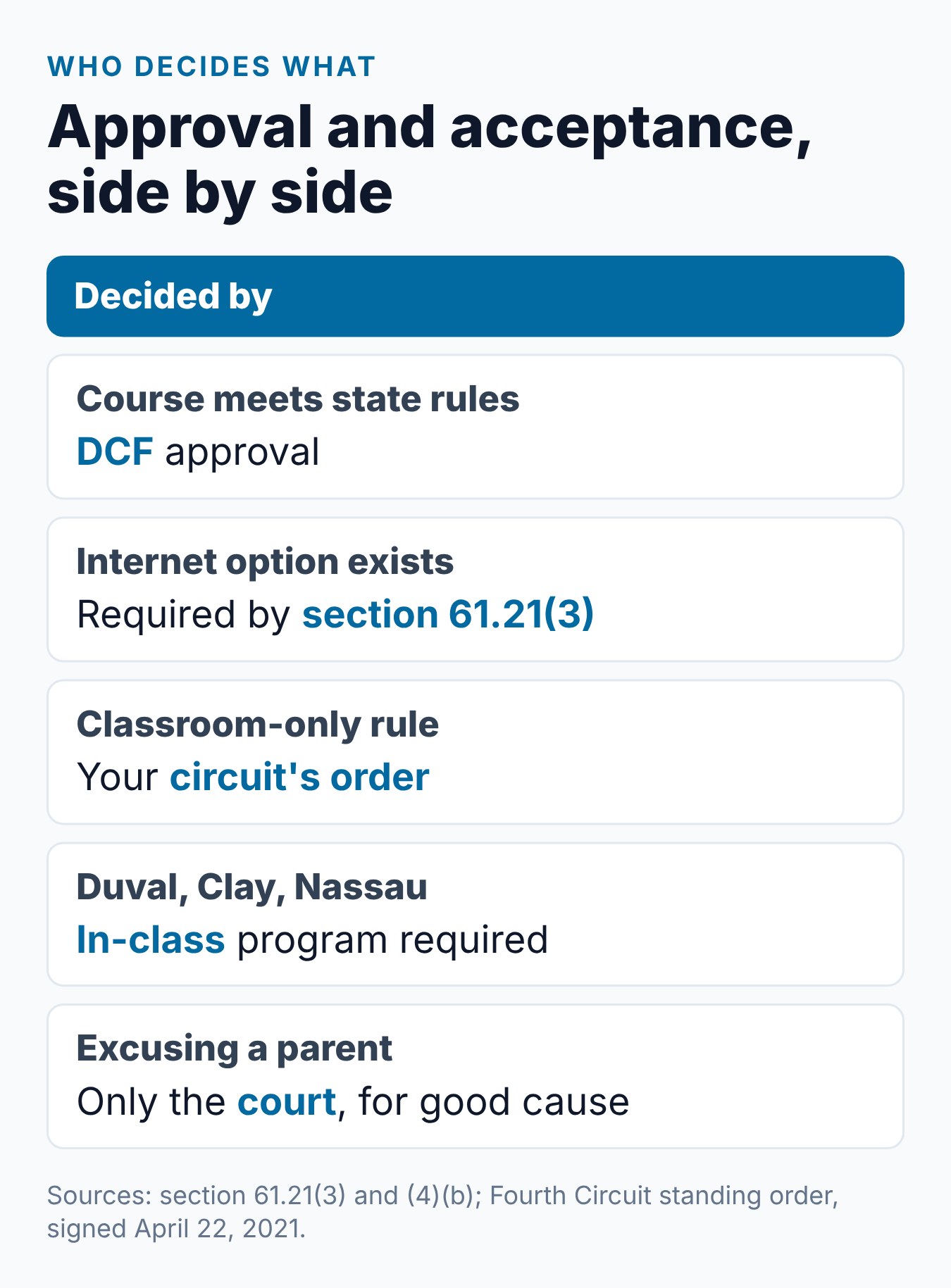
Florida law makes room for online learning. Section 61.21(3) says DCF must approve “a minimum of one statewide approved course to be provided through the Internet.” It also requires one statewide course “through correspondence,” which means by mail.
DCF’s definitions rule groups these together. It calls them “distance learning,” meaning “instruction provided through correspondence or via the Internet.”
DCF also sets rules for how online courses run, in rule 65C-32.002. The pillar guide on online parenting classes for Florida divorce covers those rules.
In short, an online course must still run at least four hours, and it must block anyone from finishing sooner. It must check who is taking it.
It must also let parents reach an instructor, who answers content questions within one business day. Those rules apply to every approved online course, but none of them makes a court take the format.
Approval and Acceptance Are Different
Two separate questions decide whether an online class works for you. The first is whether DCF approved the course. The second is whether your court takes that format.
DCF answers the first. Its provider list shows approved courses, with a column for the delivery method.
Your court answers the second. The statute sets the statewide rule, but each judicial circuit can add its own steps by order. A course can be fully approved by DCF and still not fit a circuit that requires a classroom.
Online Parenting Classes Court Approved: What the Phrase Means
People search for this phrase, but DCF is the one that approves the course. The statute does use “court-approved parenting course” in two subsections, yet it gives DCF the job of approving courses. So read “court approved” as “on DCF’s list, in a format your court takes.”
The Fourth Circuit Requires In-Person
The clearest rule we found comes from the Fourth Judicial Circuit, which covers Duval, Clay and Nassau counties. Its standing family law order was signed April 22, 2021, for petitions filed on or after that date.
Paragraph 9 says parties to a divorce with minor children “shall complete a four-hour parenting course.” It names a local program, “or a similar qualified inperson program.” The deadline is 45 days after filing for the petitioner, or after service for the respondent.
The circuit’s Family Court Services FAQ goes further. It lists three local programs and says, “YOU MUST REGISTER FOR ONE OF THE FOLLOWING IN-CLASS PARENTING CLASSES.” It also says, “When you have your case number you may register.”
The same FAQ answer also points parents to DCF’s list of local and online providers. So ask the circuit’s Family Court Services which class applies to your case.
So in this circuit, an online certificate does not meet the order. See the Duval County guide for the local details.
What Other Court Pages Say
We read the official pages for several other circuits. None of them says online classes are accepted, and none says they are banned. Here is what each page covers:
| Court page | What it says about the class |
|---|---|
| Ninth Circuit (Orange, Osceola) order | Proof goes to the Clerk; out-of-state certificates “may be accepted”; format not addressed |
| Miami-Dade circuit FAQ | Both parents attend a 4-hour course; a children’s class is also required; parents outside Florida who cannot find an approved program “may take a correspondence course by mail” |
| Broward Clerk | Parties attend separately and file a Certificate of Attendance; links to DCF’s list |
| Hillsborough circuit page | Parents must complete an approved course; links to DCF’s list |
| Palm Beach divorce checklist | Lists a Certificate of Completion from each party |
| Pinellas and Pasco circuit page | Says the statute requires the course in divorce and paternity cases |
Silence is not permission. A page that does not mention format still leaves the decision with your court. Read each page in full for your own case, and ask the clerk when it is unclear.
A 2014 DCF Warning on Classroom Orders
This issue is not new. A 2014 DCF provider list, posted by the Ninth Circuit, said, “Some Florida counties have Administrative Orders requiring parents to take the Course in a live-classroom setting.”
That list advised parents to contact their local Family Court Office before taking a distance course. The list is dated June 6, 2014, so treat it as background. The advice still fits.
How to Check Before You Enroll
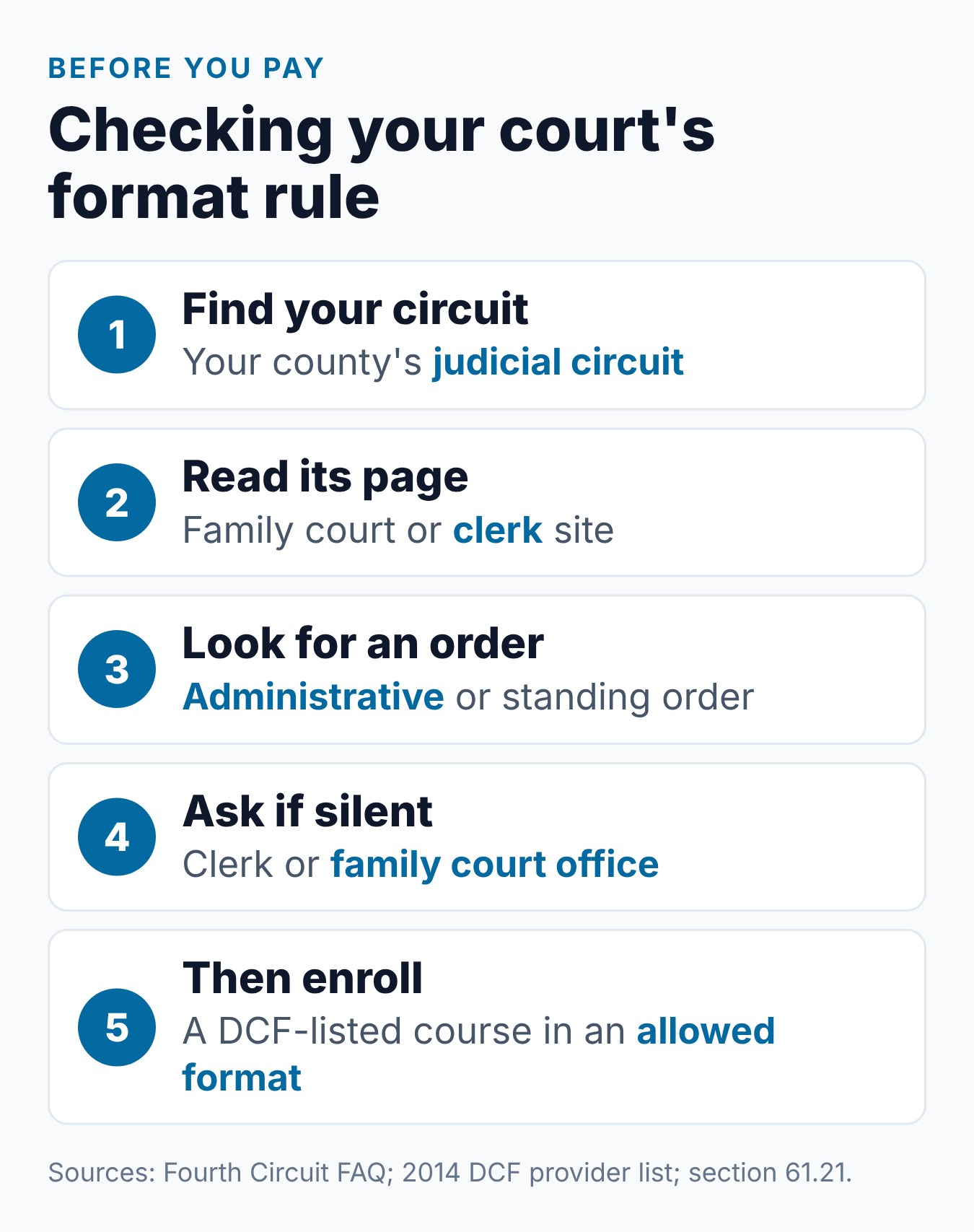
Use these steps before you pay for any online class:
- Find your circuit. Your county belongs to one of Florida’s judicial circuits.
- Read the court page. Look at the family court or clerk page for the parenting course.
- Look for an order. Search for an administrative order or standing order on the course.
- Ask the clerk. If the page is silent, ask the clerk or the family court office about online classes.
- Pick a DCF-listed course. Choose one in the format your court takes.
Write down who you asked and the date. That record helps if a question comes up later.
Special-Needs Courses Come in Set Formats
Some parents must take a different course. Under section 61.21(4)(a), if the children have identified special needs or emotional concerns, the parents must pick a course built for that.
DCF keeps a separate list of these courses. When we checked, it showed two: one online correspondence course, and one offered in person and virtually. Check that list and your court’s format rule together.
Miami-Dade Adds a Children’s Class
Format is one local rule. Extra classes are another. The Miami-Dade circuit FAQ says a child aged 6 to 17 “must attend a 3½ hour class for children of divorcing parents.”
In Miami-Dade, that rule applies to petitions for divorce, paternity or a “change in custody,” in the court’s own words. A parent course alone does not cover it. See the Miami-Dade guide.
Questions to Ask the Clerk
If your court’s page is silent, the clerk’s office is a good place to ask. Useful questions include:
- Does this court accept an online parenting course?
- Is there an administrative order or standing order on the course?
- How do I file my certificate, and by when?
- Does this court require any other class, such as one for children?
Keep notes on each answer, with the date and the name of the office. Bring those notes to your attorney if you have one. They also help you plan the 45-day deadline.
Completing the Course vs Filing Proof
Finishing the class and filing proof are separate steps. Under section 61.21(5), each party files proof of completion with the court before the final judgment.
Local pages describe this step in their own words:
- Broward. The Clerk says each party must file a Certificate of Attendance in the court file “immediately.”
- Ninth Circuit. Each party provides “a certificate of completion to the Clerk of the Circuit Court.”
- Fourth Circuit. Parties “shall file the Certificate of Completion in the Court file promptly.”
See how to submit your certificate.
Local Rules Can Add Steps
Format is not the only local rule. The Seventh Circuit, which is not one of the counties above, shows how far local orders can go.
Its order FM-2024-016-SC says to enroll within 20 days and finish within 45. It also asks parents to finish before court-ordered mediation or trial, whichever comes first. Rules like these do not appear on DCF’s list, so read your own circuit’s orders.
If Your Court Requires In-Person
Follow the court’s instruction. In the Fourth Circuit, that means registering for one of the in-class programs the court names.
Only the court can excuse a party from the course, or from finishing on time, and only for good cause, under section 61.21(4)(b). Parents cannot waive it by agreement. If you have a reason you cannot attend in person, a Florida family law attorney or the clerk can tell you how the court handles requests.
What We Found on the Official Pages
On the court and DCF pages we checked on October 26, 2026, only the Fourth Circuit set a format. Its FAQ required an in-class course from a named local list.
The Ninth Circuit order, signed July 31, 2007, and posted again in January 2026, did not address online or in-person classes.
The Broward, Hillsborough, Palm Beach and Pinellas pages were silent on format. Miami-Dade’s FAQ mentioned format only for parents who live outside Florida. We found no official page on the course for Lee County.
Common Mistakes to Avoid
Each item comes from Florida law or an official court page:
- Assuming state approval settles it. DCF approves courses; your court can still require a format.
- Enrolling online in Duval, Clay or Nassau. The Fourth Circuit requires an in-class program.
- Reading silence as a yes. A page that does not mention format is not a promise.
- Waiting too long to ask. The 45-day clock starts at filing or service.
- Forgetting to file. Proof goes to the court before the final judgment.
- Agreeing to skip it. Only the court can excuse a party, for good cause.
How Requirements Can Vary
Section 61.21 of the Florida Statutes sets the course requirement for the whole state, and DCF approves the courses. Each judicial circuit can still add its own steps, such as how to file the certificate or which class formats it accepts. The Fourth Circuit (Duval, Clay and Nassau counties), for example, requires an in-person class.
Laws, court orders and local rules can change. Check your court’s instructions, your county clerk’s website and DCF’s provider list before you enroll or file.
Frequently Asked Questions
Will my Florida court accept an online parenting class?
It depends on your court. DCF approves online courses, but the Fourth Circuit requires an in-person class, so check your circuit’s instructions or ask the clerk first.
Is an online class approved by DCF good enough?
It meets the state approval rule. Whether your court takes the online format is a separate question for your circuit.
Which Florida courts require in-person classes?
The Fourth Judicial Circuit (Duval, Clay and Nassau) does. We did not find an official page from another circuit that sets a format, so ask your clerk.
Does the Orange County order allow online classes?
The Ninth Circuit order does not address format. It does say certificates from out-of-state providers may be accepted by the court.
Who should I ask about my court’s rules?
Start with the clerk of court or the family court office for your county. A Florida family law attorney can answer questions about your own case.
What if I already took an online class?
Ask the clerk or a Florida family law attorney how your court will treat it. The statute lets a court sanction a parent who does not attend a required course, so do not ignore a court’s format rule.
Can I take the class before I get a case number?
The statute does not say. In the Fourth Circuit, the FAQ says you may register once you have your case number.
Conclusion
DCF approves online parenting courses, but your court decides which formats it takes for your case. The Fourth Circuit requires an in-person class, and other pages we read are silent. Confirm that your court accepts an online course before you enroll in DivorceParentingClass.net’s online Florida parent education course.
Related Articles
- Online Parenting Classes for Florida Divorce: DCF Rules
- Parenting Classes Jacksonville FL: Duval County Rules
- Parenting Classes Near Me or Online? Florida Divorce Guide
- How to Submit Your Parenting Class Certificate of Completion
Sources
- Florida Statutes § 61.21 — Parenting course
- Fla. Admin. Code R. 65C-32.001 — Definitions
- Fla. Admin. Code R. 65C-32.002 — Course length and delivery
- Florida DCF — Parent Education and Family Stabilization Course
- Florida DCF — Approved course provider list
- Fourth Judicial Circuit — Standing Family Law Order (PDF)
- Fourth Judicial Circuit — Family Court Services FAQ
- Ninth Judicial Circuit — Administrative Order 07-98-37-01 (PDF)
- Eleventh Judicial Circuit — Divorce Education Program FAQ
- Broward County Clerk of Courts — Family
- Thirteenth Judicial Circuit — Domestic Relations Case Management Unit
- Fifteenth Judicial Circuit — Divorce with children checklist (PDF)
- Sixth Judicial Circuit — Family Law
- Seventh Judicial Circuit — Order FM-2024-016-SC
Billy Forte is the owner of DivorceParentingClass.net.
This article is general information, not legal advice. Court rules, local practice, and case facts can differ by county, judge, and case type in Florida. Use official court and state sources, and consult a qualified Florida family law attorney for legal guidance specific to your case.