
Updated October 2026 · Reviewed by Billy Forte
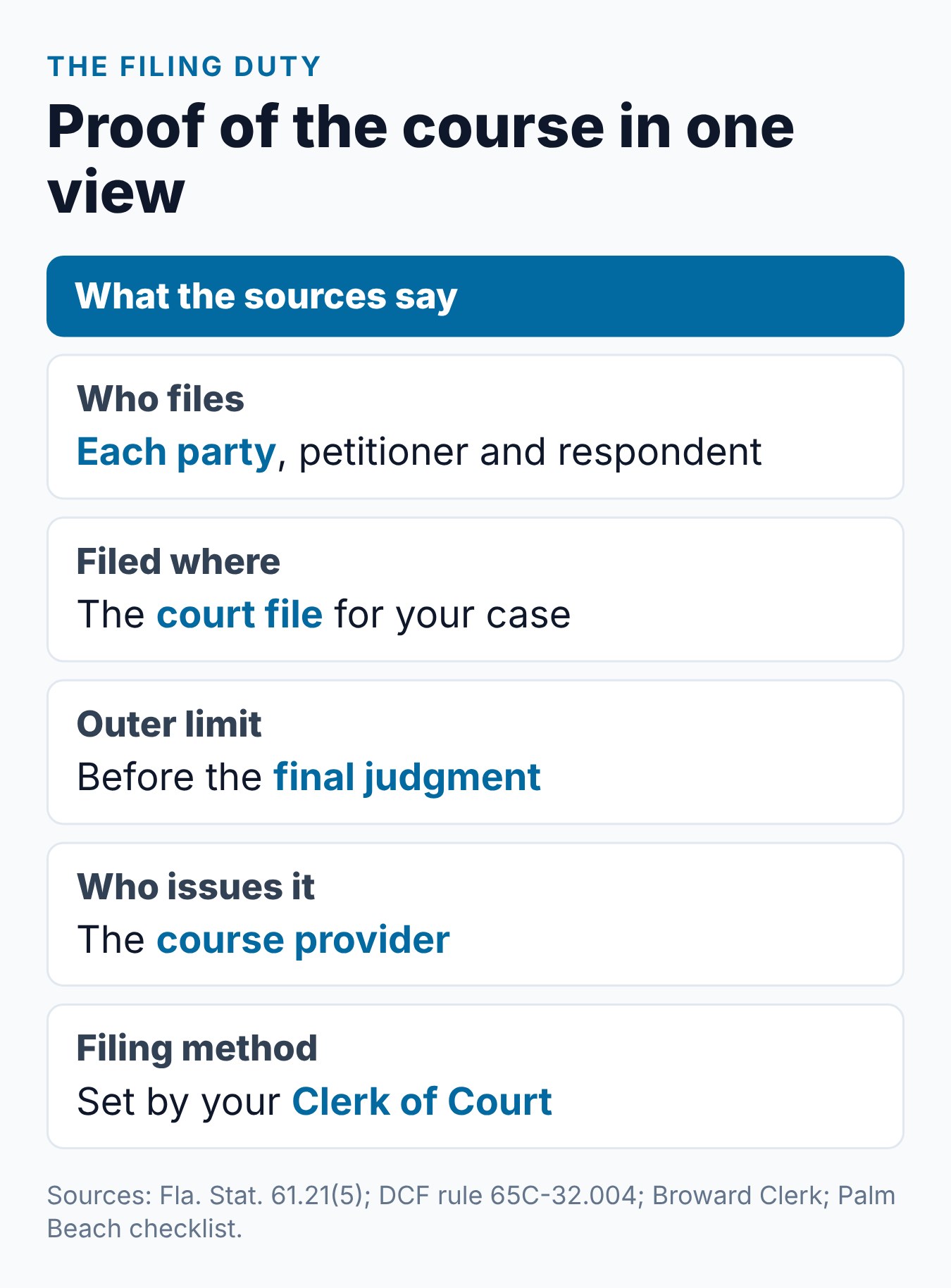
Your parenting class certificate of completion goes into the court file for your case, and each parent must file proof there before the judge signs the final judgment. Florida law sets that duty for the whole state. The exact way to file is up to your circuit and your Clerk of Court, so this page shows what four courts say.
Key Facts
- The state rule: each party files proof of the course with the court before the final judgment. See what Florida law says.
- Who files: each parent files his or her own proof. See each parent files.
- Where it goes: the court file for your case, through the clerk. See what four courts say.
- How soon: courts use words like “immediately” and “promptly.” See timing words.
- How to file: your clerk sets the method. See working with your clerk.
Where the Parenting Class Certificate of Completion Goes
The short answer is the court. Your proof belongs in the case file of the judge who will sign your final judgment. It does not go to DCF.
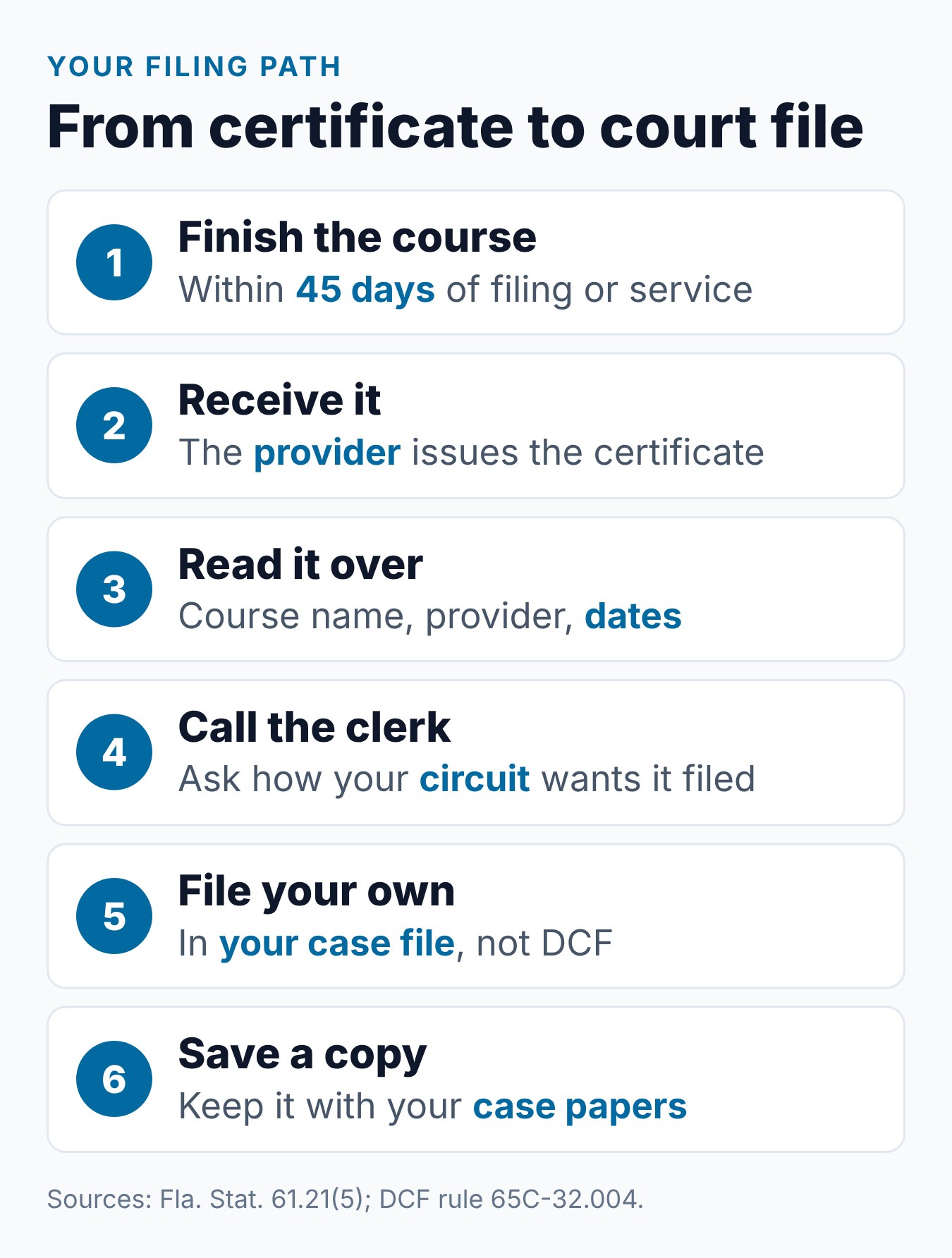
Two steps are easy to mix up. First, you finish the course and the provider gives you a certificate. Second, you file proof with the court.
The provider handles the first step. You handle the second.
DCF rule 65C-32.004 says the provider gives a certificate to each parent who completes the four-hour course and scores at least 70 percent on the end-of-course test. After that, the filing is your job.
What Florida Law Says
The filing rule is in section 61.21(5), Florida Statutes. It says each party “shall file proof of compliance” with the court “prior to the entry of the final judgment.”
The same subsection sets the course deadlines:
- Petitioner: finish within 45 days after filing the petition.
- Other party: finish within 45 days after service of the petition.
- Paternity: the other party’s clock can start at other events, such as an order granting time-sharing.
The statute does not say what the proof must look like. It also does not say who issues it. The DCF rule fills that gap with the certificate of completion.
Each Parent Files on Their Own
The law speaks of “each party.” So the duty to file belongs to each parent, not to the couple.
That fits the rest of the statute. Parents do not have to take the course together, and a judge can stop them from taking it together if there is a history of domestic violence. Each parent who finishes gets a separate certificate.
So your filing proves only your course. The other parent’s filing proves theirs. If one parent never files, the court can still act on that parent under section 61.21(9), which allows contempt, denial of shared parental responsibility or time-sharing, or other sanctions.
What Four Florida Courts Say
Circuits can add their own filing words. Here is what four official court and clerk pages say, plus one more circuit as an example:
| Court | Who files | Where it goes | Timing words |
|---|---|---|---|
| Broward Clerk (17th Circuit) | Each party | “the court file” | “immediately” |
| Ninth Circuit (Orange, Osceola) | Each party | Clerk of the Circuit Court | No judgment without proof |
| Fourth Circuit (Duval, Clay, Nassau) | The parties | “the Court file” | “promptly” |
| Fifteenth Circuit (Palm Beach) | Petitioner and Respondent | Listed on the divorce checklist | Not stated |
| Seventh Circuit (Volusia and others) | The parties | Certificate from the provider | Finish before mediation or trial |
Broward County
The Broward Clerk’s family page says the parties “shall separately attend” the course. It adds, “Each party is responsible for immediately filing his/her Certificate of Attendance in the court file.”
Note the name. Broward calls it a Certificate of Attendance. It is the same proof of the same course.
Orange and Osceola Counties
The Ninth Circuit’s Administrative Order 07-98-37-01 makes each party “responsible for providing a certificate of completion to the Clerk of the Circuit Court.”
The order is firm. “No divorce or paternity judgments involving issues of parental responsibility shall be granted in this Circuit” without that proof.
Duval, Clay and Nassau Counties
The Fourth Circuit’s standing family law order says, “Parties shall file the Certificate of Completion in the Court file promptly.”
This circuit also requires an in-person class from its own list. The circuit’s standing family law order calls for “a similar qualified inperson program.” Its Family Court Services FAQ names three local programs. So a certificate from another kind of course may not meet its order.
The same FAQ answer also points parents to DCF’s list of local and online providers. So ask the circuit’s Family Court Services which class applies to your case.
Palm Beach County
The Fifteenth Circuit’s checklist for a divorce with minor children lists a “Certificate of Completion of Parent Education Class.” It shows the filer as “Petitioner and Respondent.” The checklist gives no deadline of its own.
A Seventh Circuit Example
The Seventh Circuit covers Flagler, Putnam, St. Johns and Volusia counties. Its Order FM-2024-016-SC asks parties to file “a Certificate of Completion supplied by the program provider.” It also says to finish before court-ordered mediation or trial, whichever comes first.
This order shows how local rules can be stricter than the statute. Your own circuit may have a rule like it.
Timing Words Courts Use
The statute’s outer limit is before the final judgment. Local courts can ask for more:
- “Immediately” in Broward, for filing the certificate.
- “Promptly” in the Fourth Circuit, for filing the certificate.
- Before mediation or trial in the Seventh Circuit, for finishing the course.
- No judgment without proof in the Ninth Circuit.
None of these pages gives a number of days for filing. So a safe habit is to file soon after you get the certificate. Waiting until the final hearing leaves no room to fix a problem.
Working With Your Clerk
We do not list e-filing steps here. Filing methods are set by each clerk, and they can change. Instead, ask your clerk’s office these questions:
- How do I file the certificate in my case?
- Do I need a cover sheet or a case number on the filing?
- Can I file it myself, or does my lawyer file it?
- How can I check that it reached the court file?
Write the answers down. If you have a lawyer, ask how the office handles this step.
Check the Certificate Before You File
A quick review now can save a second trip to the clerk. Under the DCF rule, your certificate should show:
- The course name.
- The provider’s name and contact information.
- The curriculum name, if the provider uses one.
- The date you began and the date you finished.
The rule does not list a case number. Our guide to what the certificate must show explains each item.
Keep Your Own Copy
Once you file, the original or a copy sits in the court file. Keep your own copy as well, with your other case papers.
If you lose it, the provider can help. DCF rule 65C-32.004 says providers keep copies of all certificates for five years. See how to replace a lost certificate.
If the Clerk or Judge Has a Question
A court may ask about a filing. If that happens, ask the clerk or the court what is missing and how to fix it. Then follow those instructions.
Do not guess at the fix. Our page on what to do if a certificate is rejected lists the checks to make.
Completing Is Not Filing
A parent can pass the course and still miss the filing step. The provider’s records will show the course was done. The court file will not, until someone files proof.
Keep these two tasks on separate lines of your to-do list:
- Finish the course within your 45-day window.
- File the proof in the court file before the final judgment.
Our pillar guide on getting the certificate covers the first task. This page covers the second.
If You Are the Respondent
The respondent is the parent who did not file the petition. Under section 61.21(5), your course clock starts when you are served, not when the case is filed. You have 45 days from service.
Your filing duty is the same as the petitioner’s. Broward, the Fourth Circuit and the Palm Beach checklist all name both parties. File your own proof in the same case file.
Paternity Cases
The course also applies to a paternity case that involves parental responsibility. The petitioner still has 45 days after filing. Another party’s 45 days can start after an acknowledgment of paternity, a finding of paternity, or an order for time-sharing or support.
The filing rule does not change. Each party files proof before the final judgment.
What We Found on the Official Pages
On the court and clerk pages we checked on October 26, 2026, each one said the parties file proof. None of them described an e-filing screen or a filing fee for the certificate, so we do not either.
We also saw three names for the same proof: “Certificate of Attendance” in Broward, “certificate of completion” in the Ninth Circuit, and “Certificate of Completion of Parent Education Class” in Palm Beach.
Common Mistakes to Avoid
Each item comes from section 61.21, the DCF rule or a court page above:
- Assuming the provider files for you. The statute puts the filing duty on each party.
- Filing for both parents at once. Each parent proves only his or her own course.
- Waiting for the final hearing. Some courts ask for “immediately” or “promptly.”
- Using a course your circuit does not accept. The Fourth Circuit requires an in-person class from its list.
- Thinking DCF needs a copy. The proof goes in the court file.
- Skipping the respondent’s duty. Both parties file, not only the petitioner.
How Requirements Can Vary
Section 61.21 of the Florida Statutes sets the course requirement for the whole state, and DCF approves the courses. Each judicial circuit can still add its own steps, such as how to file the certificate or which class formats it accepts. The Fourth Circuit (Duval, Clay and Nassau counties), for example, requires an in-person class.
Laws, court orders and local rules can change. Check your court’s instructions, your county clerk’s website and DCF’s provider list before you enroll or file.
Frequently Asked Questions
Where do I send my parenting class certificate in Florida?
You file it with the court in your case, through the Clerk of Court. Section 61.21(5) says each party files proof before the final judgment. Your clerk tells you the method.
Does the course provider file it for me?
No official source says it does. The statute makes filing each party’s job. Ask your provider only if your court’s instructions say otherwise.
Do both parents have to file?
Yes. The law says “each party” files proof. Broward, the Fourth Circuit and the Palm Beach checklist all name both parties.
How soon after the course should I file?
The statute says before the final judgment. Broward says “immediately,” and the Fourth Circuit says “promptly.” Filing soon after you get the certificate leaves time to fix errors.
Can I e-file the certificate?
Ask your clerk. Filing methods are set locally, and we do not describe them here.
What if my court calls it something else?
Courts use more than one name. Broward calls it a “Certificate of Attendance.” It is still proof of the same DCF-approved course.
What if I finished the course but never filed?
File the proof as soon as you can, and ask the clerk how. The court can sanction a parent who does not meet the course rule. A Florida family law attorney can help with your situation.
Conclusion
Each parent files a parenting class certificate of completion in the court file before the final judgment, and the clerk sets the method. Read your circuit’s order, since some courts ask you to file “immediately” or “promptly.”
To take the course, see DivorceParentingClass.net’s online Florida parent education course. Before you enroll, confirm that your court accepts an online course.
Related Articles
- How to Get Your Florida Parenting Class Certificate
- Certificate of Completion Parenting Class: What It Must Show
- Lost Your Parenting Certificate? How to Get a Florida Copy
- Parenting Classes for Court: Why Certificates Get Rejected
Sources
- Florida Statutes § 61.21 — Parenting course
- Fla. Admin. Code R. 65C-32.004 — Test and certificate
- Broward County Clerk of Courts — Family
- Seventeenth Judicial Circuit — Family Court FAQs
- Ninth Judicial Circuit — Administrative Order 07-98-37-01 (PDF)
- Fourth Judicial Circuit — Standing Family Law Order (PDF)
- Fourth Judicial Circuit — Family Court Services FAQ
- Fifteenth Judicial Circuit — Divorce with children checklist (PDF)
- Seventh Judicial Circuit — Order FM-2024-016-SC
Billy Forte is the owner of DivorceParentingClass.net.
This article is general information, not legal advice. Court rules, local practice, and case facts can differ by county, judge, and case type in Florida. Use official court and state sources, and consult a qualified Florida family law attorney for legal guidance specific to your case.