
Updated October 2026 · Reviewed by Billy Forte
No Florida law or DCF rule says whether the Florida parenting course final test is open book, so each approved provider decides how its own test works. What the state does set is the purpose of the test, a 70 percent passing mark, and a review of missed material before each retake. Because of that review step, parents go back to the course material between tries in every approved course.
Key Facts
- Open book: no official rule allows or bans it; the provider decides. See the open-book question.
- Purpose: the rule says the test is meant to show you understood the course. See why the test exists.
- Difficulty: DCF publishes no difficulty level; the bar is 70 percent. See is the test hard.
- Course material: a below-70 score sends you back to the material you missed. See using the material.
- Answer keys: each provider writes its own test, and none is published by the state. See shared answers.
Is the Florida Parenting Course Final Test Open Book?
The official sources are silent on this point. Section 61.21, Florida Statutes creates the course but does not describe the test. The DCF rules on delivery and testing do not mention notes, books or closed-book rules.
That means the answer depends on the course you choose. A provider may allow it, or it may not. The only way to know is to read the provider’s instructions or ask before you enroll.
The course itself is the Parent Education and Family Stabilization Course. The Florida Department of Children and Families (DCF) approves each one.
What the Rule Says About the Test
The test rules sit in DCF rule 65C-32.004. The rule was adopted in 2007 and last amended effective June 5, 2016. It says four things about the test:
- Every course has one. Each course must include an end-of-course test.
- It has a purpose. The test is “designed to demonstrate” that the parent understood the course’s learning goals.
- It has a passing mark. A parent needs a score of at least 70 percent for a certificate.
- It has a safety net. Attempts are unlimited, missed material is reviewed first, and no extra fee applies.
Nothing else about the test format appears in the rule. Time limits, question style and open-book use are left to the provider.
Why the Test Exists
The test is a check on learning, not a trick. Florida lawmakers found that children can be harmed when parents divorce, especially when conflict lasts. They also found that parents gain from early education on the court process, emotional adjustment and community help.
DCF’s course page puts the goal plainly. The courses are “designed to educate, train, and assist divorcing parents.”
The test closes that loop. A certificate goes only to a parent who finishes at least 4 hours and scores 70 percent or more. So the certificate shows the court two things: the time was spent and the main ideas came through.
What the test covers comes from the course. Every course must teach the eight parts listed in rule 65C-32.003, from divorce as loss to parenting time. See what the course covers for the full list.
Is the Test Hard?
DCF does not rate or publish how hard any test is. No official source compares providers or reports scores. So we cannot tell you how hard a given test will feel.
What the rules do tell you is how the test is built to be passed:
- The bar is fixed. The passing mark is 70 percent in every approved course.
- Tries do not run out. The rule gives an “unlimited number of attempts.”
- Help comes first. Below 70 percent, you review what you missed before you try again.
- Money is not a barrier. Providers may not charge more for the extra time or teaching needed to pass.
In short, the rules aim to have parents learn the material, not to screen them out. For what happens after a low score, see retakes and the passing score.
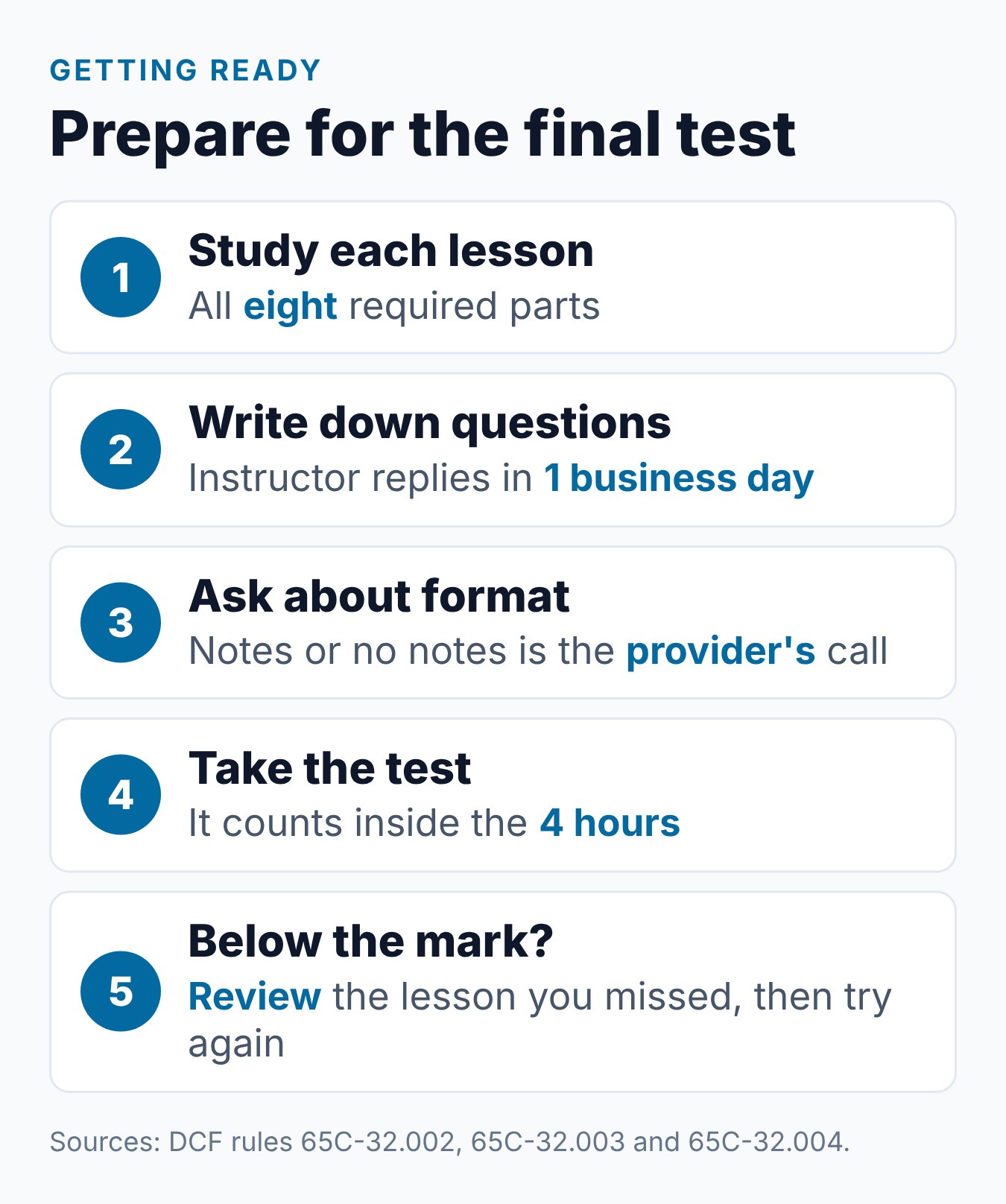
Using Course Material Between Tries
Even without an open-book rule, the material plays a set role. The rule says that if a parent scores below 70 percent, “the instructor shall review the missed material” with the parent before the retake.
Online courses work the same way, but the course does the pointing. For online courses, missed questions “shall refer the participant to the appropriate section requiring review.” So you go back to the exact lesson you need.
You can also ask questions while you study. DCF rule 65C-32.002 says online and correspondence providers must let you contact an instructor. Questions about course content must be answered within one business day.
Why Shared Test Answers Do Not Help
People search for “test answers,” but no state answer key exists. Each provider writes its own course and test, and providers may give their curriculum a unique name. A list made for one course may not match another.
The rules also make answer lists pointless. Tries are unlimited, so a low score costs time, not your certificate. And every course must include “a means of verifying the identity of participants,” so the person who takes the test is the parent who enrolled.
The better path is the one the rule builds in. Study each part, ask the instructor what is unclear, and use the review step if you need it.
What the State Sets and What the Provider Decides
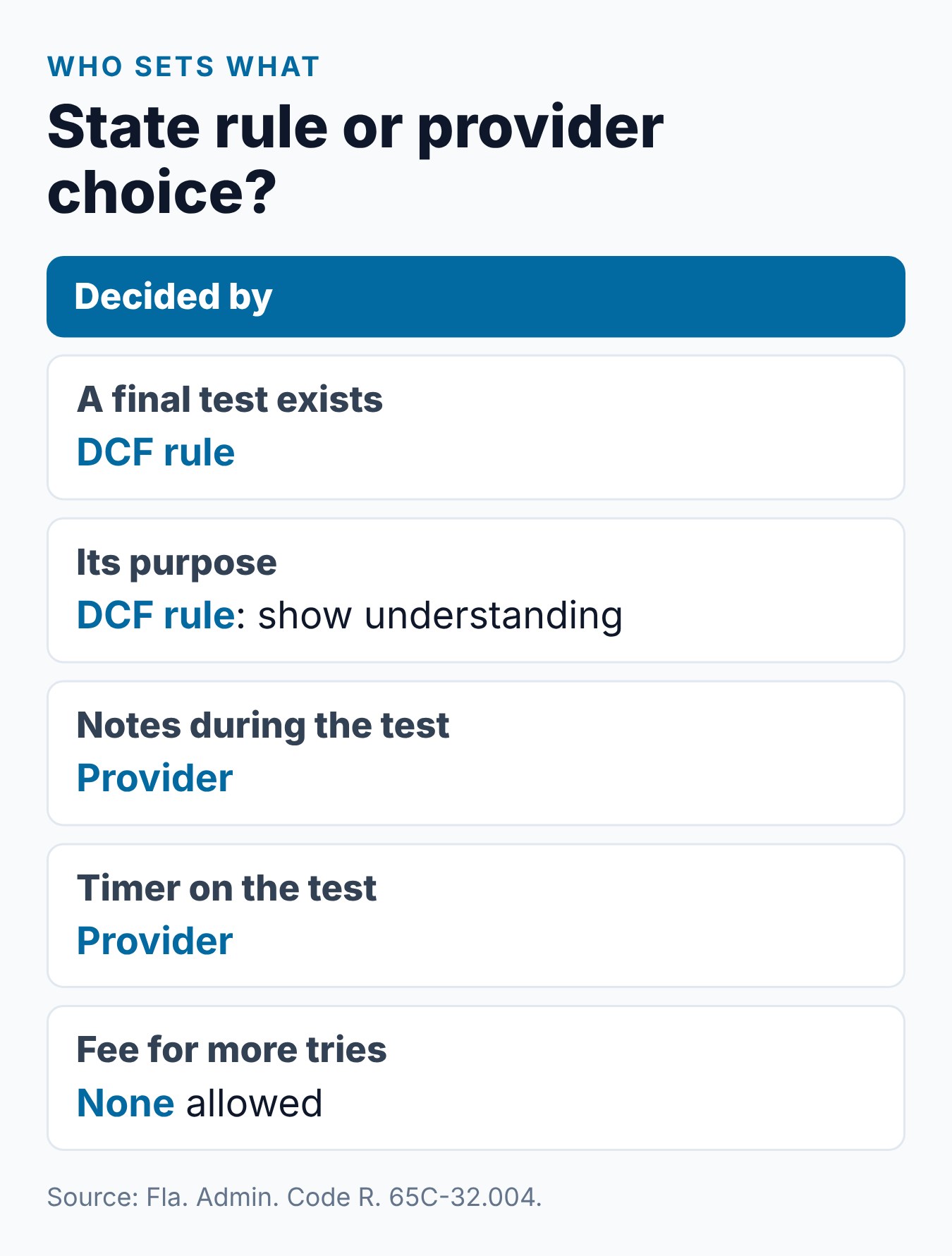
This table splits the test into the parts DCF controls and the parts each provider controls.
| Part of the final test | Who decides | What we found |
|---|---|---|
| Whether there is a final test | DCF rule | Required in every course |
| Purpose of the final test | DCF rule | To show understanding of course goals |
| Notes or lessons during the test | Provider | No state rule either way |
| Time limit for the test itself | Provider | No state rule found |
| Help after a low score | DCF rule | Review of missed material first |
| Cost of extra tries | DCF rule | No added fee allowed |
Questions to Ask Your Provider
Your provider is the only source for its own test format. Ask these before you pay:
- Can I look at my notes or the lessons during the final test?
- Is the test timed once I start it?
- How will the course show me what to review if I score below 70 percent?
- How do I reach an instructor with a content question?
- How does the course check my identity?
- Is the test offered in the same language as the lessons?
You can check the provider’s DCF approval yourself on DCF’s provider list.
In Person, Online or by Mail
The test rules apply to every approved format. Florida law requires DCF to approve at least one statewide internet course and one correspondence course, and local classes are also offered. The review step looks a little different in each.
- In a classroom. The instructor goes over the missed material with you before your next try.
- Online. The missed questions send you to the section you need to review.
- By correspondence. You can contact the instructor, and content questions get an answer within one business day.
Not every court accepts every format. The Fourth Judicial Circuit (Duval, Clay and Nassau) requires an in-person class, so check your court’s instructions first.
If English Is Not Your First Language
Reading the test in a language you know well can matter more than any open-book rule. DCF asks each provider to list the languages its course is offered in. The provider list shows a “Languages” column for each course.
Check that column before you enroll. If the course is offered in your language, ask whether the test is too.
Where the Test Fits in the 4 Hours
The test is part of the course time, not an extra step after it. Rule 65C-32.002 says the 4-hour minimum includes “instruction, participant exercises and an end of course test.” Online courses must stop anyone from finishing in under 4 hours.
A retake can add time beyond that. The rule says there is no extra charge for it. See how long the course takes for planning.
After You Pass
Passing leads to the certificate of completion. It shows the course name, the provider’s name and contact details, the curriculum name if there is one, and the dates you began and finished. Providers must be able to confirm a certificate is real and keep copies for five years.
Then you file proof with the court before the final judgment. Under section 61.21(5), the petitioner finishes within 45 days after filing, and the other party within 45 days after service.
What We Found on the Official Pages
On the DCF rule pages we checked on October 26, 2026, rule 65C-32.004 described the test’s purpose, the 70 percent mark and the retake rules. It said nothing about notes, books or open-book use.
DCF’s course page, updated April 8, 2026, described the course length but not the test format. We found no DCF page that publishes test questions or answers.
Common Mistakes to Avoid
Each point comes from a DCF rule or section 61.21:
- Assuming a state open-book rule. There is none; ask your provider.
- Hunting for an answer key. Tests differ by provider, and none is posted by DCF.
- Rushing the lessons. The test checks what you learned, and the course cannot end before 4 hours online.
- Skipping the review. The rule puts the review before a retake for a reason.
- Letting someone else test for you. Every course must check identity.
- Forgetting the filing step. Passing gives you a certificate; you still file proof with the court.
How Requirements Can Vary
Section 61.21 of the Florida Statutes sets the course requirement for the whole state, and DCF approves the courses. Each judicial circuit can still add its own steps, such as how to file the certificate or which class formats it accepts. The Fourth Circuit (Duval, Clay and Nassau counties), for example, requires an in-person class.
Laws, court orders and local rules can change. Check your court’s instructions, your county clerk’s website and DCF’s provider list before you enroll or file.
Frequently Asked Questions
Can I use my notes on the Florida parenting class final test?
No Florida rule says yes or no. Each provider sets its own test format, so check the course instructions or ask the provider.
Is the Florida parenting class test hard?
DCF does not rate test difficulty. The rules set a 70 percent passing mark, unlimited tries and a review of missed material before each retake.
What is the final test for?
DCF rule 65C-32.004 says the test is designed to show that you understood the course’s learning goals. You need a passing score to get a certificate.
Where can I find the test answers?
No official source publishes them. Each provider writes its own test, so the best help is the course itself and the review step after a low score.
Can I ask an instructor for help?
Yes. Online and correspondence providers must let you contact an instructor. Content questions must be answered within one business day.
Does the test count toward the 4 hours?
Yes. DCF rule 65C-32.002 counts instruction, exercises and the end-of-course test toward the 4-hour minimum.
Is the test timed?
No Florida rule sets a time limit for the test itself. Ask your provider whether its test has a timer once you start.
Do I restart the course if I score below 70 percent?
The rule does not call for a restart. It calls for a review of the material you missed before you retake the test. Ask your provider how its retake process works.
Conclusion
The Florida parenting course final test has no state open-book rule, so the format is up to each provider. The state does set its purpose, the 70 percent mark and a review before each retake. To see how one course handles it, visit DivorceParentingClass.net’s online Florida parent education course, and first confirm that your court accepts an online course.
Related Articles
- How Long Are Parenting Classes for Divorce in Florida?
- Can You Fail a Parenting Class? Florida Retake Rules
- Florida Parenting Course End of Course Test: How Many Questions?
- Is There a 4 Hour Co Parenting Class Quiz in Florida?
Sources
- Fla. Admin. Code R. 65C-32.004 — Test and certificate
- Fla. Admin. Code R. 65C-32.002 — Course length and delivery
- Fla. Admin. Code R. 65C-32.003 — Required course content
- Florida Statutes § 61.21 — Parenting course
- Florida DCF — Parent Education and Family Stabilization Course
- Florida DCF — Approved course provider list
Billy Forte is the owner of DivorceParentingClass.net.
This article is general information, not legal advice. Court rules, local practice, and case facts can differ by county, judge, and case type in Florida. Use official court and state sources, and consult a qualified Florida family law attorney for legal guidance specific to your case.