
Updated October 2026 · Reviewed by Billy Forte
If you are asking what are parenting classes in a Florida divorce, they are DCF-approved courses that teach parents how divorce affects children and how to keep raising them as a team. Florida law lists topics a course may cover, and a DCF rule lists eight parts every course must include. Every course must also teach about abuse and neglect and give parents a list of local agencies that help.
Key Facts
- Official name: the Parent Education and Family Stabilization Course, approved by DCF. See what the course is.
- Two lists: the statute says what a course may include; the DCF rule says what it must include. See the two lists.
- Eight required parts: from divorce as loss to parenting time. See the eight parts.
- Abuse and safety: required in every course, with a local agency list. See abuse information.
- Not therapy or legal advice: the course is educational only. See what the course is not.
What Are Parenting Classes in Florida?
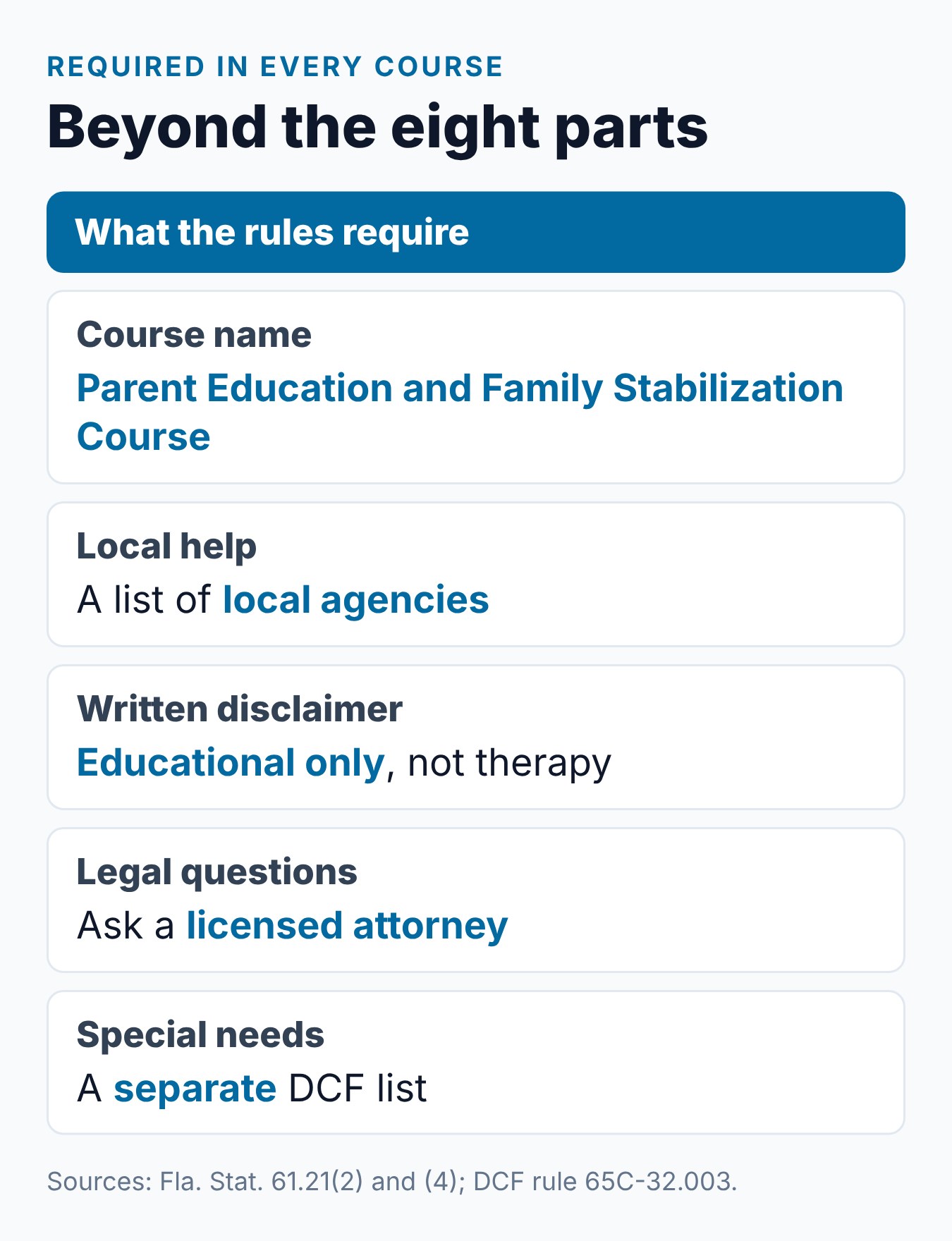
In a Florida divorce, “parenting class” means one course. Its official name is the Parent Education and Family Stabilization Course. The Florida Department of Children and Families (DCF) approves each course, provider and site under section 61.21, Florida Statutes.
All parties to a divorce with minor children must complete it. So must the parties to a paternity case that involves parental responsibility. In a case to change a parenting plan or time-sharing schedule, the judge may require it.
DCF’s course page says the courses are “designed to educate, train, and assist divorcing parents.” Each course lasts at least 4 hours. Providers may give their curriculum its own name, but the course name stays the same.
Two Lists: What a Course May and Must Cover
Two official sources describe the topics. They work in different ways.
- The statute is a menu. Section 61.21(2)(a) says a course “may include, but need not be limited to” a set of topics.
- The DCF rule is a floor. Rule 65C-32.003 lists eight parts that every approved course must contain.
- One topic is required by both. The statute says abuse and neglect information “shall be included in every” course.
So a provider may add material, but it may not leave out a required part. The rule also sets the course name and a written disclaimer.
Topics Florida Law Lists
Section 61.21(2)(a) names these topics. A course may cover:
- The legal side of deciding issues about children
- The emotional effects of separation and divorce on adults
- The emotional effects of separation and divorce on children
- Family relationships and family dynamics
- Financial duties to a child
- Spousal or child abuse and neglect
- Skill-based relationship education
- The needs of children with special needs or emotional concerns
The list is open, so a provider may teach more than these topics. The law was last changed in 2021, and the 2026 statutes show the same list.
The Eight Required Parts
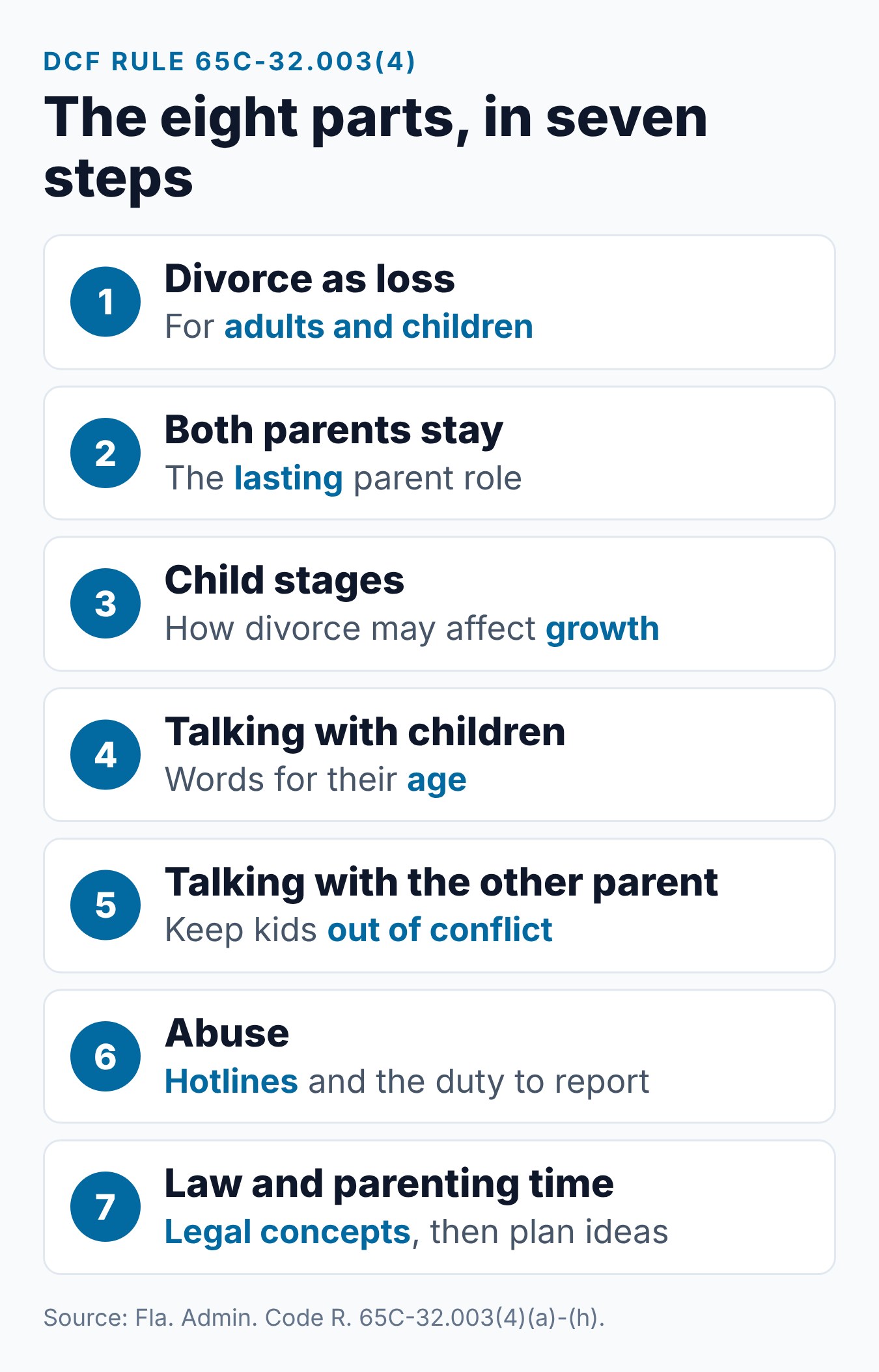
DCF rule 65C-32.003(4) lists the parts below. Each one appears in every approved course, whatever the provider calls its curriculum.
1. Divorce as Loss
The course treats divorce as the loss of the current family structure. It covers how adults and children work through that loss. It also makes clear that the parent role goes on, even though the marriage ends.
2. The Lasting Role of Both Parents
This part explains how children gain from a continuing bond with both parents. It also covers the support children need from each parent. The rule calls this “permanency of parental role” and “shared parenting.”
3. Stages of Child Development
Parents learn the stages children grow through. The course explains how divorce may affect a child at each stage. It also covers what parents can do to lower that impact, and when to seek more help for a child who is struggling.
4. Talking With Children
This part covers how to talk with children about the divorce. The goal is to match the words to the child’s age and stage. Parents learn what to share and how to share it.
5. Talking With the Other Parent
This part covers the harm done when a parent shows anger at the other parent in front of the children. It explains why children do better when kept out of parent conflict. It also covers how to build a working relationship with the other parent.
6. Abuse
This part covers the power and control patterns of domestic violence. It gives the statewide domestic violence hotline number. It also explains child abuse and neglect, the legal duty to report to the Florida Abuse Hotline, and the penalties for false reports.
7. Legal Concepts
This part gives general facts about Florida family law. It includes definitions that matter to divorcing parents with minor children. It also covers “financial responsibilities to the child(ren).”
8. Parenting Time
The last part covers why a steady, consistent bond with both parents helps children. It includes “suggestions about how to develop a parenting plan.” It also covers how parents can talk with each other about parenting time.
How the Law’s Topics Match the Rule’s Parts
The two lists overlap. This table shows where each statute topic shows up among the rule’s required parts.
| Topic named in section 61.21(2)(a) | Closest required part in rule 65C-32.003 |
|---|---|
| Legal side of decisions about children | Part 7, legal concepts |
| Emotional effects on adults | Part 1, divorce as loss |
| Emotional effects on children | Parts 1 and 3, loss and child development |
| Family relationships and dynamics | Parts 2 and 5, both parents and parent talk |
| Financial duties to a child | Part 7, financial responsibilities |
| Abuse and neglect | Part 6, abuse (required by both) |
| Relationship skills | Parts 4 and 5, talking with children and the other parent |
| Children with special needs | Not one of the eight parts; see below |
Abuse Information Every Course Must Include
Abuse is the one topic that both the law and the rule require. Section 61.21(2)(b) says information on spousal and child abuse and neglect “shall be included in every” course. It also says “a list of local agencies that provide assistance with such issues shall also be provided.”
The DCF rule adds the details. The course must give the statewide domestic violence hotline number. It must explain the duty to report child abuse to the Florida Abuse Hotline and the penalties for false reports.
The law also protects parents who have faced abuse. Parents do not have to take the course together. A judge may stop them from taking it together if there is a history of domestic violence, even if neither parent asks.
What the Course Is Not
The topics are taught for learning only. Florida law and the DCF rule draw clear lines:
- Not therapy. Section 61.21(2)(c) says the course “shall not be designed to provide individual mental health therapy.” Each parent gets a written disclaimer that the course is “intended for educational purposes only.”
- Not legal advice. The legal part gives general principles. Course material must tell parents to “consult with a licensed attorney” for specific legal questions.
- Not a sales pitch. Providers may not recruit parents in the course as private clients.
- Not evidence. What a parent says in a session is not used in the case unless both parties agree in writing (section 61.21(8)).
The disclaimer also suggests that parents bring mental health questions to a licensed therapist of their choice.
Courses for Children With Special Needs
Special needs is a topic in the statute’s list, but it is not one of the rule’s eight parts. Instead, the law sets a separate rule. If the children have special needs or emotional concerns, the parents “must select” a course built for that.
DCF keeps a separate list of these courses. The judge may also order a parent to attend more courses on children with special needs, in addition to the main course (section 61.21(12)).
How the Topics Are Taught and Tested
DCF rule 65C-32.002 sets the format. The course lasts at least 4 hours, counting instruction, exercises and the end-of-course test. It must use a mix of methods, such as lectures, group talks, role-plays and videos.
The end-of-course test checks what parents learned. Rule 65C-32.004 says it is “designed to demonstrate” understanding of the course goals. Parents need 70 percent, and they may try as many times as it takes.
For timing, see how long the course takes. For a short view of what fills the hours, see what the 4-hour class includes.
How the Topics Connect to Your Case
The course does not decide anything in your case. It does not write a parenting plan or set a time-sharing schedule. Part 8 gives ideas for a plan, but the plan itself is a separate document.
Under section 61.13, a parenting plan the court approves must cover daily tasks, the time-sharing schedule, health care, school and how parents talk with the child. For the difference, see parenting plan vs the parent course.
What We Found on the Official Pages
On the DCF pages and rules we checked on October 26, 2026, rule 65C-32.003 still listed the same eight parts. Its last change took effect April 17, 2016. DCF’s course page was last updated April 8, 2026.
The statute’s topic list matched the 2026 Florida Statutes. We found no newer rule notice changing the required parts.
Common Mistakes to Avoid
Each item comes from section 61.21 or a DCF rule:
- Picking any general parenting class. Only a DCF-approved Parent Education and Family Stabilization Course meets section 61.21.
- Skipping the special-needs list. If your children have special needs or emotional concerns, the law says to pick a course built for that.
- Expecting legal advice. The course gives general law only and sends specific questions to an attorney.
- Expecting therapy. The course is educational, and the disclaimer says so.
- Thinking the course makes your parenting plan. It offers ideas; the plan is a separate step.
- Worrying that your words will be used in court. They are not used unless both parties agree in writing.
How Requirements Can Vary
Section 61.21 of the Florida Statutes sets the course requirement for the whole state, and DCF approves the courses. Each judicial circuit can still add its own steps, such as how to file the certificate or which class formats it accepts. The Fourth Circuit (Duval, Clay and Nassau counties), for example, requires an in-person class.
Laws, court orders and local rules can change. Check your court’s instructions, your county clerk’s website and DCF’s provider list before you enroll or file.
Frequently Asked Questions
What topics does the Florida parenting class cover?
Every course has eight required parts: divorce as loss, both parents’ lasting role, child development, talking with children, talking with the other parent, abuse, legal concepts and parenting time. Providers may add more.
Is abuse information required?
Yes. Section 61.21 requires abuse and neglect information in every course, plus a list of local agencies. The DCF rule adds the domestic violence hotline and the duty to report child abuse.
Do all approved courses teach the same thing?
They all cover the same eight parts. Providers may name their curriculum and add material, so the lessons and order can differ.
Will the course help me write a parenting plan?
It gives suggestions on how to develop one. It does not create or file a plan for you.
Does the course give legal advice?
No. It gives general Florida family law principles. For questions about your own case, the course must tell you to consult a licensed attorney.
Is there a different course for children with special needs?
Yes. If your children have special needs or emotional concerns, you must pick a course built for that. DCF keeps a separate list.
Is what I say in class private?
Statements made in a session are not used in your case unless both parties agree in writing. No report from the session goes into the court record.
Conclusion
So what are parenting classes in a Florida divorce? They are DCF-approved courses with eight required parts, plus abuse information and a local help list.
You can review the topics in DivorceParentingClass.net’s online Florida parent education course. Before you enroll, confirm that your court accepts an online course.
Related Articles
- How Long Are Parenting Classes for Divorce in Florida?
- 4 Hour Parenting Class Florida: What the Course Includes
- What Is the Parent Education and Family Stabilization Course in Florida?
- Parenting Plan Florida Rules vs. the Parent Education Course
Sources
- Florida Statutes § 61.21 — Parenting course
- Fla. Admin. Code R. 65C-32.002 — Course length and delivery
- Fla. Admin. Code R. 65C-32.003 — Required course content
- Fla. Admin. Code R. 65C-32.004 — Test and certificate
- Florida DCF — Parent Education and Family Stabilization Course
- Florida DCF — Approved course provider list
- Florida DCF — Courses for children with special needs or emotional concerns
Billy Forte is the owner of DivorceParentingClass.net.
This article is general information, not legal advice. Court rules, local practice, and case facts can differ by county, judge, and case type in Florida. Use official court and state sources, and consult a qualified Florida family law attorney for legal guidance specific to your case.