
Updated October 2026 · Reviewed by Billy Forte
A Pinellas County parenting class for divorce is the statewide Parent Education and Family Stabilization Course, which the Sixth Judicial Circuit says is “required by statute in any divorce with children case or any paternity case involving issues of parental responsibility.” The circuit, which also serves Pasco County, lists the course under its procedural requirements and leaves approval to the state. Florida law sets the 45-day deadlines and says proof is filed before the final judgment.
Key Facts
- Required by statute: in a divorce with children or a paternity case involving parental responsibility. See the circuit page.
- Approval: DCF approves courses; the circuit stopped doing so after a 2003 law change. See why the circuit does not approve courses.
- Forms: the course forms entry on the page is marked “Pasco Only.” See the Pasco Only label.
- Deadline: 45 days after filing or service. See deadlines.
- Proof: filed with the court before the final judgment. See proof.
What the Sixth Circuit Page Says
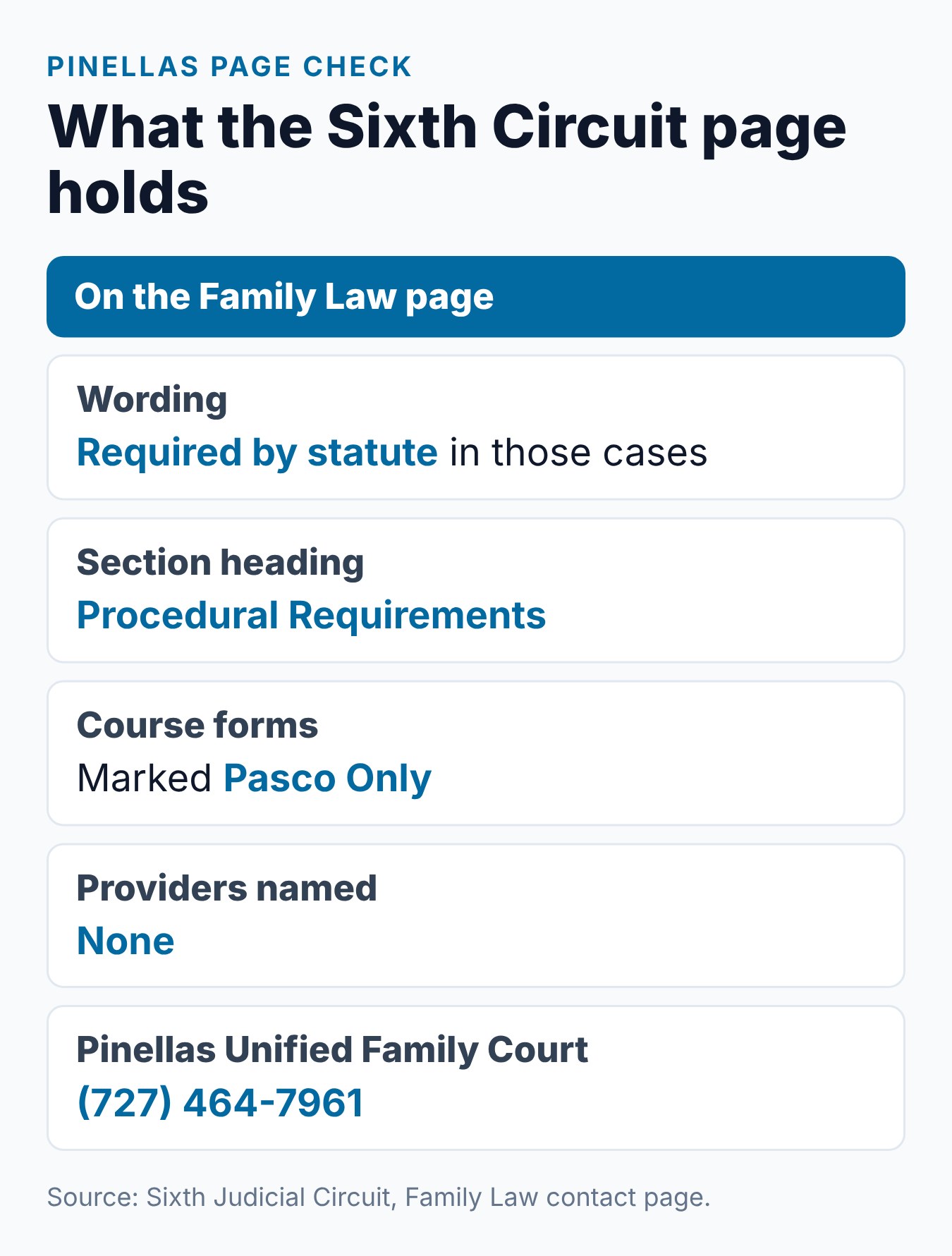
Pinellas and Pasco counties make up Florida’s Sixth Judicial Circuit. The circuit’s Family Law page has a section called “Procedural Requirements.” One entry there is “Parent Education and Family Stabilization Course Providers.”
Next to it, the page explains why. The course is “required by statute in any divorce with children case or any paternity case involving issues of parental responsibility.”
The page does not name any providers. It does not set a local deadline, a format rule or a filing method.
The “Pasco Only” Label
The page has one related-forms entry for the course. That entry is labeled “Pasco Only.” The page does not list the forms by name.
So a Pinellas parent should not assume those forms apply in a Pinellas case. Ask the Pinellas family court staff or the Clerk what, if anything, your case needs beyond the certificate.
Who Takes the Course in Pinellas
The page’s wording tracks state law. Each party to a divorce with minor children takes the course. So does each party to a paternity case that involves parental responsibility.
That means both parents, not just the one who filed. Each parent takes the course and earns a separate certificate.
Some cases fall outside those two types. A divorce with no minor children is not covered by section 61.21.
In a case that changes a parenting plan or time-sharing schedule, the court may require the course. In that kind of case, ask the court.
Why the Circuit Does Not Approve Courses
The Sixth Circuit once had its own order on parenting courses. In July 2003, it issued Administrative Order 2003-039, titled “PARENTING COURSES.” That order rescinded the earlier Administrative Order 2003-002.
The reason was a change in state law. The order says section 61.21 “was amended by House Bill 113A during Special Session A of the 2003 Legislature.” It says the change “deletes the requirement that the Circuit approve parenting courses.”
| Question | Before the 2003 change | After the 2003 change |
|---|---|---|
| Who approved courses | The circuit | The Florida Department of Children and Families (DCF) |
| Where parents checked approval | A circuit order | DCF’s provider list |
| Sixth Circuit order on courses | Administrative Order 2003-002 | Rescinded by Administrative Order 2003-039 |
Today, section 61.21 says DCF approves the course, its providers and its sites. DCF gives each circuit a list of approved providers.
Finding a Pinellas County Parenting Class on DCF’s List
DCF’s provider list is the place to check a course. Its columns show the course name, provider, languages, phone, website, city, indigent status, delivery method and expiration date.
Three DCF rules help you judge a listing:
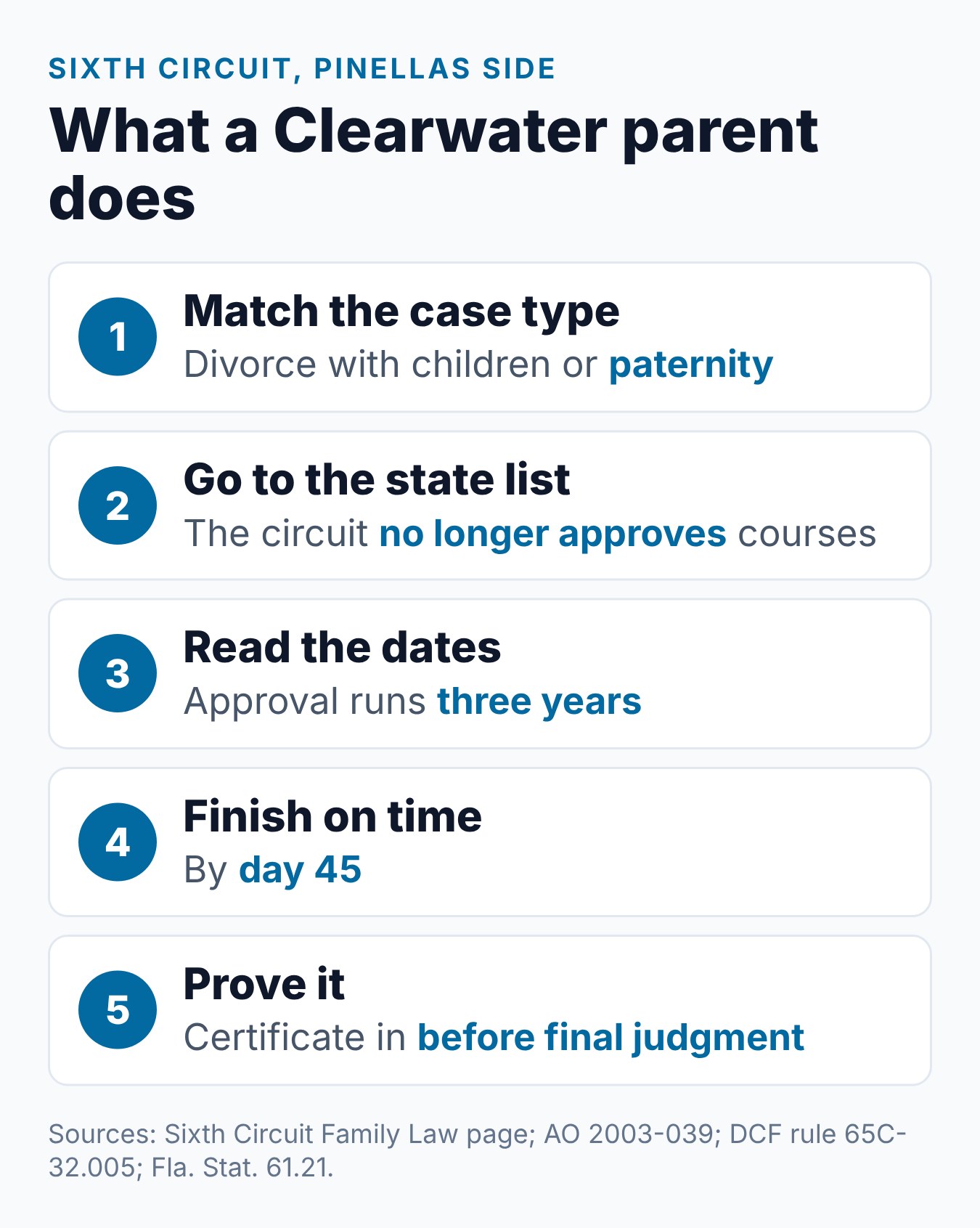
- Three-year approval. Under rule 65C-32.005, approval lasts three years, so check the date.
- Approval notice. Under rule 65C-32.006, the notice of DCF approval must be in all course materials.
- Help with cost. The “Indigent Status” column shows a course’s options for parents who cannot pay.
If your children have special needs or emotional concerns, state law says you must select a course made for that. DCF keeps a special-needs course list.
Questions to Ask Before You Pay
A few quick questions can save you trouble:
- Is this course on DCF’s list right now?
- When does its approval end?
- Does my court accept this format?
- Is there a sliding fee or other help with cost?
- How do I reach the instructor with a question?
Deadlines for Pinellas Parents
The Sixth Circuit page relies on the statute, so the state deadlines apply:
- In a divorce: the parent who filed has 45 days from the filing. The other parent has 45 days from service.
- In a paternity case: the filer also has 45 days from filing. The other parent’s time starts after an acknowledgment of paternity, an adjudication of paternity, or an order granting time-sharing or support.
As an example, a petition filed on October 1 puts the filer’s 45th day on November 15. The law also asks parents to begin “as expeditiously as possible.”
Proof Before the Final Judgment
Section 61.21(5) says each party files proof of completion with the court before the final judgment. The Sixth Circuit page does not describe how to file it.
Your proof is the certificate from your provider. DCF’s rule 65C-32.004 says it must show the course name, the provider’s name and contact details, the curriculum name if any, and your start and finish dates.
You earn it by finishing the course and scoring at least 70 percent on the test. Attempts are unlimited. Providers keep copies for five years.
Check that the course name, provider details and your start and finish dates are right before you file. Then keep a copy for your own records.
The Course in Brief
DCF’s rule 65C-32.002 sets the length at four hours or more. The four hours include teaching, exercises and the final test.
A few more state rules apply in Pinellas:
- Apart is fine. Parents do not have to attend together.
- Safety. With a history of domestic violence, the court can stop joint attendance.
- Privacy. Statements in the course stay out of the case, unless both parents agree in writing.
The course also has limits. Section 61.21 says it is educational and not built to give personal mental health therapy. Providers may not give you personal legal advice or recruit you as a private client.
DCF’s rules list eight topics every course must teach. They include child development, talking with the other parent, and abuse and the hotlines. Our guide on what the course covers explains them.
For the full definition, see what the Parent Education and Family Stabilization Course is.
Online or In Person?
The Sixth Circuit page does not say whether an online course counts. Florida law requires at least one statewide internet course, but some courts require classroom attendance. The Fourth Circuit around Jacksonville is one.
Before you choose an online course for a Pinellas case, ask the court or the Clerk.
Family Court Contacts
The page lists Unified Family Court contacts for both counties:
- Pinellas: Unified Family Court, 14250 49th Street North, Clearwater; phone (727) 464-7961
- Pasco, West Pasco Judicial Center: 7530 Little Road, Suite 201, New Port Richey; phone (727) 847-2411 ext. 8889
- Pasco, Robert D. Sumner Judicial Center: 38053 Live Oak Avenue, Suite 124, Dade City; phone (352) 523-2411 ext. 4800
The page does not list a contact just for the parenting course.
Self-Help Links on the Page
The Family Law page also links to help for people without lawyers:
- a “Representing Yourself in Family Court” page with forms and information
- a “What is a Parenting Plan?” resource
- steps for a hearing before the Saint Petersburg General Magistrate for self-represented parties
- the Florida Courts Help App
Under Pinellas County, the page also mentions legal clinics for low-income self-represented parties. It does not name them.
A Note for Pasco Parents
Pasco shares the Sixth Circuit with Pinellas. The same “required by statute” wording covers a Pasco case.
Pasco parents also have the course forms entry marked “Pasco Only,” and two Pasco family court locations listed above. Ask Pasco court staff which of those forms your case needs.
Paying for the Course
Florida has no set price for the course. A provider may charge each parent “a reasonable fee.” DCF must also list at least one place in each circuit where the course is offered on a sliding fee scale, if one exists.
One more cost rule is worth knowing. If you need extra tries to pass the test, the provider may not charge you more for that time.
If the Course Is Skipped
Under section 61.21(9), a parent who fails to attend can be held in contempt. The court may also deny that parent shared parental responsibility or time-sharing, or impose other sanctions.
Only the court can excuse a parent, and it must find good cause. A deal between the parents cannot waive the course.
What We Found on the Official Pages
On the Sixth Circuit Family Law page we checked on October 26, 2026, the course appeared under “Procedural Requirements” with the “required by statute” wording. The only course forms entry was marked “Pasco Only.”
Administrative Order 2003-039 was still posted, with the July 2003 date. We found no newer Sixth Circuit order on the course.
Common Mistakes to Avoid
Each point comes from the Sixth Circuit page, its 2003 order or section 61.21:
- Looking for a circuit-approved list. DCF approves courses now, not the circuit.
- Using Pasco forms in a Pinellas case. That entry is marked “Pasco Only.”
- Missing a paternity case. The page says the course applies there too.
- Skipping the expiration date. DCF approvals last three years.
- Assuming online counts. The page does not say; ask first.
How Requirements Can Vary
Section 61.21 of the Florida Statutes sets the course requirement for the whole state, and DCF approves the courses. Each judicial circuit can still add its own steps, such as how to file the certificate or which class formats it accepts. The Fourth Circuit (Duval, Clay and Nassau counties), for example, requires an in-person class.
Laws, court orders and local rules can change. Check your court’s instructions, your county clerk’s website and DCF’s provider list before you enroll or file.
Frequently Asked Questions
Is a parenting class required in Pinellas County?
Yes, in a divorce with children or a paternity case involving parental responsibility. The Sixth Circuit page says it is “required by statute” in those cases.
Does the Sixth Circuit approve parenting classes?
No. A 2003 law change removed circuit approval, as Administrative Order 2003-039 explains. DCF approves the courses now.
What does “Pasco Only” mean on the page?
The course forms entry is labeled “Pasco Only.” The page does not name the forms, so ask the Pinellas court staff what applies to you.
How long do I have to finish?
The filer has 45 days after filing. The other parent in a divorce has 45 days after service.
Can I take the class online for a Clearwater case?
The page does not say. Ask the court or the Clerk before you choose an online course.
Do both parents take the class together?
They do not have to. State law does not require parents to attend together.
With a history of domestic violence, the court can bar joint attendance. With a history of domestic violence, the court can bar joint attendance.
Does a divorce without children need the class?
No. Section 61.21 covers divorces with minor children and certain paternity cases. A divorce with no minor children is not covered.
Who do I call in Pinellas?
The page lists the Pinellas Unified Family Court at (727) 464-7961. It does not list a contact just for the course.
Conclusion
Pinellas parents should pick a course from DCF’s list, finish within 45 days, and file proof before the final judgment, as section 61.21 requires. If you are weighing DivorceParentingClass.net’s online Florida parent education course, first confirm that the Sixth Circuit accepts an online course in your case. The Unified Family Court and the Clerk can point you to local steps.
Related Articles
- Parenting Classes Florida by County: Court Certificate Guide
- Hillsborough County Parenting Class for Divorce
- DCF Approved Parenting Classes and the Florida Divorce Class
- What Is the Parent Education and Family Stabilization Course in Florida?
Sources
- Sixth Judicial Circuit — Family Law
- Florida Statutes § 61.21 — Parenting course
- Florida Statutes § 61.046 — Definitions
- Fla. Admin. Code R. 65C-32.002 — Course length and delivery
- Fla. Admin. Code R. 65C-32.004 — Test and certificate
- Fla. Admin. Code R. 65C-32.005 — Provider approval
- Fla. Admin. Code R. 65C-32.006 — Approval process
- Florida DCF — Parent Education and Family Stabilization Course
- Florida DCF — Approved course provider list
- Florida DCF — Courses for children with special needs or emotional concerns
Billy Forte is the owner of DivorceParentingClass.net.
This article is general information, not legal advice. Court rules, local practice, and case facts can differ by county, judge, and case type in Florida. Use official court and state sources, and consult a qualified Florida family law attorney for legal guidance specific to your case.