
Updated October 2026 · Reviewed by Billy Forte
Parenting classes ordered by court in a Florida divorce must be a Parent Education and Family Stabilization Course approved by the Florida Department of Children and Families (DCF). A voluntary class you pick on your own does not meet that rule unless it is on DCF’s list. Voluntary classes may still help you as a parent, but they do not replace the required course.
Key Facts
- The required course: section 61.21 names one course, approved by DCF. See the required course.
- Voluntary classes: they do not count unless they appear on DCF’s list. See voluntary classes.
- Extra classes: a judge may order more classes on special needs. See extra classes.
- Local programs: Miami-Dade adds a class for children. See local programs.
- Child welfare cases: case plans follow a separate statute. See case plans.
What “Ordered by Court” Means in Florida
People say “court-ordered class” for several different things. Florida law sorts them into a few groups:
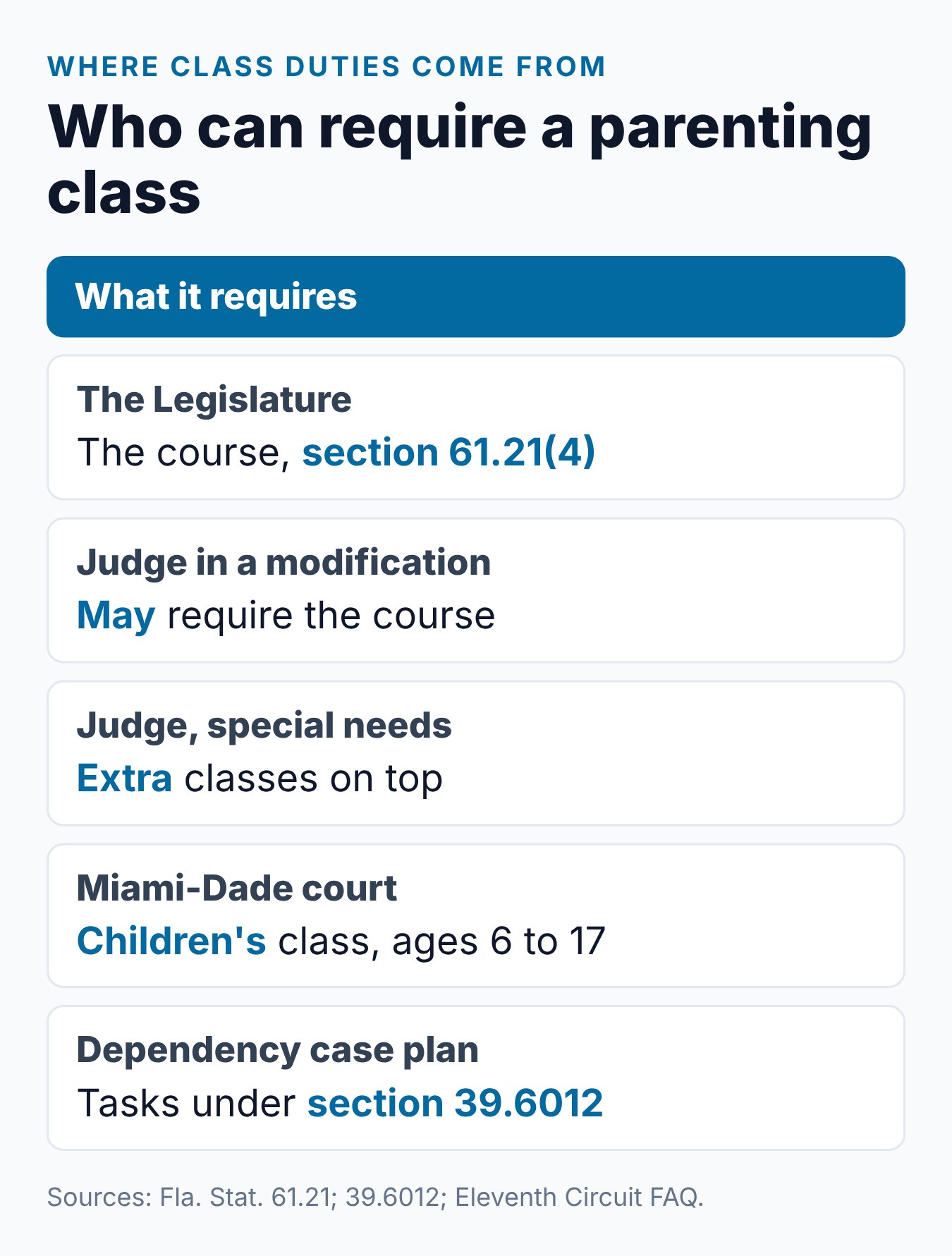
- Required by statute. Section 61.21(4)(a) requires the course for all parties to a divorce with minor children. It also applies to a paternity case involving parental responsibility.
- Ordered in a modification. Under section 61.21(6), parties to a change of a parenting plan or time-sharing schedule “may be required” to take it.
- Extra classes. Under section 61.21(12), the court may require classes on children with special needs or emotional concerns.
- Local programs. Some circuits add their own, such as a children’s class.
A voluntary class is anything outside these groups. No statute or order requires it.
Parenting Classes Ordered by Court: The Required Course
The required course has one official name: the Parent Education and Family Stabilization Course. DCF approves the course, its providers and its sites.
The rules for it are set out in DCF rules:
- Length. At least 4 hours, including instruction, exercises and the end-of-course test, under rule 65C-32.002.
- Content. Eight required parts under rule 65C-32.003, from divorce as loss to parenting time.
- Test. A score of at least 70 percent, with unlimited attempts, under rule 65C-32.004.
- Certificate. Given by the provider to each parent who finishes and passes.
Each parent files proof with the court before the final judgment. The petitioner has 45 days after filing, and the other party 45 days after service.
What Counts as a Voluntary Class
A voluntary class is one you choose without a statute or court order behind it. It could be a general parenting class, a co-parenting class or a class on child behavior.
Here is the key point. Section 61.21 requires the course that DCF approves. A class that is not a DCF-approved Parent Education and Family Stabilization Course does not meet the statute, whatever it is called.
The reverse can also happen. A DCF-approved course you take by choice is still the approved course. Whether your court will accept it for your case is a separate question, covered below.
What the Required Course Is Not
The statute also limits what the required course can be. Section 61.21(2) says it is educational and not built to give individual mental health therapy. Providers may not give individual legal advice or recruit parents as private clients.
So a therapy session or a meeting with a lawyer is not the course, even if a judge or a parent finds it useful.
Side-by-Side Comparison
| Question | Required course | Extra classes a judge orders | Voluntary classes |
|---|---|---|---|
| Legal basis | Section 61.21(4) | Section 61.21(12), or a court order | None |
| Who approves it | DCF | Set by the court’s order | No approval needed |
| Meets section 61.21? | Yes | No, it is on top of the course | Only if it is the DCF-approved course |
| Proof filed? | Yes, before final judgment | As the order says | Not required |
| Deadline | 45 days after filing or service | As the order says | None |
How to Check DCF’s List
DCF’s provider list is the place to confirm a class. Each entry shows the course name, provider, languages, phone, website, city, indigent status, delivery method and an expiration date.
Two more checks help:
- Expiration date. DCF approval is valid for three years and must be renewed.
- Approval notice. Under DCF rule 65C-32.006, the notice of DCF approval must be included in all course materials.
If a class is missing from the list, it is not the approved course.
Format of the Required Course
The required course comes in more than one format. Section 61.21(3) says DCF must approve at least one statewide course through the internet and one through correspondence. Local classes are offered too.
But the format your court accepts is up to the court. The Fourth Circuit (Duval, Clay and Nassau) requires an in-class program from its list.
Check your court’s instructions before you sign up. For a full look at local versus online choices, see parenting classes near me or online.
Extra Classes a Judge May Add
Section 61.21(12) lets the court require a parent to attend classes about children with special needs or emotional concerns. These come “in addition to” the main course. They do not replace it.
There is also a special-needs rule for the main course itself. If the children have special needs or emotional concerns, section 61.21(4)(a) says the parties must select a course made for that. DCF keeps a separate list of those courses.
Local Programs Courts Add
Some circuits set their own programs on top of the statewide rule. Two examples from official pages:
- Miami-Dade. The Eleventh Circuit’s FAQ says a child aged 6 to 17 must attend a 3½-hour class for children of divorcing parents.
- Duval, Clay and Nassau. The Fourth Circuit’s standing family law order calls for “a similar qualified inperson program.” Its FAQ lists three in-class programs mandated by administrative order. The same FAQ answer also points to DCF’s local and online list, so ask Family Court Services.
These are court requirements, not voluntary choices. If your circuit has one, it applies to your case.
Can One Class Be Both?
Yes, in one sense. A parent may take the DCF-approved course before any order exists. The course is the same, but the timing raises a question.
Section 61.21 does not say whether a course taken before filing counts. Local rules differ:
- Seventh Circuit. Its order exempts parties who already completed a course and filed certificates.
- Fourth Circuit. Its FAQ says to register once you have your case number.
Ask your court before you rely on a course taken by choice.
Child Welfare Case Plans Are Different
A child welfare (dependency) case runs under a different chapter of Florida law. Under section 39.6012, a case plan lists the tasks the parent must complete and the services to be provided.
That is a separate process from the divorce course. Section 39.6012 does not mention the Parent Education and Family Stabilization Course. If you have a case plan, follow it and ask your case worker or attorney about any class it lists.
If You Took the Wrong Class
A voluntary class does not pause the deadline. The petitioner’s 45 days still run from filing, and the other party’s from service. You would still need the DCF-approved course and proof before the final judgment.
Missing the required course has costs. Section 61.21(9) lets the court hold a parent in contempt, deny shared parental responsibility or time-sharing, or order other sanctions. Only the court can excuse a party, for good cause.
Paying for the Required Course
Florida sets no price for the required course. Section 61.21(7) allows “a reasonable fee” for each parent. DCF must list at least one sliding-fee site in each circuit, if available, and providers may not charge more for retakes.
Why Voluntary Classes Can Still Help
The Legislature explained why it created the required course. Section 61.21(1) finds that children of divorcing parents can suffer lasting harm, especially when conflict goes on. It also finds that parents benefit from early education about court steps, emotional adjustment and community resources.
A voluntary class can add to that learning. It might cover a topic in more depth, or help a parent who wants more practice with new skills. Just keep it in its place: it is extra, and it does not satisfy the statute.
If you take one, keep your own record of it. Do not file it in place of the required certificate unless your court tells you to.
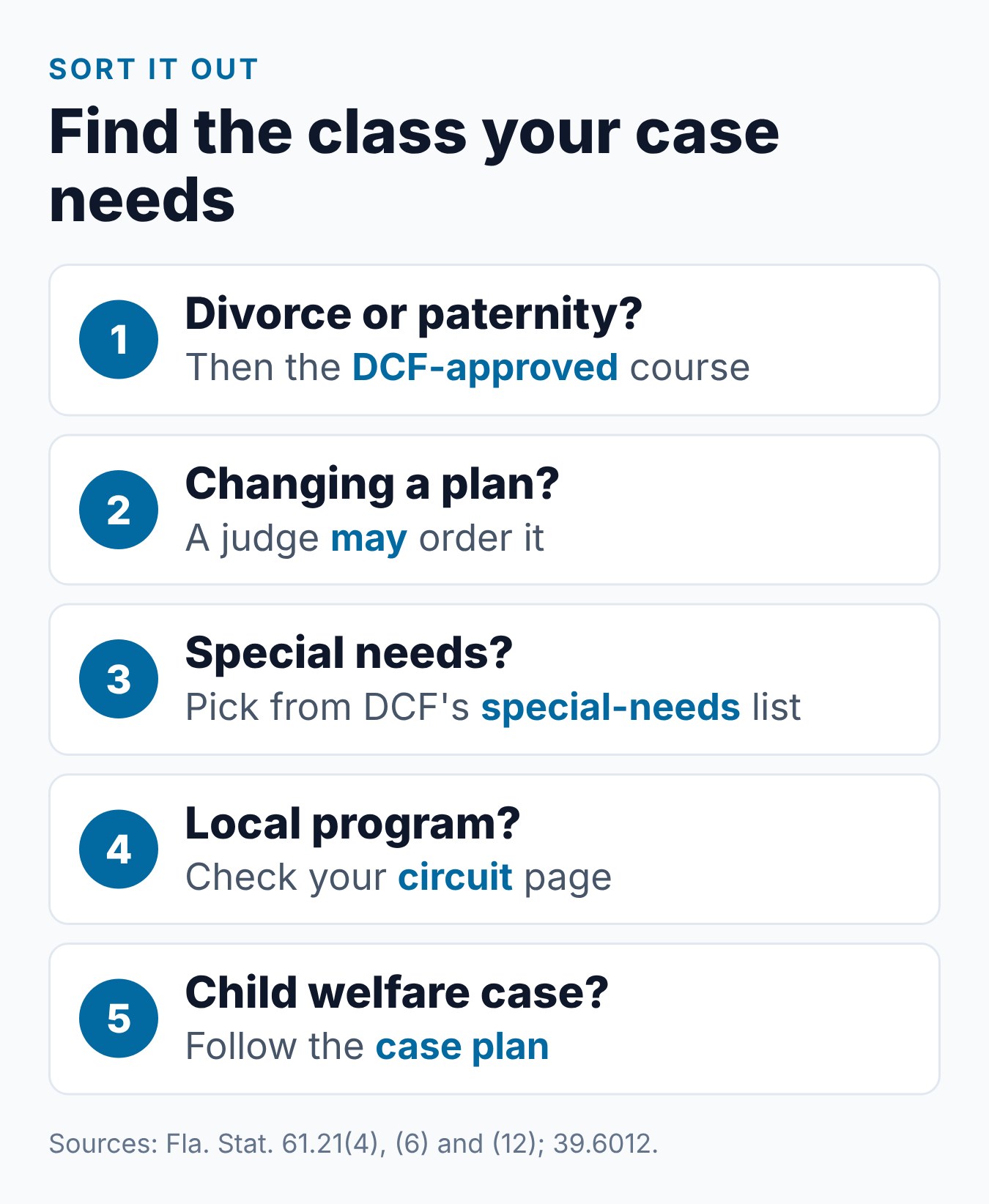
How to Tell Which One You Need
Ask these questions in order:
- Is my case a divorce with minor children, or a paternity case involving parental responsibility? If so, I need the DCF-approved course.
- Is it a modification case? The judge may order the course.
- Do my children have special needs or emotional concerns? Then I need a course from DCF’s special-needs list.
- Does my circuit add a local program?
- Do I have a child welfare case plan? Then I follow that plan as well.
Common Mistakes
Each one is based on section 61.21, a DCF rule or a court page:
- Taking any parenting class. Only a DCF-approved course meets section 61.21.
- Using an extra class instead of the course. Classes under section 61.21(12) come on top of it.
- Missing a local program. Miami-Dade adds a children’s class.
- Mixing up case plans. A dependency case plan is a separate process.
- Not filing proof. The required course needs proof in the court file before judgment.
What We Found on the Official Pages
On the official pages we checked on October 26, 2026, section 61.21 in the 2026 Florida Statutes still listed extra special-needs classes in subsection (12). DCF’s provider list said its providers “are approved by the Florida Department of Children and Families.”
Section 39.6012 described case plan tasks and services. It did not mention parenting classes or DCF approval of them.
How Requirements Can Vary
Section 61.21 of the Florida Statutes sets the course requirement for the whole state, and DCF approves the courses. Each judicial circuit can still add its own steps, such as how to file the certificate or which class formats it accepts. The Fourth Circuit (Duval, Clay and Nassau counties), for example, requires an in-person class.
Laws, court orders and local rules can change. Check your court’s instructions, your county clerk’s website and DCF’s provider list before you enroll or file.
Frequently Asked Questions
Will a voluntary parenting class satisfy my divorce court?
Only if it is a DCF-approved Parent Education and Family Stabilization Course. Check DCF’s provider list before you rely on it.
Is the court-ordered class the same in every county?
The statewide course is the same, but circuits may add steps. The Fourth Circuit, for example, requires an in-class program.
Can the judge order more than one class?
Yes. Section 61.21(12) lets the court add classes on children with special needs or emotional concerns.
Does a co-parenting class count?
Only if it is the DCF-approved course. The name of the class does not decide it; DCF approval does.
Is a dependency case plan class the same thing?
No. Case plans fall under section 39.6012, a separate process. Follow your plan and ask your attorney about it.
Do I file proof for a voluntary class?
Florida law does not require it. Proof is required for the DCF-approved course in a covered case.
Do both parents take the required course?
Yes, in a covered case. They do not have to take it together, and the court can bar a joint class if there is a history of domestic violence.
How do I know a class is DCF-approved?
Find it on DCF’s provider list and check that its expiration date has not passed. The course materials must also show DCF’s approval notice.
Conclusion
When a Florida court requires a parenting class, it means the DCF-approved Parent Education and Family Stabilization Course, plus any extra class your judge or circuit adds. Voluntary classes can add to what you learn, but they do not replace it. If you choose DivorceParentingClass.net’s online Florida parent education course, confirm first that your court accepts an online course.
Related Articles
- Parenting Classes Near Me or Online? Florida Divorce Guide
- Court Ordered Parenting Classes Online: Florida Rules
- DCF Approved Parenting Classes and the Florida Divorce Class
- Court Ordered Parenting Classes for Paternity and Custody
Sources
- Florida Statutes § 61.21 — Parenting course
- Florida Statutes § 39.6012 — Case plan tasks and services
- Fla. Admin. Code R. 65C-32.002 — Course length and delivery
- Fla. Admin. Code R. 65C-32.003 — Required course content
- Fla. Admin. Code R. 65C-32.004 — Test and certificate
- Fla. Admin. Code R. 65C-32.006 — Approval process
- Florida DCF — Approved course provider list
- Florida DCF — Courses for children with special needs or emotional concerns
- Eleventh Judicial Circuit — Divorce Education Program FAQ
- Fourth Judicial Circuit — Family Court Services FAQ
- Seventh Judicial Circuit — Order FM-2024-016-SC
- Fourth Judicial Circuit — Standing Family Law Order (PDF)
Billy Forte is the owner of DivorceParentingClass.net.
This article is general information, not legal advice. Court rules, local practice, and case facts can differ by county, judge, and case type in Florida. Use official court and state sources, and consult a qualified Florida family law attorney for legal guidance specific to your case.