
Updated October 2026 · Reviewed by Billy Forte
Parenting classes Miami families need in a divorce come in two parts: each parent takes a 4-hour course, and each child aged 6 to 17 attends a 3½-hour class for children of divorcing parents. The Eleventh Judicial Circuit, which serves Miami-Dade County, sets the children’s part on top of Florida’s statewide rule. Classes are offered in English and Spanish, and the court lists a fee waiver for low-income parents.
Key Facts
- Two classes: a 4-hour course for each parent and a 3½-hour class for each child aged 6 to 17. See the two classes.
- Which cases: divorce, paternity or a “change in custody” petition, with a child under 18. See which cases.
- Attending: parents do not have to go together, and children may not attend the parents’ course. See who may attend.
- Cost: the court FAQ lists a fee range and a waiver below federal poverty guidelines. See fees.
- If you skip it: the judge may not grant the divorce. See consequences.
What the Eleventh Circuit Requires
The court’s Divorce Education Program for Parents page puts it plainly. It says “divorcing parents must complete parenting education courses before a divorce is granted.”
The page names three sources for that rule. They are section 61.21 of the Florida Statutes, an Administrative Order of the Chief Judge, and an order of the Family Court Administrative Judge. The page does not give the order numbers.
The stated goal is simple. The classes “are designed to help parents and their children adjust with the changes that come with divorce.”
Courthouses on the Program Page
The program page lists five Miami-Dade court locations:
- Lawson E. Thomas Courthouse Center
- Richard E. Gerstein Justice Building
- Miami-Dade Children’s Courthouse
- Harvey Ruvin Justice Center, formerly the North Dade Justice Center
- South Dade Justice Center
The page does not say which location handles your case. Your case papers or the Clerk’s Office can tell you that.
Two Classes, Not One
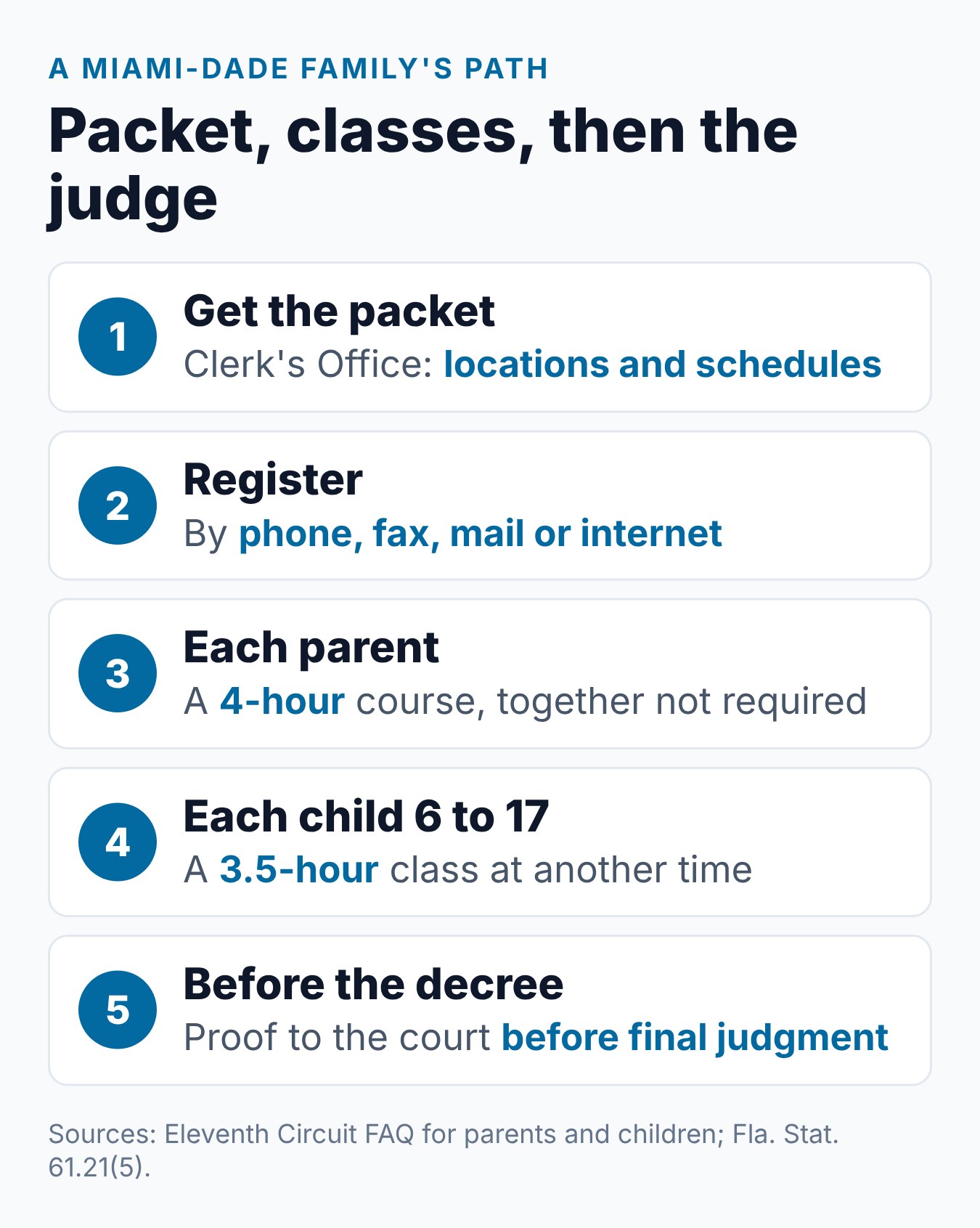
The detail sits in the court’s FAQ for parents and children. It says both you and your spouse must attend a 4-hour parenting course. It also says, “Your child must attend a 3½ hour class for children of divorcing parents,” for children aged 6 to 17.
The children’s class is a Miami-Dade rule. Florida’s statute, section 61.21, speaks only of a course for the parties.
| Parents’ course | Children’s class | |
|---|---|---|
| Who goes | Each parent | Each child aged 6 to 17 |
| Length on the FAQ | 4 hours | 3½ hours |
| Where the rule comes from | Section 61.21 and local orders | Eleventh Circuit FAQ and local orders |
| What it teaches | How divorce affects children and the parent’s lasting role | Coping with the divorce and sharing feelings with peers |
What Each Class Covers
The FAQ says parents learn how divorce affects children and how to help them adjust. It also stresses each parent’s role as a “Parent Forever.”
Children learn ways to cope with their parents’ divorce. They also get to share feelings with other children their age.
Statewide, DCF sets the parent course content. Rule 65C-32.003 lists eight required parts. Our guide to what the 4-hour course includes explains them.
Which Cases the Program Covers
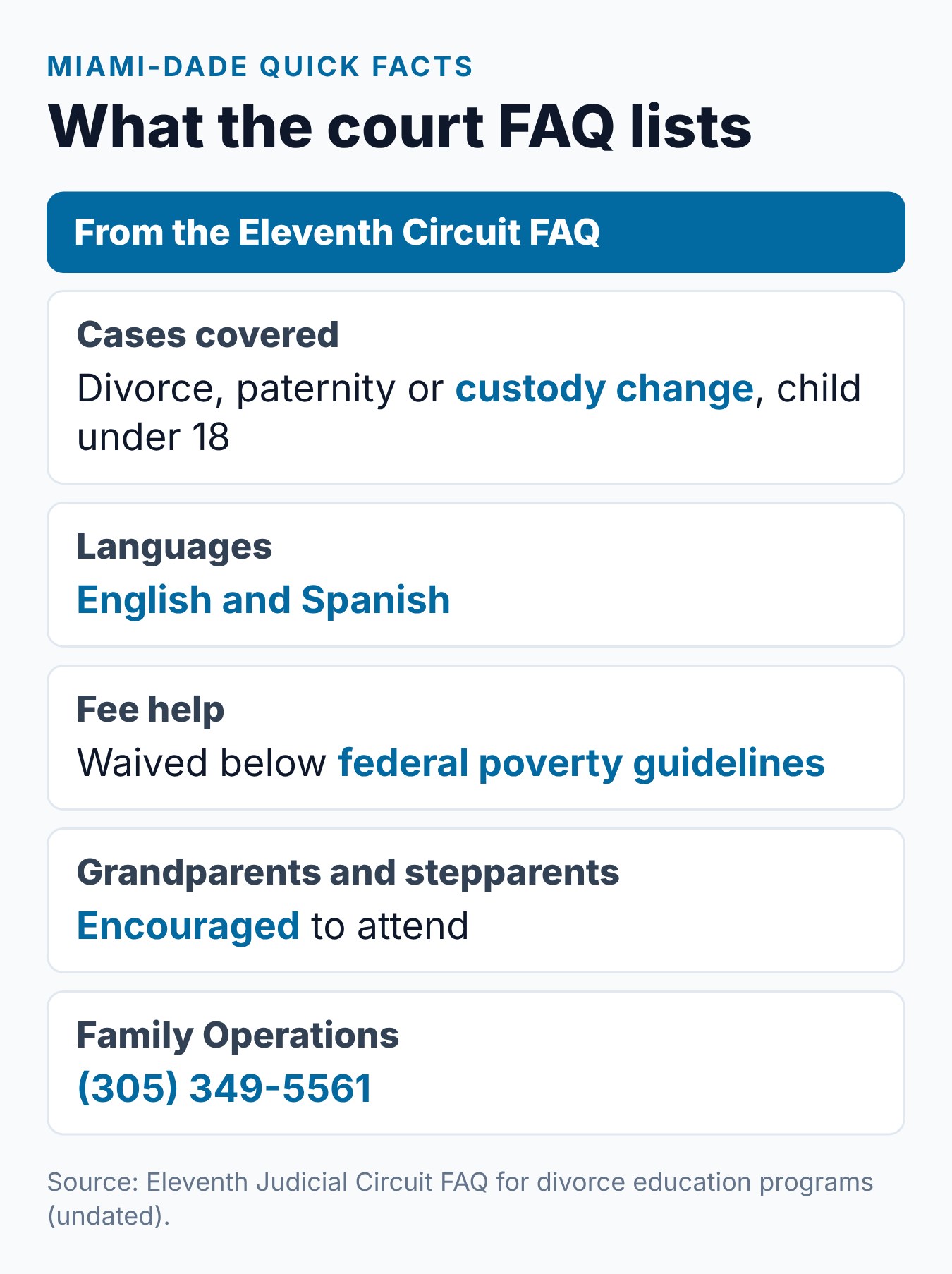
The FAQ opens with its trigger. It applies “If you have filed a petition for divorce, paternity or change in custody and have a child under the age of 18.”
That reaches a little wider than state law. Section 61.21 requires the course in a divorce with minor children and in a paternity case that involves parental responsibility.
In a case that changes a parenting plan or time-sharing schedule, state law says the court “may” require it. Miami-Dade’s FAQ lists “change in custody” petitions in its program. Florida’s statutes now use the terms time-sharing and parental responsibility for those matters.
See paternity and time-sharing cases for the statewide rules on those cases.
Who May Attend Each Class
The FAQ answers several “who can come” questions:
- Parents: “you do not have to attend the course together with your spouse.”
- Children: they may not attend the parents’ course.
- Family members: significant others, grandparents and stepparents are encouraged to attend.
- Children’s class: the parent who brings the child joins the last 30 minutes. The other parent may also attend if there is no restraining order.
The FAQ also says to schedule your own course at a different time from your child’s class.
State law adds one more point. If there is a history of domestic violence, the court can stop parents from taking the course together.
How to Sign Up for Parenting Classes Miami-Dade Lists
The FAQ says the Clerk’s Office gives you an information packet. It holds class locations, schedules and registration forms. Schedules include nights and weekends.
You can register by phone, fax, mail or internet, based on the FAQ. It also says that “three organizations have been certified by the Court to provide divorce education courses.” The page we read did not name them.
For a wider list, the FAQ sends parents to DCF’s list of approved course providers and tells them to select the 11th Circuit. DCF, the Florida Department of Children and Families, approves these courses statewide. The list has columns for languages, city, delivery method and indigent status.
Online or In Person?
The Miami-Dade pages do not say whether an online parent course counts. The FAQ mentions signing up by internet, but it does not describe class formats.
So call Family Operations before you pick an online course. The FAQ lists the Family Operations Division at (305) 349-5561.
Fees and the Fee Waiver
The FAQ says, “Parents and children’s classes range between $18.00 and $39.00 each.” The page is not dated, so these amounts may be out of date. Confirm the current fee with the class you choose.
The same answer adds, “Fees will be waived for persons whose income is below the federal poverty guidelines.” Ask about this when you register if it may apply to you.
State law allows “a reasonable fee” per parent. It also tells DCF to list at least one site in each circuit with a sliding fee scale, if available. For more, see what Florida parenting classes cost.
Language and Disability Help
The FAQ says Miami-Dade’s courses are “offered in English and Spanish.” DCF’s provider list also has a Languages column, which shows the languages each approved course offers.
Some certified courses also offer special services for people with disabilities. The FAQ says to contact the provider or to list the services you need on the application in your packet.
Parents Who Live Outside Florida
The FAQ treats out-of-state parents a little differently. A parent who lives in Florida must attend one of the approved programs in the state.
A parent outside Florida should first ask the local Clerk of Court about classes. If no approved program can be found, the FAQ says that parent may take a correspondence course by mail.
Deadlines and Proof
Miami-Dade’s pages do not list their own deadline. State law fills the gap:
- Filing parent: must finish within 45 days after the petition is filed.
- Other parent: must finish within 45 days after being served.
- Proof: each party files proof of completion with the court before the final judgment.
The pages we read do not say how to file the certificate. Ask the Clerk’s Office or Family Operations how your division wants it.
Under DCF rule 65C-32.004, a parent who finishes the course and scores at least 70 percent on the end-of-course test gets a certificate. Attempts are unlimited, and the provider may not charge more for the extra time.
The certificate must show the course name and the provider’s name and contact details. It must also show the date you began and the date you finished. Providers keep copies for five years, so ask the provider if you lose yours.
Questions for Family Operations
A short call can clear up the local steps. Questions worth asking include:
- How should I file my certificate in this division?
- How do I show that my child finished the children’s class?
- Does the court accept an online course for the parents’ part?
- How do I ask for the fee waiver?
What the Judge Can Do
The FAQ warns, “The Judge may choose not to grant the divorce or may hold a parent in contempt of court.”
State law goes further. A parent who skips the course may also be denied shared parental responsibility or time-sharing. Only the court can excuse a parent, and only for good cause.
Parents cannot agree between themselves to skip the classes. See whether the requirement can be waived.
Children With Special Needs
If a child has special needs or emotional concerns, state law says the parents must choose a course built for that. DCF keeps a separate list of special-needs courses. Ask Family Operations how that course fits with Miami-Dade’s children’s class.
What We Found on the Official Pages
On the Eleventh Circuit pages we checked on October 26, 2026, the program page cited section 61.21 and two local orders without numbers. The FAQ listed the $18 to $39 fee range and the poverty-guideline waiver.
Neither page had a date. Neither page named the three certified organizations or said how to file the certificate.
Common Mistakes to Avoid
Each point comes from the Eleventh Circuit FAQ or section 61.21:
- Forgetting the children’s class. A child aged 6 to 17 has a 3½-hour class.
- Booking both classes at once. The FAQ says to schedule them at different times.
- Bringing children to the parents’ course. Children are not allowed in it.
- Paying when a waiver may apply. Ask about the poverty-guideline waiver.
- Assuming online counts. The Miami-Dade pages do not say; ask first.
How Requirements Can Vary
Section 61.21 of the Florida Statutes sets the course requirement for the whole state, and DCF approves the courses. Each judicial circuit can still add its own steps, such as how to file the certificate or which class formats it accepts. The Fourth Circuit (Duval, Clay and Nassau counties), for example, requires an in-person class.
Laws, court orders and local rules can change. Check your court’s instructions, your county clerk’s website and DCF’s provider list before you enroll or file.
Frequently Asked Questions
Do children have to take a class in a Miami-Dade divorce?
Yes, if they are 6 to 17. The FAQ says the child “must attend a 3½ hour class for children of divorcing parents.” Children under 6 are not named.
How long is the parents’ course in Miami-Dade?
The FAQ says 4 hours. DCF’s rule 65C-32.002 sets 4 hours as the minimum, counting the end-of-course test.
Do my spouse and I take the course together?
No. The FAQ says you do not have to attend with your spouse. With a history of domestic violence, the court can bar joint attendance.
Are Miami-Dade classes offered in Spanish?
Yes. The FAQ says the courses are offered in English and Spanish.
What if I cannot afford the class?
The FAQ says fees are waived for people with income below the federal poverty guidelines. Confirm the details and current fees when you register.
Does the children’s class apply in a paternity case?
The FAQ says yes when a child is under 18. Its trigger covers a petition for divorce, paternity or change in custody, so a child aged 6 to 17 would attend in those cases too.
Who do I call with questions?
The FAQ lists the Family Operations Division at (305) 349-5561. Ask them about local steps, and ask a Florida family law attorney about your own case.
Conclusion
Miami-Dade parents should plan for both pieces: a 4-hour course for each parent and a 3½-hour class for each child aged 6 to 17. If you are weighing DivorceParentingClass.net’s online Florida parent education course for the parents’ part, first confirm with the court that it accepts an online course. The children’s class is a separate local step, so ask Family Operations how to meet it.
Related Articles
- Parenting Classes Florida by County: Court Certificate Guide
- Parenting Classes Fort Lauderdale: Broward County Guide
- How Much Are Parenting Classes in Florida? Fees Explained
- Court Ordered Parenting Classes for Paternity and Custody
Sources
- Eleventh Judicial Circuit — Divorce Education Program for Parents
- Eleventh Judicial Circuit — Divorce Education Program FAQ
- Florida Statutes § 61.21 — Parenting course
- Fla. Admin. Code R. 65C-32.002 — Course length and delivery
- Fla. Admin. Code R. 65C-32.004 — Test and certificate
- Florida DCF — Approved course provider list
- Florida DCF — Courses for children with special needs or emotional concerns
Billy Forte is the owner of DivorceParentingClass.net.
This article is general information, not legal advice. Court rules, local practice, and case facts can differ by county, judge, and case type in Florida. Use official court and state sources, and consult a qualified Florida family law attorney for legal guidance specific to your case.