
Updated October 2026 · Reviewed by Billy Forte
If you are asking how much are parenting classes in Florida, state law sets no price, and each provider may charge “a reasonable fee” to each parent under section 61.21(7). DCF must list at least one sliding-fee site in each circuit if one is available, and providers may not charge extra to retake the test. One court, Miami-Dade, lists its own class fees, so always confirm current fees with the provider.
Key Facts
- No state price: the law allows “a reasonable fee” for each parent. See what the law says.
- DCF collects fee details: providers report what they charge and their indigent options. See what DCF collects.
- No retake surcharge: extra time or help to pass costs nothing more. See what one fee covers.
- Lower-cost routes: sliding fees, scholarships and court waivers. See ways to lower the cost.
- Local notes: Miami-Dade’s court lists fees and a waiver. See local court fee notes.
- Price is not the test: DCF approval and court format decide if a course counts. See price and what counts.
What Florida Law Says About Price
The course law is section 61.21, Florida Statutes. Subsection (7) says, “A reasonable fee may be charged to each parent attending the course.”
Three points follow from that sentence:
- No set price. The law does not name a dollar amount.
- Per parent. The fee is charged to each parent who attends.
- A standard, not a number. The fee must be “reasonable,” but the law does not define that word.
Section 61.21 has no statewide fee waiver of its own. It does require a sliding-fee site in each circuit, if one is available. That is covered below.
What DCF Collects From Providers
DCF approves the course and its providers. When a provider applies, DCF rule 65C-32.005 asks for several items, including:
- “The amount charged to participants.”
- Provisions for indigent status, “such as scholarships, acceptance of court waivers, and sliding fee scales if available.”
- The languages the course is offered in.
Approval “is valid for three (3) years.” DCF rule 65C-32.006 says DCF must approve every application that meets the law and the rules. So DCF knows what providers charge, but approval does not depend on price.
What One Fee Covers by Rule
DCF rules set what every approved course includes, whatever it costs. DCF rule 65C-32.002 requires at least four hours, including instruction, exercises and the end-of-course test.
DCF rule 65C-32.004 adds a fee protection. “Providers shall not require additional fees for any additional time or instruction” needed to pass. Attempts are unlimited, and missed material is reviewed before a retake.
The same rule says each parent who finishes and scores at least 70 percent gets a certificate. No rule sets a fee for other services, such as an extra copy. Ask the provider about those.
Who Pays
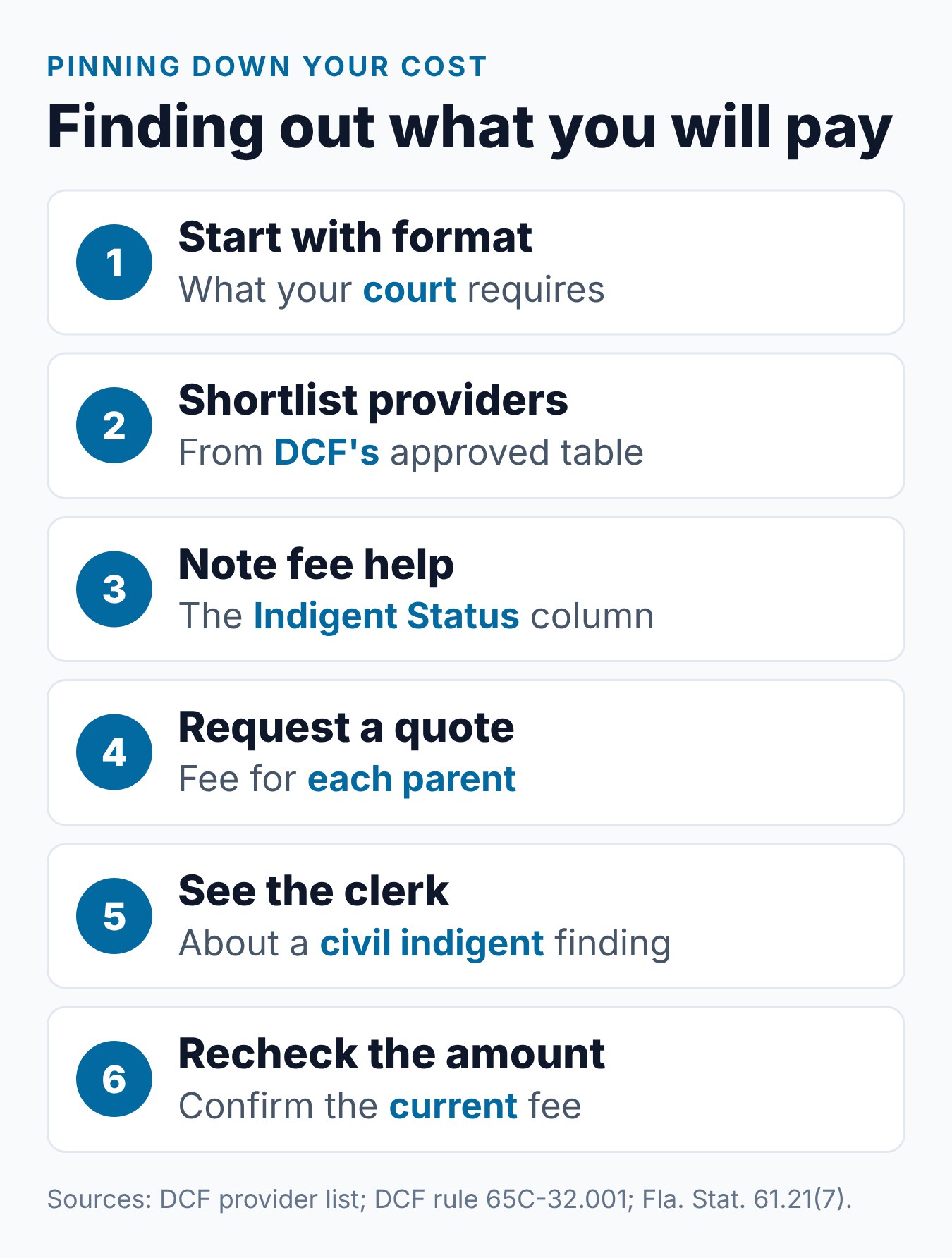
Each parent pays for his or her own course, unless an indigent option applies. The statute ties the fee to “each parent attending.”
The Broward Clerk states it directly: “The parties shall be responsible for the fees for the course.” Parents do not have to take the course together, so each parent can choose a provider and fee option.
Ways to Lower the Cost
The law and DCF rules build in four routes to a lower fee:
- Sliding-fee sites. Section 61.21(3) says DCF’s list for each circuit must include “at least one site in that circuit where the … course may be completed on a sliding fee scale, if available.”
- Scholarships. DCF’s rule names them as an indigent provision.
- Court waivers. The rule names “acceptance of court waivers” as another.
- Indigent status. DCF rule 65C-32.001 says “indigent” means “a determination of civil indigent status made by the clerk of the circuit court.”
DCF’s provider list has an Indigent Status column. Start there, then ask your clerk about the indigent determination. For a step-by-step checklist, see free parenting classes vs low-cost options.
Local Court Fee Notes
A few official court pages speak to cost. Here is what we found:
| Court | What its page says about cost | Note |
|---|---|---|
| Miami-Dade (11th Circuit) | Classes “range between $18.00 and $39.00 each”; fees waived below federal poverty guidelines | Page is undated; confirm current fees |
| Broward (17th Circuit) | “The parties shall be responsible for the fees for the course” | No amount stated |
| Seventh Circuit (Volusia and others) | Cost “should be based on each party’s ability to pay, as determined by the program provider” | No amount stated |
| Statewide (section 61.21) | “A reasonable fee may be charged to each parent” | No amount stated |
Miami-Dade in Detail
The Eleventh Judicial Circuit’s program FAQ says its classes “range between $18.00 and $39.00 each.” It adds, “Fees will be waived for persons whose income is below the federal poverty guidelines.” Classes are offered “in English and Spanish.”
These figures come from the court’s page, not from us. The page is undated, so the fees may have changed. Confirm current fees with the provider or the court before you rely on them.
Miami-Dade also requires a 3½-hour class for children aged 6 to 17, per the same FAQ. If that applies to your family, ask about its cost, too.
Seventh Circuit
The Seventh Circuit covers Flagler, Putnam, St. Johns and Volusia counties. Its Order FM-2024-016-SC ties cost to each party’s ability to pay, “as determined by the program provider.” Ask the provider how it applies that rule.
Time Is Part of the Cost
Money is not the only cost. Every approved course takes at least four hours, and online courses must block anyone from finishing sooner. Plan that time into your week.
The law also sets a window. The petitioner finishes within 45 days after filing the petition, and the other party within 45 days after service. If you need a clerk’s indigent finding first, start that early so the window does not close.
Paternity and Modification Cases
The fee rule is the same in a paternity case that involves parental responsibility. Section 61.21(7) applies to “each parent attending the course,” whatever the case type.
In a modification of a parenting plan or time-sharing schedule, the court may require the course under section 61.21(6). If it does, the same fee rules and lower-cost routes apply.
Other Costs to Plan For
The parent course may not be the only course in your case. Official sources point to a few others:
- Special-needs courses. If your children have identified special needs or emotional concerns, section 61.21(4)(a) says parents must select a course designed for that. DCF keeps a separate list.
- Added courses. Under section 61.21(12), a court may require courses about children with special needs or emotional concerns in addition to the parent course.
- Children’s class. Miami-Dade requires one for children aged 6 to 17.
- Modification cases. A court may require the course again in a later modification, under section 61.21(6).
We do not give amounts for any of these. Ask the provider or court.
Price Does Not Decide Whether It Counts
A course counts because DCF approves it and your court accepts its format, not because of its price. The Fourth Circuit (Duval, Clay and Nassau), for example, requires an in-person class from its own list, per its standing order and its Family Court Services FAQ.
The same FAQ answer also points parents to DCF’s list of local and online providers. So ask the circuit’s Family Court Services which class applies to your case.
So check approval and format before you compare fees. Our guide on what matters besides price explains the four checks.
Free Class Questions
No official source we read lists free courses. A free offer counts only if it is the DCF-approved course and your court accepts its format. See free online classes with a certificate.
You may also hear of a free “DCF class.” The divorce class is itself the DCF-approved course, and we found no separate free DCF version. See DCF parenting classes vs the divorce class.
Skipping the Course Costs More
Not taking the course is not a way to save. Under section 61.21(9), a court may hold a parent who fails to attend in contempt, deny shared parental responsibility or time-sharing, or impose other sanctions.
Only the court can excuse a party, for good cause, under section 61.21(4)(b). If cost is a barrier, ask your clerk about indigent status early.
Cost Guides in This Series
Each guide covers one cost question in depth:
- Free online classes with a certificate: when a free course can work for court.
- Free vs low-cost options: a checklist for choosing an affordable course.
- What matters besides price: why the lowest price is not the test.
- DCF classes vs the divorce class: one course, and who sets the fee.
What We Found on the Official Pages
On the DCF and court pages we checked on October 26, 2026, we found no state price for the course. DCF’s provider list showed an Indigent Status column, but its rows load by script, so we could not read each provider’s fee.
Miami-Dade’s FAQ was the only official page we found that named dollar amounts. It is undated, which is why we ask you to confirm current fees.
Common Mistakes to Avoid
Each item comes from section 61.21, a DCF rule or a court page above:
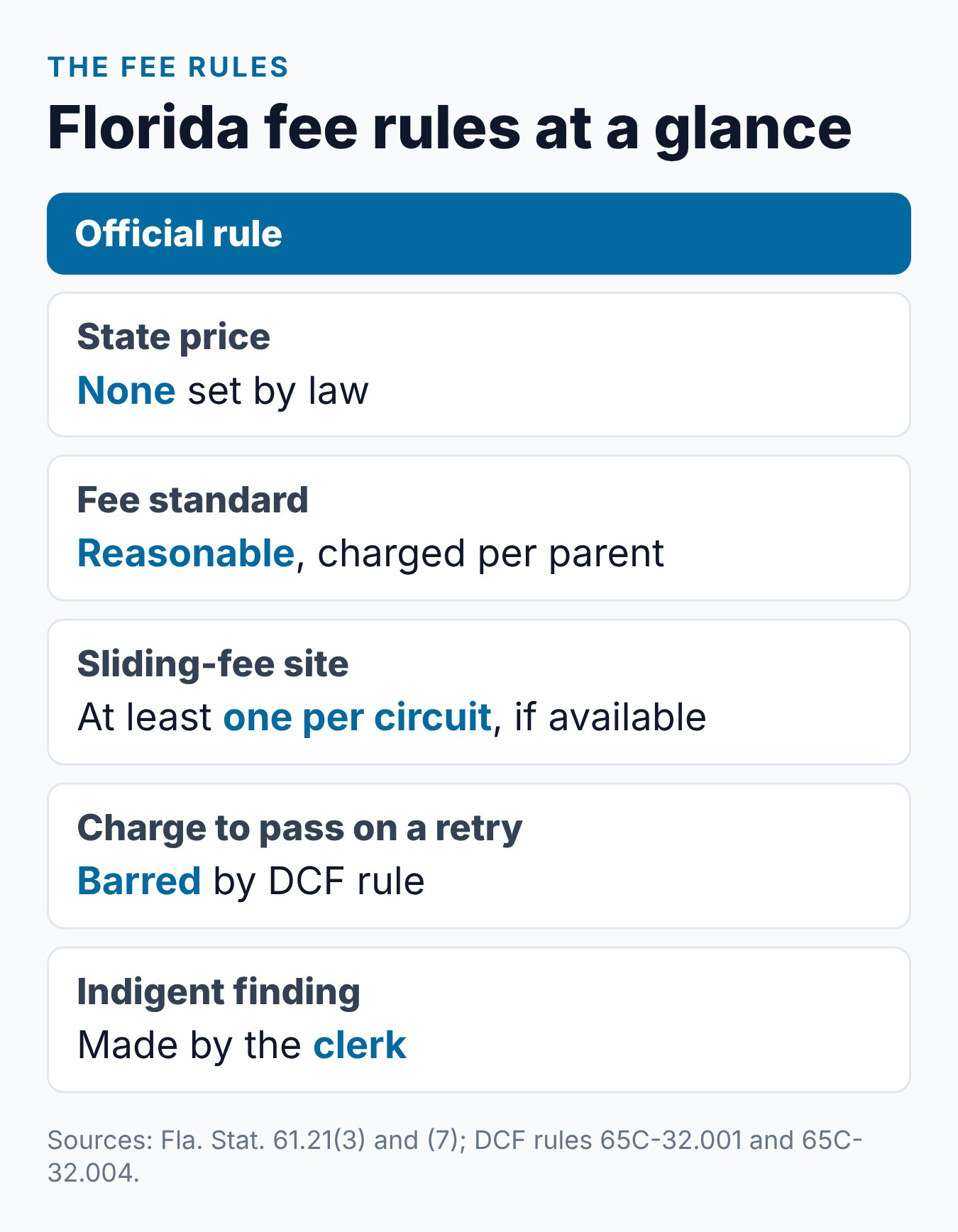
- Looking for a state price. The law sets a “reasonable fee” standard, not a number.
- Comparing fees before approval and format. A low fee does not help if the course does not count.
- Paying extra to retake. DCF rules bar extra fees for added time to pass.
- Asking the provider to decide indigent status. The clerk makes that finding.
- Relying on an old fee list. Confirm current fees with the provider.
- Skipping the course to save money. Sanctions can follow.
How Requirements Can Vary
Section 61.21 of the Florida Statutes sets the course requirement for the whole state, and DCF approves the courses. Each judicial circuit can still add its own steps, such as how to file the certificate or which class formats it accepts. The Fourth Circuit (Duval, Clay and Nassau counties), for example, requires an in-person class.
Laws, court orders and local rules can change. Check your court’s instructions, your county clerk’s website and DCF’s provider list before you enroll or file.
Frequently Asked Questions
How much are parenting classes in Florida?
Florida sets no price. Providers may charge a reasonable fee to each parent, and some offer sliding fees, scholarships or court waivers. Confirm current fees with the provider.
Does the state set the fee?
No. Section 61.21(7) allows a reasonable fee. DCF asks providers what they charge but does not set the amount.
Do both parents pay?
The statute allows a fee for each parent attending. Each parent can ask about lower-cost options.
Can I get the course for less if I cannot afford it?
Possibly. Ask your clerk about a civil indigent determination, then ask providers about sliding fees, scholarships and court waivers.
Does it cost more if I fail the test?
No. DCF rule 65C-32.004 bars extra fees for added time or instruction needed to pass, and attempts are unlimited.
What does Miami-Dade charge?
Its court FAQ says classes “range between $18.00 and $39.00 each,” with fees waived below federal poverty guidelines. The page is undated, so confirm current fees.
Are there free parenting classes in Florida?
No official source we read lists free courses. Fees can drop through sliding-fee sites, scholarships or court waivers, and Miami-Dade’s FAQ describes a waiver below federal poverty guidelines.
Is a more expensive course more likely to be accepted?
No official source says so. DCF approval and your court’s format rules decide whether a course counts.
Conclusion
So how much are parenting classes in Florida? There is no state price, only a reasonable fee per parent, with sliding fees and indigent help built into the rules.
To compare one option, see DivorceParentingClass.net’s online Florida parent education course. Confirm current fees with any provider, and confirm that your court accepts an online course.
Related Articles
- Free Online Parenting Classes With Certificate for Court?
- Free Parenting Classes vs. Low Cost Options in Florida
- Court Approved Parenting Classes Florida: Is Cheapest Safe?
- DCF Parenting Classes vs. the Court-Ordered Divorce Class
Sources
- Florida Statutes § 61.21 — Parenting course
- Fla. Admin. Code R. 65C-32.001 — Definitions
- Fla. Admin. Code R. 65C-32.002 — Course length and delivery
- Fla. Admin. Code R. 65C-32.004 — Test and certificate
- Fla. Admin. Code R. 65C-32.005 — Provider approval
- Fla. Admin. Code R. 65C-32.006 — Approval process
- Florida DCF — Parent Education and Family Stabilization Course
- Florida DCF — Approved course provider list
- Florida DCF — Courses for children with special needs or emotional concerns
- Eleventh Judicial Circuit — Divorce Education Program for Parents
- Eleventh Judicial Circuit — Divorce Education Program FAQ
- Broward County Clerk of Courts — Family
- Seventh Judicial Circuit — Order FM-2024-016-SC
- Fourth Judicial Circuit — Family Court Services FAQ
- Fourth Judicial Circuit — Standing Family Law Order (PDF)
Billy Forte is the owner of DivorceParentingClass.net.
This article is general information, not legal advice. Court rules, local practice, and case facts can differ by county, judge, and case type in Florida. Use official court and state sources, and consult a qualified Florida family law attorney for legal guidance specific to your case.