
Updated October 2026 · Reviewed by Billy Forte
If you are looking for free DCF parenting classes to replace the court-ordered divorce class, the key fact is that the divorce class is itself the DCF-approved Parent Education and Family Stabilization Course. We found no separate free DCF class that replaces it: providers set the fees, Florida requires a sliding-fee site in each circuit if one is available, and providers report their options for low-income parents to DCF. Parents in child-welfare cases follow a case plan under section 39.6012, which is a separate process.
Key Facts
- One course: the court-ordered divorce class is the DCF-approved course. See one course, not two.
- DCF’s role: it approves providers, instructors and curriculum, but does not set a price. See what DCF does.
- Fees: providers may charge “a reasonable fee” to each parent. See who sets the fee.
- Help with cost: sliding-fee sites, scholarships and court waivers. See reduced-fee routes.
- Child welfare is separate: case plans follow section 39.6012. See case plans.
One Course, Not Two
The phrase “DCF parenting class” and the phrase “court-ordered divorce class” point to the same course. Section 61.21(2), Florida Statutes says the Department of Children and Families (DCF) approves the Parent Education and Family Stabilization Course.
The court orders it. DCF approves it. That is why both names fit the same class.
DCF’s course page says the courses are “designed to educate, train, and assist divorcing parents.” It also says the courses are “a minimum of 4 hours.”
Is There a Free DCF Class That Replaces It?
We found none. On the official pages we read, DCF approves providers but does not list a free DCF-run version of the divorce course.
So a “free DCF class” is not a shortcut around the requirement. The requirement is the DCF-approved course itself. Lower cost comes from the fee options built into that system, which the sections below explain.
Who Must Take the DCF-Approved Course
Section 61.21(4)(a) requires the course of all parties to a divorce with minor children. It also covers parties to a paternity case that involves parental responsibility.
In a modification of a parenting plan or time-sharing schedule, the court may require it. Divorces without minor children are not covered by this section.
What Every Approved Course Covers
DCF rule 65C-32.003 sets eight required parts, from divorce as a loss to parenting time and parenting plans. Every approved course also covers domestic violence and child abuse, including the hotlines. Our guide to what the course covers explains each part.
What DCF Does for This Course
DCF has a clear role, and it is not the role of a course seller. Here is what the official sources say DCF does and does not do:
| DCF does | DCF does not |
|---|---|
| Approve providers, instructors and course curriculum | Set a state price for the course |
| Give each circuit a list of approved providers and sites | Decide civil indigent status (the clerk does) |
| Require a sliding-fee site on each circuit list, if available | Decide whether your court accepts a format |
| Keep a separate list of special-needs courses | Decide your court case |
| Take complaints about providers | Issue your certificate (the provider does) |
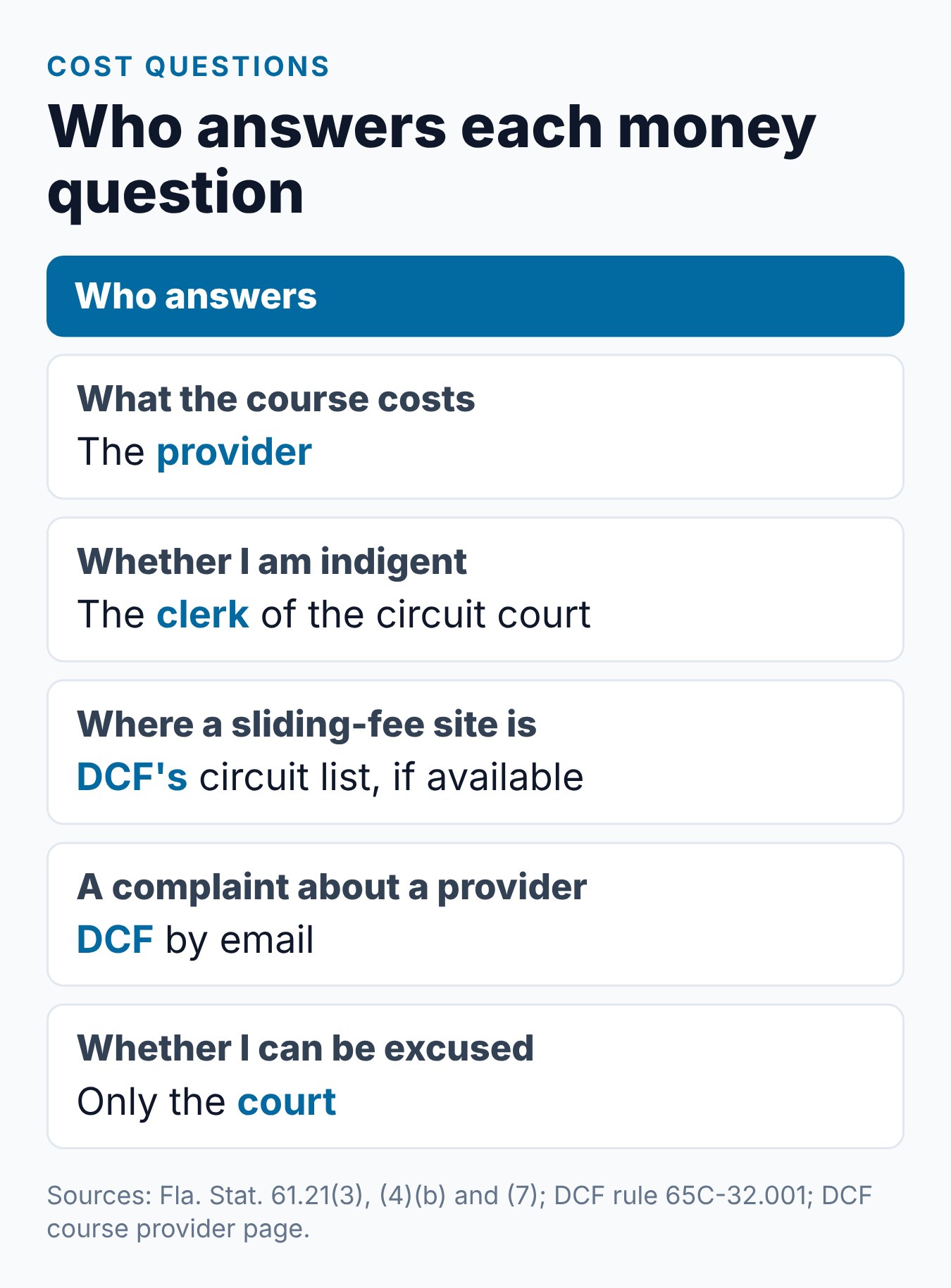
DCF’s course provider page says DCF is “responsible for approving providers, instructors, and course curriculum.” It lists Parentstabilizationcourse@myflfamilies.com for complaints.
Who Sets the Fee
Providers set their own fees. Section 61.21(7) says, “A reasonable fee may be charged to each parent attending the course.”
DCF collects fee details but does not fix them. Under rule 65C-32.005, each applicant tells DCF “the amount charged to participants.” It also describes its provisions for parents with indigent status.
And under rule 65C-32.006, DCF must approve every application that meets the law and rules. Approval is about the course, not the price.
Some courts speak to fees, too. The Broward Clerk says, “The parties shall be responsible for the fees for the course.” The Seventh Circuit’s Order FM-2024-016-SC says cost “should be based on each party’s ability to pay, as determined by the program provider.”
Reduced-Fee Routes
The system has three routes to a lower fee. Each one comes from the statute or a DCF rule:
- Sliding-fee site. Section 61.21(3) says each circuit’s list must include “at least one site in that circuit where the … course may be completed on a sliding fee scale, if available.”
- Indigent provisions. Rule 65C-32.005 names “scholarships, acceptance of court waivers, and sliding fee scales if available” as examples.
- Indigent status. DCF rule 65C-32.001 defines “indigent” as a civil indigent determination “made by the clerk of the circuit court.”
To use these routes, start with DCF’s provider list. It has an Indigent Status column. Then ask your clerk about the indigent determination, and ask providers what they offer.
Online, Mail and In-Person Versions
The DCF-approved course comes in more than one format. Section 61.21(3) requires DCF to approve at least one statewide internet course and one correspondence course.
But a format DCF approves is not always one your court accepts. The Fourth Circuit (Duval, Clay and Nassau) requires an in-person class from a local list. So before you weigh any fee, check your court’s instructions on format.
Deadlines Keep Running
Looking for a free version does not pause the clock. Under section 61.21(5), the petitioner finishes within 45 days after filing the petition, and the other party within 45 days after service. Each party then files proof before the final judgment.
A parent who fails to attend can face contempt, denial of shared parental responsibility or time-sharing, or other sanctions under section 61.21(9). If cost is a barrier, raise it with the clerk early.
Child-Welfare Case Plans Are Separate
A child-welfare (dependency) case runs under chapter 39, not section 61.21. In those cases, section 39.6012, Florida Statutes sets out the case plan.
The case plan lists “the tasks with which the parent must comply and the services to be provided to the parent.” It names who is accountable for each service. Services may be provided by “the department or its agent.”
That section does not mention parenting classes or DCF approval of them. So we do not claim that any class in a case plan can replace the divorce course, or the other way around. If you are in a dependency case, follow your case plan and ask your caseworker or lawyer.
The Divorce Course Is Education, Not a Service Plan
The divorce course has a narrow purpose. Section 61.21(2) says it “shall be educational in nature” and “shall not be designed to provide individual mental health therapy.” Providers may not give individual legal advice.
A case plan works differently. It lists tasks and services for a parent in a child-welfare case. The two serve different goals under different laws.
Why the Two Get Confused
Both involve DCF. In a divorce, DCF approves the course. In a dependency case, DCF or its agent may provide services under a case plan.
The overlap in names is easy to see. But the laws, the purposes and the paperwork are different. Our guide on DCF-approved parenting classes and the divorce class covers that difference in depth.
Can Any Other Class Replace the Divorce Course?
The statute names the DCF-approved course. It does not name a substitute.
Only the court can excuse a party from the course, or from its deadline, for good cause. That is section 61.21(4)(b). Parents cannot agree to skip it.
The statute also lets a court add courses. Under section 61.21(12), a court may require a parent to attend courses about children with special needs or emotional concerns “in addition to” the divorce course.
Special Needs Courses Are Also DCF-Approved
If your children have identified special needs or emotional concerns, section 61.21(4)(a) says parents must select a course designed for that. DCF keeps a separate list of those courses.
That list is part of the same DCF-approved system. It is not a free alternative. Ask the providers on it about fees and indigent options.
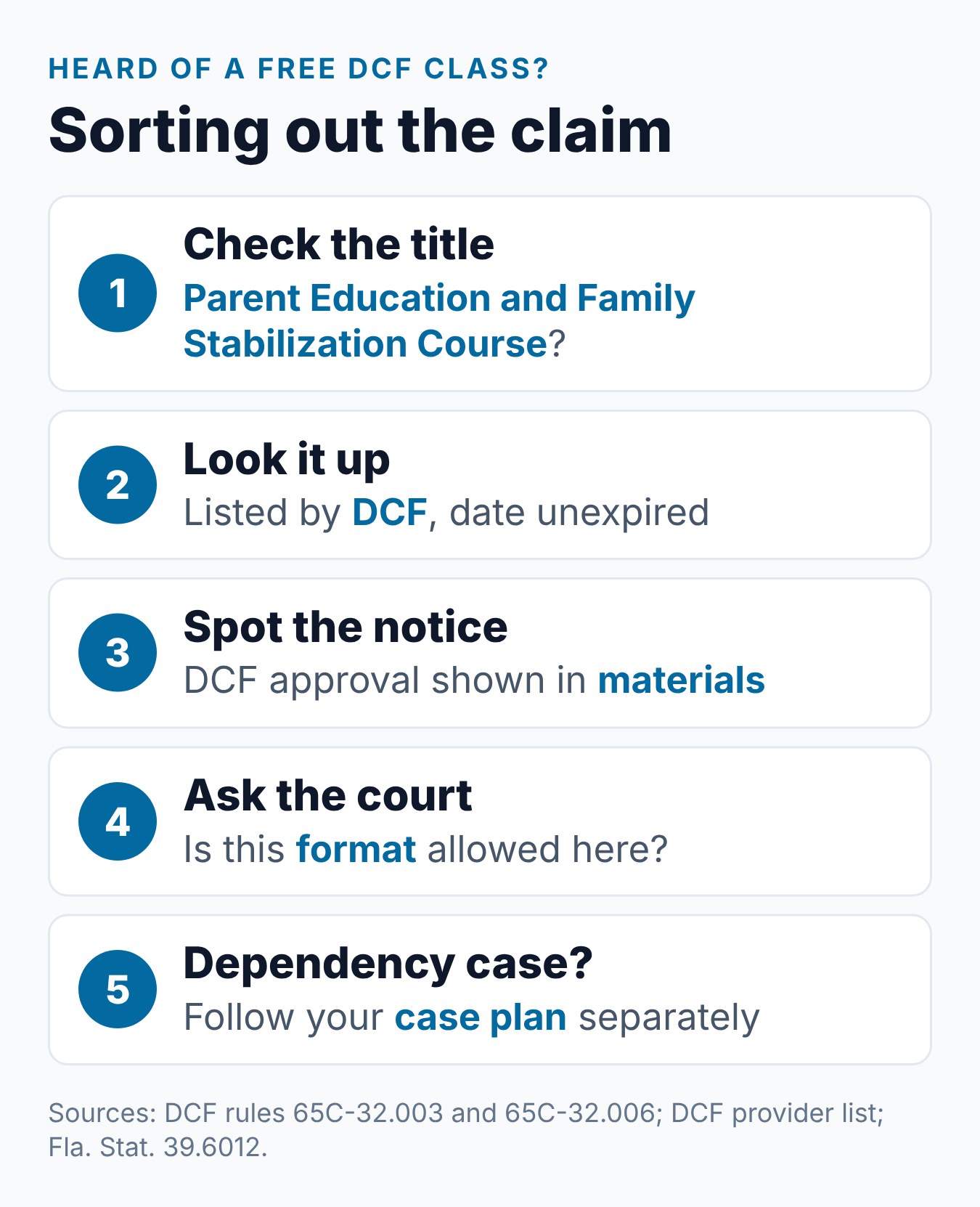
How to Check a “Free DCF Class” Claim
If you see an offer for a free DCF class, run these checks:
- Is it called the Parent Education and Family Stabilization Course?
- Is the provider on DCF’s provider list, with a current Exp. Date?
- Do course materials show DCF’s approval notice, as rule 65C-32.006 requires?
- Does your court accept its format?
If the answer to any of these is no, ask your court before you rely on it.
Where This Fits
This page answers one question about DCF and free classes. For Florida’s full fee rules, including local court fee notes, see our guide on how much parenting classes cost. For free online offers, see whether a court accepts a free class.
What We Found on the Official Pages
On the DCF pages we checked on October 26, 2026, the course page and provider list described DCF-approved providers. We found no page listing a free DCF-run divorce course.
We also found no official list of “DCF approved parenting classes” for dependency cases. The case plan statute speaks of services, not of a DCF class list.
Common Mistakes to Avoid
Each item comes from section 61.21, section 39.6012 or a DCF rule above:
- Thinking the divorce class and a DCF class differ. In a divorce, they are the same course.
- Waiting for a free DCF version. We found no official source for one.
- Asking DCF to set your fee. Providers set fees; DCF approves the course, not the price.
- Asking a provider to declare you indigent. The clerk makes that finding.
- Using a case-plan class for the divorce rule. No official source says it counts.
- Treating parent agreement as an excuse. Only the court can excuse the course.
How Requirements Can Vary
Section 61.21 of the Florida Statutes sets the course requirement for the whole state, and DCF approves the courses. Each judicial circuit can still add its own steps, such as how to file the certificate or which class formats it accepts. The Fourth Circuit (Duval, Clay and Nassau counties), for example, requires an in-person class.
Laws, court orders and local rules can change. Check your court’s instructions, your county clerk’s website and DCF’s provider list before you enroll or file.
Frequently Asked Questions
Can a free DCF class replace the court-ordered divorce class?
We found no separate free DCF class that does. The court-ordered divorce class is the DCF-approved Parent Education and Family Stabilization Course.
Are DCF parenting classes free?
No official source says so. Providers may charge a reasonable fee, and options like sliding fees, scholarships and court waivers can lower the cost.
Does DCF teach the divorce course?
The official pages we read describe DCF as the approver of providers, instructors and curriculum. Approved providers teach the course.
How do I get a lower fee?
Ask your clerk about a civil indigent determination. Then check DCF’s provider list and ask providers about sliding fees, scholarships and court waivers.
Is a dependency case plan class the same as the divorce course?
No official source says so. Case plans fall under section 39.6012, which does not mention the divorce course.
Where is DCF’s list of approved providers?
On DCF’s provider list page. It shows each provider’s course name, languages, phone, website, city, indigent status, delivery method and the date the approval expires.
Who do I contact about a provider problem?
DCF’s course provider page lists Parentstabilizationcourse@myflfamilies.com for complaints.
Do both parents have to take the course?
In a divorce with minor children, yes. Section 61.21(4)(a) applies to all parties, and each parent may be charged a fee.
Conclusion
DCF parenting classes and the court-ordered divorce class are the same DCF-approved course, and we found no free DCF version that replaces it. Ask your clerk and providers about indigent options and sliding fees.
To compare one option, see DivorceParentingClass.net’s online Florida parent education course. Before you enroll, confirm that your court accepts an online course.
Related Articles
- How Much Are Parenting Classes in Florida? Fees Explained
- Free Online Parenting Classes With Certificate for Court?
- Free Parenting Classes vs. Low Cost Options in Florida
- DCF Approved Parenting Classes and the Florida Divorce Class
Sources
- Florida Statutes § 61.21 — Parenting course
- Florida Statutes § 39.6012 — Case plan tasks and services
- Fla. Admin. Code R. 65C-32.001 — Definitions
- Fla. Admin. Code R. 65C-32.003 — Required course content
- Fla. Admin. Code R. 65C-32.005 — Provider approval
- Fla. Admin. Code R. 65C-32.006 — Approval process
- Florida DCF — Parent Education and Family Stabilization Course
- Florida DCF — Approved course provider list
- Florida DCF — Course provider process
- Florida DCF — Courses for children with special needs or emotional concerns
- Broward County Clerk of Courts — Family
- Seventh Judicial Circuit — Order FM-2024-016-SC
Billy Forte is the owner of DivorceParentingClass.net.
This article is general information, not legal advice. Court rules, local practice, and case facts can differ by county, judge, and case type in Florida. Use official court and state sources, and consult a qualified Florida family law attorney for legal guidance specific to your case.