
Updated October 2026 · Reviewed by Billy Forte
If you are searching for free parenting classes in Florida, the safe way to choose an affordable class is to check four things first: current DCF approval, a format your court accepts, any sliding-fee or indigent option, and the rule that bars extra fees to retake the test. Florida sets no price, so each provider sets its own fee under a “reasonable fee” standard. The checklist below comes from Florida law and DCF rules, not from any provider.
Key Facts
- No state price: the law allows “a reasonable fee” for each parent. See what the rules say.
- Approval first: an affordable course still has to be on DCF’s list with a current date. See step 1.
- Help with cost: sliding fees, scholarships and court waivers are named in DCF’s rule. See step 4.
- No retake surcharge: providers may not charge more for extra time to pass. See step 5.
- Fair comparisons: some things must match across all courses, and some can differ. See comparing courses.
Free vs Low-Cost: What the Rules Say
Florida law does not list free courses, and it does not set a price. Section 61.21(7), Florida Statutes says, “A reasonable fee may be charged to each parent attending the course.”
The law and DCF rules do build in ways to lower cost:
- Sliding-fee sites. Each circuit’s list must include at least one sliding-fee site, “if available” (section 61.21(3)).
- Indigent provisions. Under DCF rule 65C-32.005, providers describe options “such as scholarships, acceptance of court waivers, and sliding fee scales if available.”
- No retake fees. DCF rule 65C-32.004 bars extra fees for added time or instruction to pass.
So “free” is one possible outcome of those options. It is not a separate kind of course.
Your Affordable-Course Checklist
Use these six steps in order. Each one comes from an official source:
| Step | What to check | Official source |
|---|---|---|
| 1 | Provider is on DCF’s list with a current Exp. Date | DCF provider list; rule 65C-32.005 |
| 2 | Your court accepts the format | Your circuit’s order or FAQ |
| 3 | A special-needs course, if your family needs one | Section 61.21(4)(a); DCF special-needs list |
| 4 | Sliding fee, scholarship or court waiver | Section 61.21(3); rule 65C-32.005 |
| 5 | Fee per parent, and no charge to retake | Section 61.21(7); rule 65C-32.004 |
| 6 | Four-hour minimum, ID check, instructor contact | Rule 65C-32.002 |
Step 1: Confirm DCF Approval and the Date
Open DCF’s provider list. It says the providers listed “are approved by the Florida Department of Children and Families.”
Find the provider, then look at the Exp. Date column. DCF approvals are valid for three years, and DCF’s provider page says they “must be renewed.” A low price does not help if the approval has lapsed.
Step 2: Confirm Your Court’s Format
A low-cost online course only helps if your court accepts online courses. Florida law requires DCF to approve at least one statewide internet course, but not every court accepts them.
The Fourth Circuit (Duval, Clay and Nassau) is one example. The circuit’s standing family law order calls for “a similar qualified inperson program.” Its Family Court Services FAQ says parents “MUST REGISTER FOR ONE OF THE FOLLOWING IN-CLASS PARENTING CLASSES.” Check your own court’s instructions before you compare prices.
The same FAQ answer also points parents to DCF’s list of local and online providers. So ask the circuit’s Family Court Services which class applies to your case.
Step 3: Check the Special-Needs Rule
If your children have identified special needs or emotional concerns, section 61.21(4)(a) says parents must select a course designed for that. DCF keeps a separate list of those courses.
If this applies to you, compare costs only among the courses on that list. A cheaper general course would not meet the rule for your family.
Step 4: Ask About Sliding Fees and Indigent Help
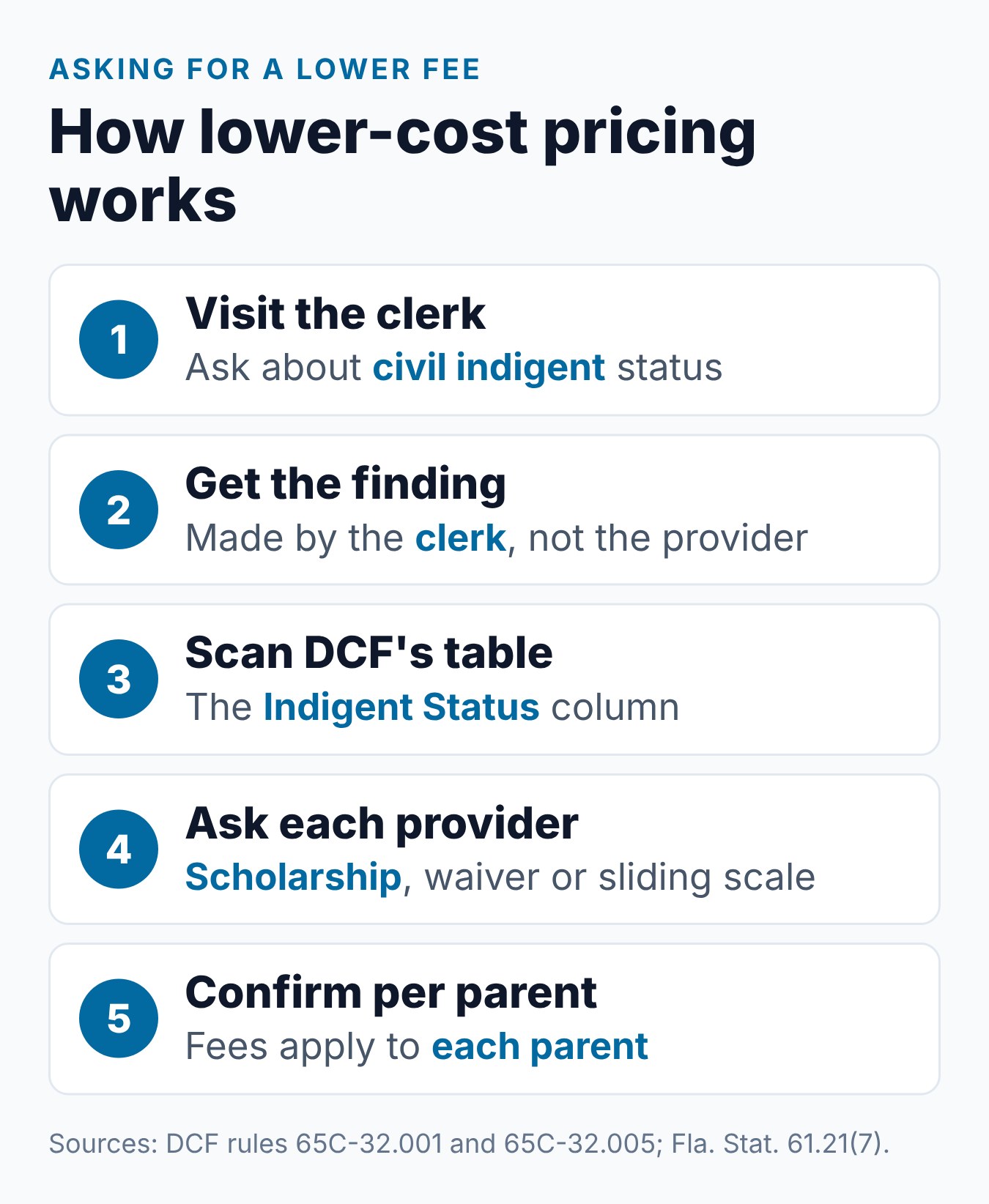
DCF’s provider list has an Indigent Status column. Start there to see which providers report options for parents who cannot pay full price.
Then ask the provider directly:
- Do you offer a sliding fee scale?
- Do you offer scholarships?
- Do you accept a court waiver?
Indigent status is not something a provider decides. DCF rule 65C-32.001 defines “indigent” as “a determination of civil indigent status made by the clerk of the circuit court.” Ask your clerk how to apply.
Step 5: Ask What the Fee Covers
The statute allows a fee “to each parent attending.” So two parents may each pay a fee, unless an indigent option applies.
Ask the provider what the fee includes. Then remember one firm rule: “Providers shall not require additional fees for any additional time or instruction” needed to pass the test. Attempts are unlimited, and missed material is reviewed before a retake.
No rule sets a fee for other services, such as an extra copy of a certificate. Ask about those up front if they matter to you.
Step 6: Read the Course Rules Before You Pay
Every approved course follows DCF rule 65C-32.002, whatever it costs:
- At least four hours, including instruction, exercises and the end-of-course test.
- Online courses must stop anyone from finishing in under four hours.
- A way to verify identity of participants.
- For online and mail courses, instructor answers to content questions within one business day.
A course that skips these does not follow the DCF rules. Treat that as a reason to look elsewhere.
Comparing Two Affordable Courses
When you compare courses, some things must be the same by rule. Other things can differ.
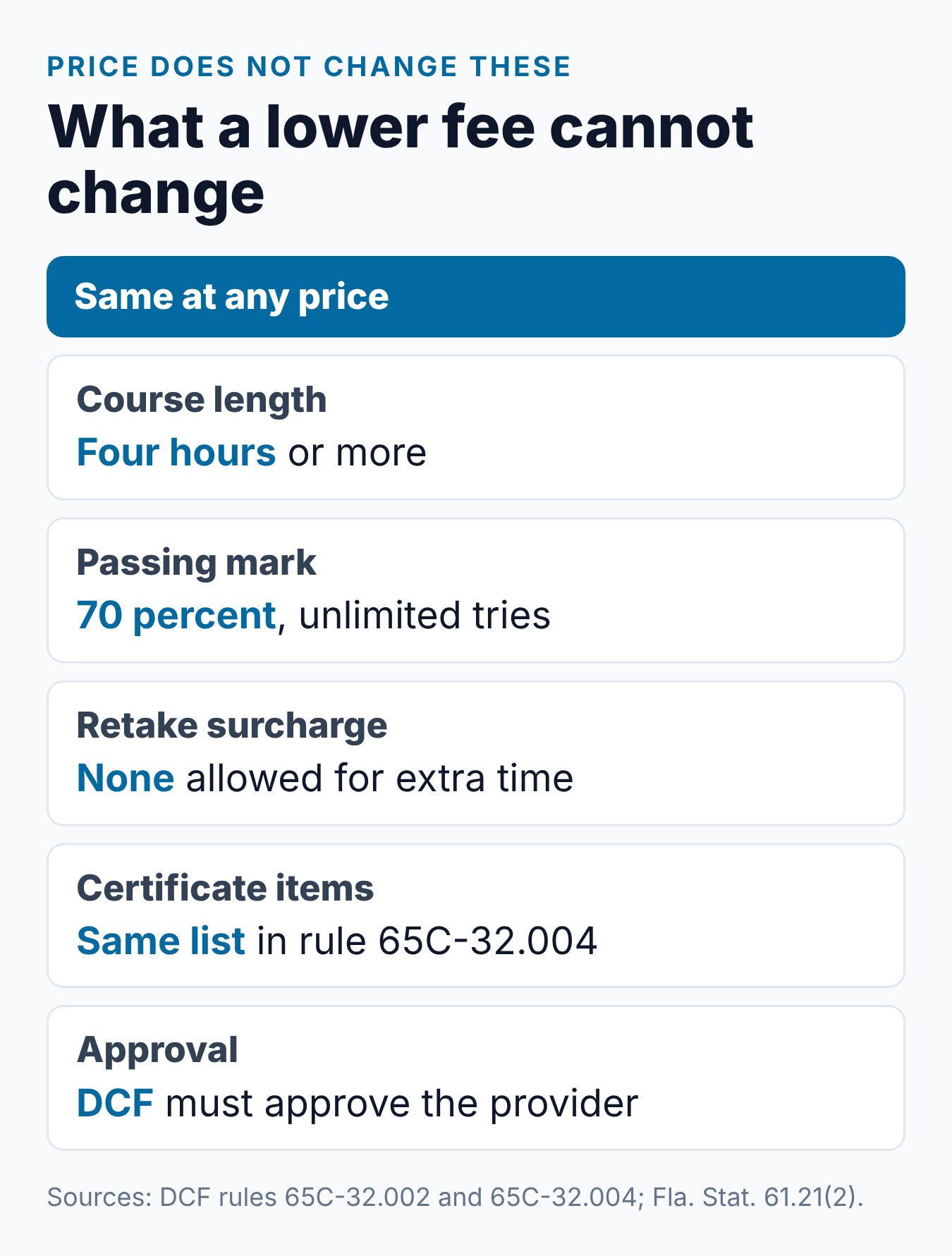
The same at every approved course:
- The four-hour minimum.
- The 70 percent passing mark and unlimited attempts.
- The certificate items: course name, provider name and contact information, curriculum name if any, and start and finish dates.
Can differ between courses:
- The fee and any indigent options.
- The languages offered, which DCF’s list shows in a Languages column.
- The delivery method, such as in person, online or by mail.
So the real choice is about cost, language and format. The core course rules do not change with price.
Planning Around Your Deadline
Shopping for a lower price takes time, and the law sets a clock. Under section 61.21(5), the petitioner finishes within 45 days after filing, and the other party within 45 days after service. Each party should “begin the course as expeditiously as possible.”
So set a short window for comparing options. If a lower-cost route needs a clerk’s finding, start that request early. Missing the deadline can lead to sanctions under section 61.21(9), including contempt.
If No Option Fits Your Budget
Start with the clerk. Ask how to apply for a civil indigent determination, since that is how DCF’s rule defines “indigent.”
Next, ask providers on DCF’s list whether they accept a court waiver or offer a scholarship. If you still cannot find an option, tell the court before your deadline passes.
Only the court can excuse a party from the course, or from its deadline, for good cause. That is section 61.21(4)(b). We cannot say whether cost counts as good cause in your case, so ask the court or a Florida family law attorney.
Keep Your Receipt and Certificate
Once you pay and finish, keep your receipt and your certificate together. Each party files proof with the court before the final judgment.
Providers must keep copies of all certificates for five years. For the full proof process, see our certificate guide.
Language Options
DCF’s provider list includes a Languages column. If you need a course in a language other than English, check that column first.
Some courts note this, too. Miami-Dade’s court FAQ says its classes are offered “in English and Spanish.”
Courses by Mail
Online is not the only distance option. Section 61.21(3) requires DCF to approve at least one statewide course by correspondence. DCF rule 65C-32.001 defines “distance learning” as instruction “through correspondence or via the Internet.”
A mail course follows the same rules as any other approved course. You can contact the instructor, and content questions get an answer within one business day. If you lack reliable internet, ask providers on DCF’s list about this format, and check that your court accepts it.
Why “Free” Searches Can Mislead
A search for free parenting classes can turn up general classes that are not the state course. Section 61.21 requires the Parent Education and Family Stabilization Course approved by DCF.
A general class may be useful on its own terms. But it is not the course the statute names.
If a free class is not on DCF’s list, ask your court before you rely on it. Our guide to free online classes with a certificate covers acceptance in more depth.
Where This Fits
This page is a checklist for choosing an affordable course. For the full picture of Florida’s fee rules, see our guide on how much parenting classes cost.
If you are weighing the cheapest course you can find, see what matters besides price. That guide explains why price does not decide whether a course counts.
What We Found on the Official Pages
On the DCF pages we checked on October 26, 2026, the provider list showed Languages, Indigent Status, Delivery Method and Exp. Date columns. The rows load by script, so we could not read each provider’s details or prices.
We found no official list of free courses and no state price. The rules we found set a “reasonable fee” standard. They require each provider to describe a way for low-income parents to complete the course, and each circuit’s list to include a sliding-fee site if one is available.
Common Mistakes to Avoid
Each item comes from section 61.21 or a DCF rule above:
- Comparing prices before approval. Check DCF’s list and the Exp. Date first.
- Ignoring the format. The Fourth Circuit requires an in-person class.
- Missing the special-needs rule. Some families must use DCF’s separate list.
- Expecting the provider to decide indigent status. The clerk makes that finding.
- Paying extra to retake. The rule bars extra fees for added time to pass.
- Choosing a general class. The statute names the DCF-approved course.
How Requirements Can Vary
Section 61.21 of the Florida Statutes sets the course requirement for the whole state, and DCF approves the courses. Each judicial circuit can still add its own steps, such as how to file the certificate or which class formats it accepts. The Fourth Circuit (Duval, Clay and Nassau counties), for example, requires an in-person class.
Laws, court orders and local rules can change. Check your court’s instructions, your county clerk’s website and DCF’s provider list before you enroll or file.
Frequently Asked Questions
Are there free parenting classes for divorce in Florida?
No official source lists free courses. Lower cost can come from sliding fees, scholarships or court waivers, which DCF’s rule names as indigent options.
How do I find a low-cost DCF-approved course?
Use DCF’s provider list. Check the Indigent Status column, then ask providers about sliding fees and scholarships.
Who decides if I qualify for a lower fee?
The clerk of the circuit court decides civil indigent status. Then ask the provider how it applies that finding.
Does a cheaper course have fewer hours?
No. Every DCF-approved course is at least four hours, including the end-of-course test.
Can I be charged to retake the test?
No. DCF rule 65C-32.004 says providers may not require extra fees for added time or instruction needed to pass.
Do both parents pay?
The statute allows a fee for each parent attending. Each parent can ask about indigent options on his or her own.
Does DCF set the price?
No. DCF approves providers and asks them to report what they charge. Section 61.21(7) allows each provider a reasonable fee.
Is a low-cost online course accepted everywhere?
No. The Fourth Circuit requires an in-person class from its list. Check your court’s instructions first.
Conclusion
Free parenting classes are not a separate kind of course, so judge any low-cost option by DCF approval, court format and the fee rules. Ask about sliding fees and indigent help, and remember that retakes carry no extra fee.
To compare, see DivorceParentingClass.net’s online Florida parent education course. Before you enroll, confirm that your court accepts an online course.
Related Articles
- How Much Are Parenting Classes in Florida? Fees Explained
- Free Online Parenting Classes With Certificate for Court?
- Court Approved Parenting Classes Florida: Is Cheapest Safe?
- DCF Parenting Classes vs. the Court-Ordered Divorce Class
Sources
- Florida Statutes § 61.21 — Parenting course
- Fla. Admin. Code R. 65C-32.001 — Definitions
- Fla. Admin. Code R. 65C-32.002 — Course length and delivery
- Fla. Admin. Code R. 65C-32.004 — Test and certificate
- Fla. Admin. Code R. 65C-32.005 — Provider approval
- Florida DCF — Approved course provider list
- Florida DCF — Courses for children with special needs or emotional concerns
- Florida DCF — Course provider process
- Fourth Judicial Circuit — Family Court Services FAQ
- Eleventh Judicial Circuit — Divorce Education Program FAQ
- Fourth Judicial Circuit — Standing Family Law Order (PDF)
Billy Forte is the owner of DivorceParentingClass.net.
This article is general information, not legal advice. Court rules, local practice, and case facts can differ by county, judge, and case type in Florida. Use official court and state sources, and consult a qualified Florida family law attorney for legal guidance specific to your case.