
Updated October 2026 · Reviewed by Billy Forte
In Florida custody laws, the words that matter are “time-sharing” and “parental responsibility,” and the parent education course connects to both. The course teaches about parenting time, but what you say in class stays out of your case unless the parties agree in writing. A parent who skips a required course, though, can be denied shared parental responsibility or time-sharing.
Key Facts
- Florida terms: “time-sharing” covers the schedule, and “parental responsibility” covers who decides. See custody in Florida terms.
- Starting point: the law presumes equal time-sharing is best for the child, but that can be rebutted. See what the law presumes.
- Course content: DCF requires a part on parenting time. See what the course teaches.
- Privacy: class statements are not used in the case without written agreement. See the course does not decide.
- Risk of skipping: a parent may be denied shared parental responsibility or time-sharing. See skipping the course.
- Changes later: in a modification, the court may require the course. See modifying a schedule.
Custody in Florida Terms
People search for “custody,” but Florida’s parenting statutes do not use that word. They split the idea into two parts. Florida’s parenting statutes split the idea into two parts.
The first part is time. Section 61.046 defines a time-sharing schedule as “a timetable that must be included in the parenting plan.” It sets the time, including overnights and holidays, that the child spends with each parent.
The second part is decisions. Shared parental responsibility means both parents keep full rights and duties and make major choices together. Sole parental responsibility means one parent makes those choices under a court order.
| Word you may search | Florida term | Where it is defined |
|---|---|---|
| Who decides for the child | Shared or sole parental responsibility | Section 61.046(17) and (18) |
| When the child is with each parent | Time-sharing schedule | Section 61.046(23) |
| The written arrangement | Parenting plan | Section 61.046(14) |
| Changing the arrangement | Modification of the plan or schedule | Section 61.13(3) |
For how the plan itself works, see the parenting plan vs the parent course.
What Florida Custody Laws Presume
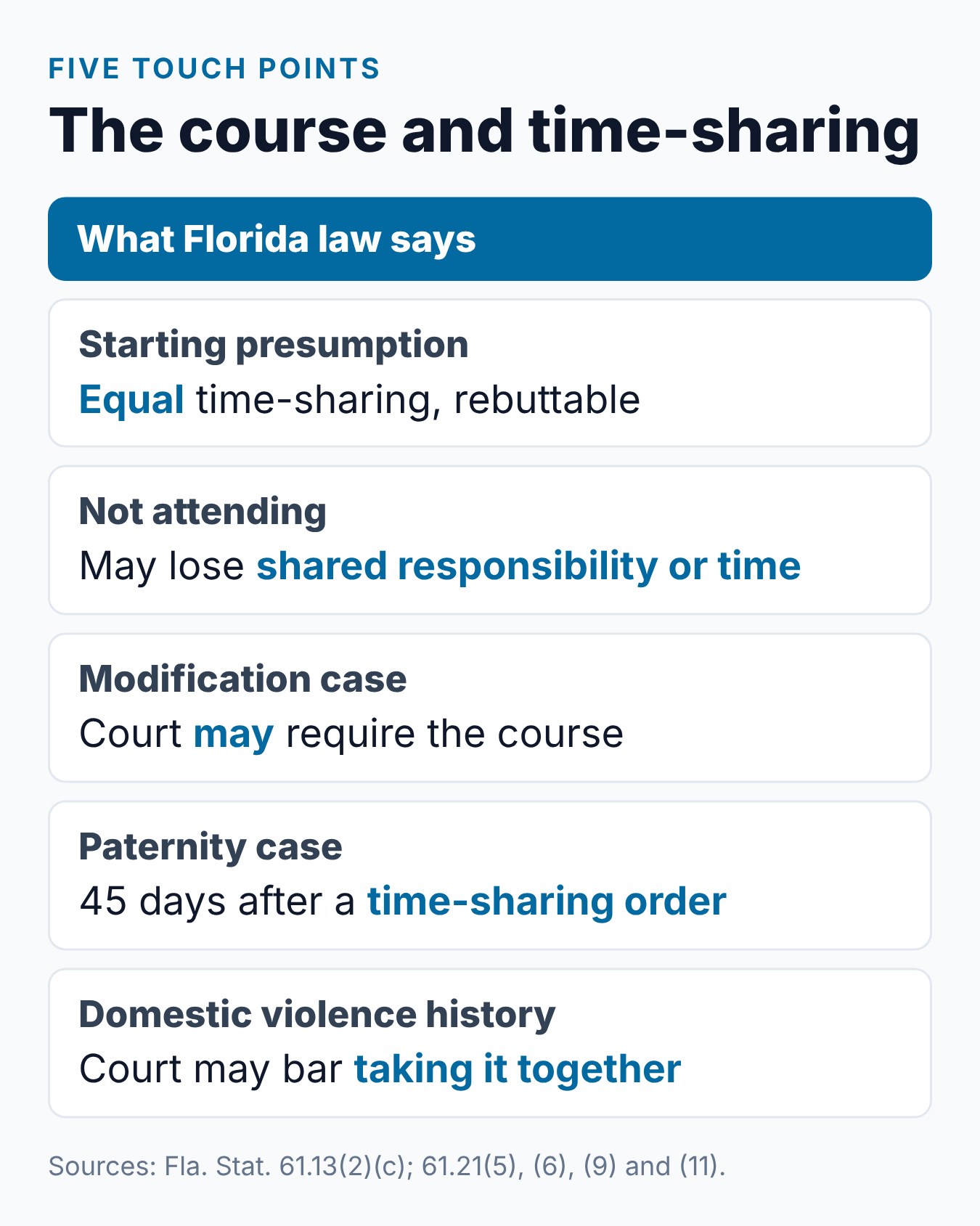
Section 61.13 sets the starting point. It says “there is a rebuttable presumption that equal time-sharing of a minor child is in the best interests of the minor child.” The presumption applies unless the statute provides otherwise or the parties agree to something else.
“Rebuttable” means a parent can try to show that equal time is not best. To do that, the parent must prove it by a preponderance of the evidence. That is the standard section 61.13 names.
The same section also sets a default for decisions. The court orders shared parental responsibility unless it finds that would be “detrimental to the child.”
Time Sharing in Florida: How a Schedule Is Set
There are two ways to reach a schedule. Section 61.046 spells them out:
- By agreement. The parents develop and agree to a schedule, and the court approves it.
- By the court. The court sets the schedule if the parents cannot agree. It also sets one if it does not approve the schedule they agreed on.
Either way, the schedule lives inside the parenting plan. It is not a separate order you file on its own.
The course plays no part in this choice. It does not ask you to pick a schedule. It gives you ideas and skills, and the case does the rest.
How the Court Weighs Best Interests
The child’s best interests are the main concern when the court sets or approves a schedule. Section 61.13(3) lists 20 factors, from (a) to (t). A few of them are:
- Putting the child first. Each parent’s ability to place the child’s needs above their own.
- Stability. How long the child has lived in a stable home and the value of keeping it.
- Health. The mental and physical health of each parent.
- School and community. The child’s home, school and community record.
- The child’s view. The child’s reasonable preference, if the court finds the child mature enough.
Finishing the course is not a factor on that list. Section 61.21 handles the course on its own track.
What the Course Teaches About Parenting Time
DCF rule 65C-32.003 sets eight required parts for every approved course. Three of them speak to time-sharing:
- Part (b). The lasting role of each parent and shared parenting.
- Part (c). The stages of child development.
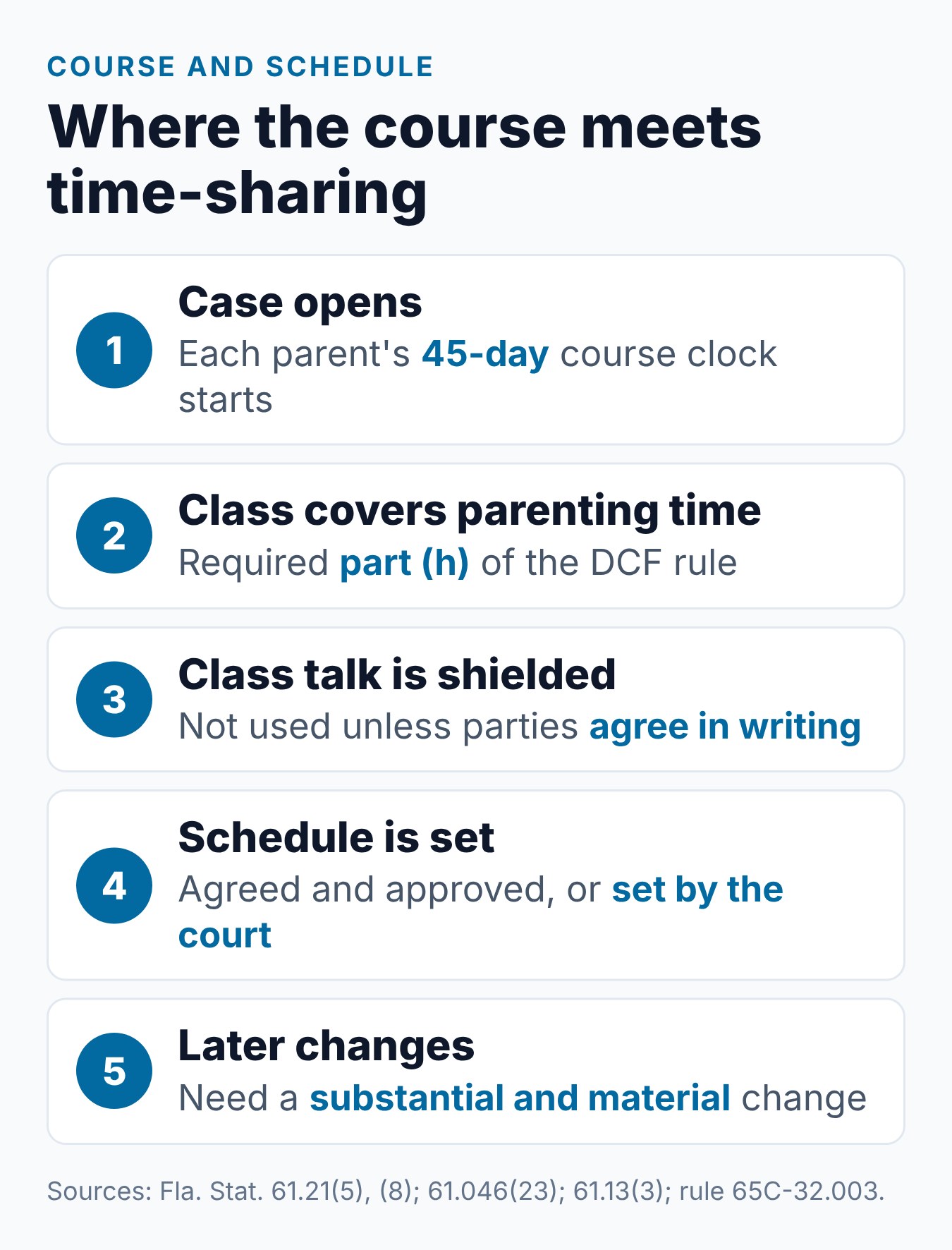
- Part (h). Parenting time, including suggestions about how to develop a parenting plan.
The course runs at least 4 hours, including an end-of-course test. It is meant to teach. It does not set your schedule, and the provider may not give individual legal advice.
The Course Does Not Decide Time-Sharing
The course has no vote in your schedule. Section 61.21(8) says statements made in a session “shall not be considered” in a pending or later case. No report from a session becomes part of the record, unless the parties agree in writing.
That rule lets parents learn without worrying that a class answer will be used against them. The judge decides time-sharing from the case itself.
What the Provider Will Not Do
The law also limits the course provider. Under section 61.21(2), the course is educational and is not built to give individual mental health therapy. Providers may not give individual legal advice, and they may not recruit parents as private clients.
DCF rule 65C-32.003 adds two safeguards. Each parent gets a written notice that the course is for educational purposes only.
Course material must also tell parents to consult a licensed attorney with specific legal questions. So if you have a question about your own schedule, ask a lawyer, not the class.
Skipping the Course Can Cost Time-Sharing
The course is not a factor, but ignoring it has a cost. Section 61.21(9) says a parent who fails to attend a required course may be held in contempt. That parent “may be denied shared parental responsibility or time-sharing,” or face other sanctions the court finds proper.
Local pages repeat the warning. The Eleventh Circuit’s Miami-Dade FAQ says the judge may choose not to grant the divorce or may hold a parent in contempt.
Only the court can excuse a party from the course, or from its deadline, for good cause. Parents cannot waive it by agreement.
Paternity Cases and Time-Sharing
The course also applies to a paternity case that involves parental responsibility. The deadlines differ from a divorce.
The petitioner has 45 days after filing. Any other party has 45 days after one of these events: an acknowledgment of paternity by that party, an adjudication of paternity of that party, or an order granting time-sharing to or support from that party. For more on these cases, see paternity, custody and time-sharing cases.
Counting a Paternity Deadline
Here is simple date math. Say a court order granting time-sharing to a parent is entered on May 1. Forty-five days after May 1 is June 15.
Your court may count days in its own way. Ask the clerk if you are unsure, and do not wait until the last day.
Modifying a Schedule
A time-sharing schedule can change after the judgment, but section 61.13 sets a high bar. There must be “a substantial and material change” in circumstances, and the change must serve the child’s best interests.
The course can return in that case. Section 61.21(6) says parties to a modification of a time-sharing schedule “may be required” to complete a parenting course. The word “may” leaves it up to the court.
Domestic Violence and the Course
Parents do not have to take the course together, under section 61.21(10). If there is a history of domestic violence, section 61.21(11) lets the court bar them from taking it together, even without a motion.
Section 61.13 also lets the court require a neutral, safe exchange spot or a supervised visitation site when there is a risk of harm. Every course must include information on domestic violence and the statewide hotline.
Children With Special Needs
Some children need more support during a family change. If the children have special needs or emotional concerns, section 61.21(4)(a) says the parties must select a course made for that topic.
DCF keeps a separate list of those courses. The court may also order a parent to take more classes on special needs, on top of the main course.
Questions to Bring to Your Court or Attorney
The rules above are general. Your own case may raise other issues. These questions can help you get clear answers:
- Does my case type require the course for both parents?
- What is my 45-day deadline, and when did it start?
- Does my court accept an online course?
- If I ask to change a schedule later, will the judge order the course again?
- Do my children’s needs call for a special-needs course?
A Florida family law attorney or the clerk’s office can point you to the right steps. This page cannot tell you what to file.
Common Mistakes
These come straight from the statutes and DCF rules:
- Using “custody” in court papers without checking terms. Florida’s parenting statutes use time-sharing and parental responsibility.
- Assuming equal time is fixed. The presumption can be rebutted by a preponderance of the evidence.
- Thinking the course grades your parenting. Class statements stay out of the case unless the parties agree in writing.
- Skipping the course because time-sharing is agreed. A parent who fails to attend may be denied time-sharing.
- Missing the paternity trigger. An order granting time-sharing can start the other party’s 45 days.
What We Found on the Official Pages
On the official pages we checked on October 26, 2026, section 61.13 in the 2026 Florida Statutes still stated the rebuttable presumption of equal time-sharing. Its history showed amendments in 2024 and 2025.
Section 61.21 had not changed since 2021. DCF’s course page, last updated April 8, 2026, said the courses “are a minimum of 4 hours.”
How Requirements Can Vary
Section 61.21 of the Florida Statutes sets the course requirement for the whole state, and DCF approves the courses. Each judicial circuit can still add its own steps, such as how to file the certificate or which class formats it accepts. The Fourth Circuit (Duval, Clay and Nassau counties), for example, requires an in-person class.
Laws, court orders and local rules can change. Check your court’s instructions, your county clerk’s website and DCF’s provider list before you enroll or file.
Frequently Asked Questions
Does Florida still use the word custody?
Florida’s parenting statutes use “time-sharing” and “parental responsibility” for these decisions. People still search for custody, so courts and guides may explain the link.
Does taking the course help me get more time-sharing?
No official source says so. The course is educational, and class statements are not used in the case unless the parties agree in writing.
Can skipping the course hurt my time-sharing?
Yes. Section 61.21(9) says a parent who fails to attend may be denied shared parental responsibility or time-sharing, or held in contempt.
Is equal time-sharing automatic in Florida?
No. The law presumes equal time-sharing is best, but a parent can rebut it by a preponderance of the evidence. The parties can also agree to another schedule.
Do I need the course to change a time-sharing schedule?
The court may require it. Section 61.21(6) uses the word “may” for modification cases.
Do both parents take the course at the same time?
They do not have to. The court can stop them from taking it together if there is a history of domestic violence.
Conclusion
Florida’s parenting statutes frame custody as time-sharing and parental responsibility, and the parent course supports both without deciding either. Finish the course on time, keep in mind that class talk stays private, and let the court handle the schedule. You can start with DivorceParentingClass.net’s online Florida parent education course after you confirm that your court accepts an online course.
Related Articles
- How to File for Divorce in Florida With Minor Children: The Parent Course Step
- Parenting Plan Florida Rules vs. the Parent Education Course
- Court Ordered Parenting Classes for Paternity and Custody
- Skipping the Parenting Class Florida Divorce Courts Require
Sources
- Florida Statutes § 61.13 — Parenting plans and time-sharing
- Florida Statutes § 61.046 — Definitions
- Florida Statutes § 61.21 — Parenting course
- Fla. Admin. Code R. 65C-32.003 — Required course content
- Eleventh Judicial Circuit — Divorce Education Program FAQ
- Florida DCF — Parent Education and Family Stabilization Course
Billy Forte is the owner of DivorceParentingClass.net.
This article is general information, not legal advice. Court rules, local practice, and case facts can differ by county, judge, and case type in Florida. Use official court and state sources, and consult a qualified Florida family law attorney for legal guidance specific to your case.