
Updated October 2026 · Reviewed by Billy Forte
Parenting classes Orlando parents take in a divorce or paternity case are governed by the Ninth Judicial Circuit’s Administrative Order 07-98-37-01, which covers Orange and Osceola counties. The order requires the Parent Education and Family Stabilization Course, sets 45-day deadlines, and says each parent gives a certificate of completion to the Clerk. Without that proof, the circuit does not grant a judgment on parental responsibility.
Key Facts
- The order: Administrative Order 07-98-37-01, signed July 31, 2007. See the order at a glance.
- Cases: divorce with minor children, and paternity with parental responsibility issues. See which cases.
- Deadline: 45 days after filing for the petitioner, or after service for the other party. See the deadlines.
- Proof: each party gives a certificate of completion to the Clerk. See the Clerk step.
- Waivers: need good cause shown in writing and “shall not be liberally provided.” See waivers.
- Penalties: dismissal, striking of pleadings or other sanctions. See sanctions.
The Order at a Glance
The Ninth Circuit posts the order as a PDF on its website. Its title is the “Amended Administrative Order Pertaining to Mandatory Educational Programs for All Parties in Dissolution Actions.” It covers actions with minor children and paternity actions involving parental responsibility.
Chief Judge Belvin Perry, Jr., signed it in Orlando on July 31, 2007. It replaced the earlier order, 07-98-37. It cites section 61.21 of the Florida Statutes and Rule 2.215 of the Florida Rules of Judicial Administration.
The order is short. Its paragraphs line up like this:
| Paragraph | What it covers |
|---|---|
| A.1 | The course is mandatory for all parties |
| A.2 | Deadlines for divorce and paternity cases |
| A.3 | No judgment on parental responsibility without proof |
| A.4 | Waivers in writing; certificates from other states |
| A.5 | Course standards set by the state |
| A.6 | The Clerk’s provider list and docketing |
| A.7 | Each party enrolls and pays |
| A.8 | Certificate to the Clerk; sanctions |
Which Cases It Covers
Paragraph A.1 makes “The Parent Education and Family Stabilization Course” mandatory. It applies to all parties in two kinds of cases:
- a dissolution of marriage with minor children
- a paternity action that involves parental responsibility
That matches state law. Section 61.21 names the same two case types. For a case that changes an existing parenting plan or time-sharing schedule, state law says the court “may” require the course.
Parenting Classes Orlando Deadlines
Paragraph A.2 sets the clock. It follows section 61.21 closely:
- Divorce, petitioner: “within 45 days after the filing of the petition.”
- Divorce, other parties: within 45 days after service of the petition.
- Paternity, petitioner: within 45 days after filing.
- Paternity, other parties: within 45 days after an acknowledgment of paternity, an adjudication of paternity, or an order granting visitation or support.
The order uses the older word “visitation.” State law now says “time-sharing” in the same spot.
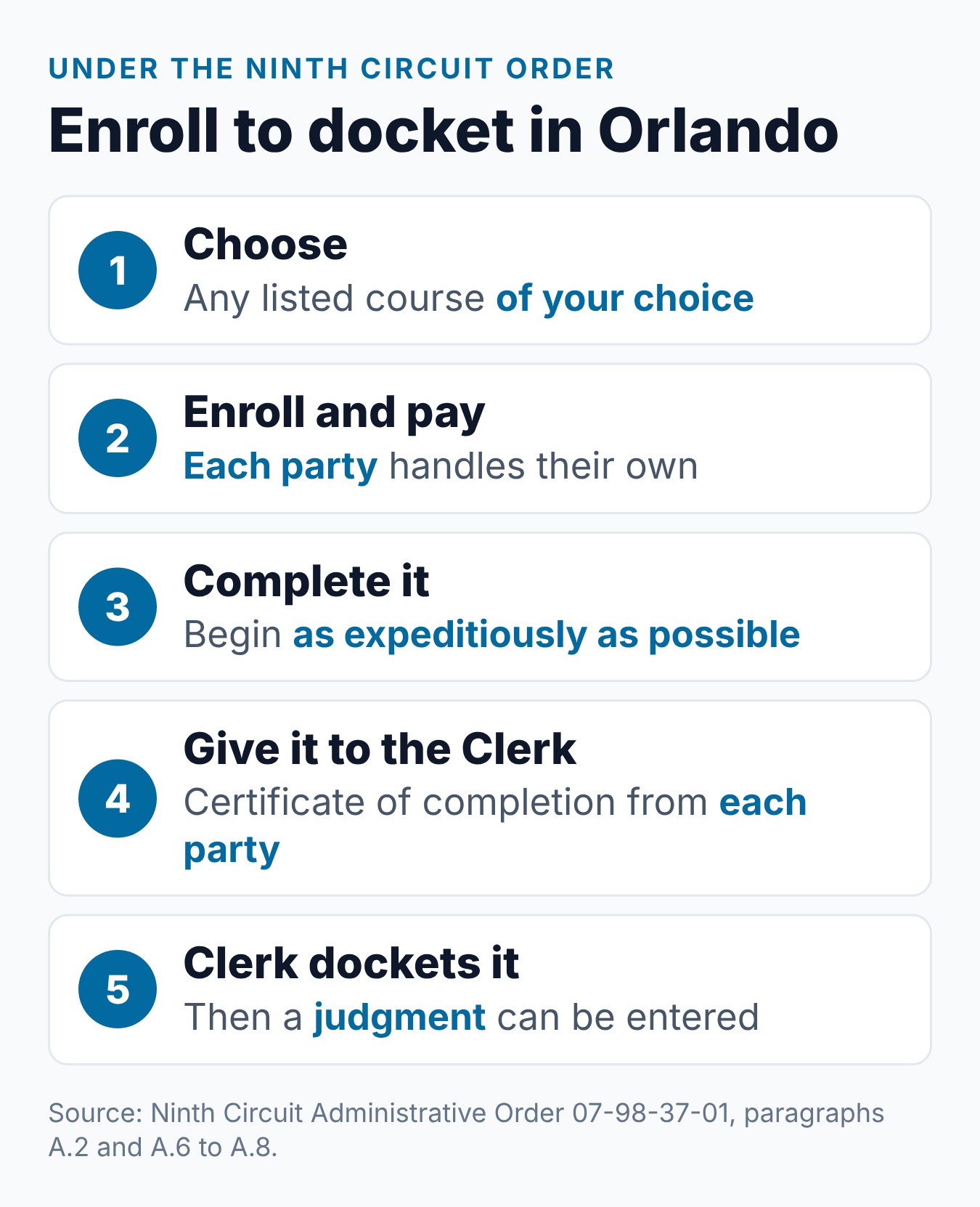
Here is a quick example. If a respondent is served on May 5, day 45 falls on June 19. A.2 also says every party must begin “as expeditiously as possible,” unless the court excuses that party for good cause.
No Judgment Without Proof
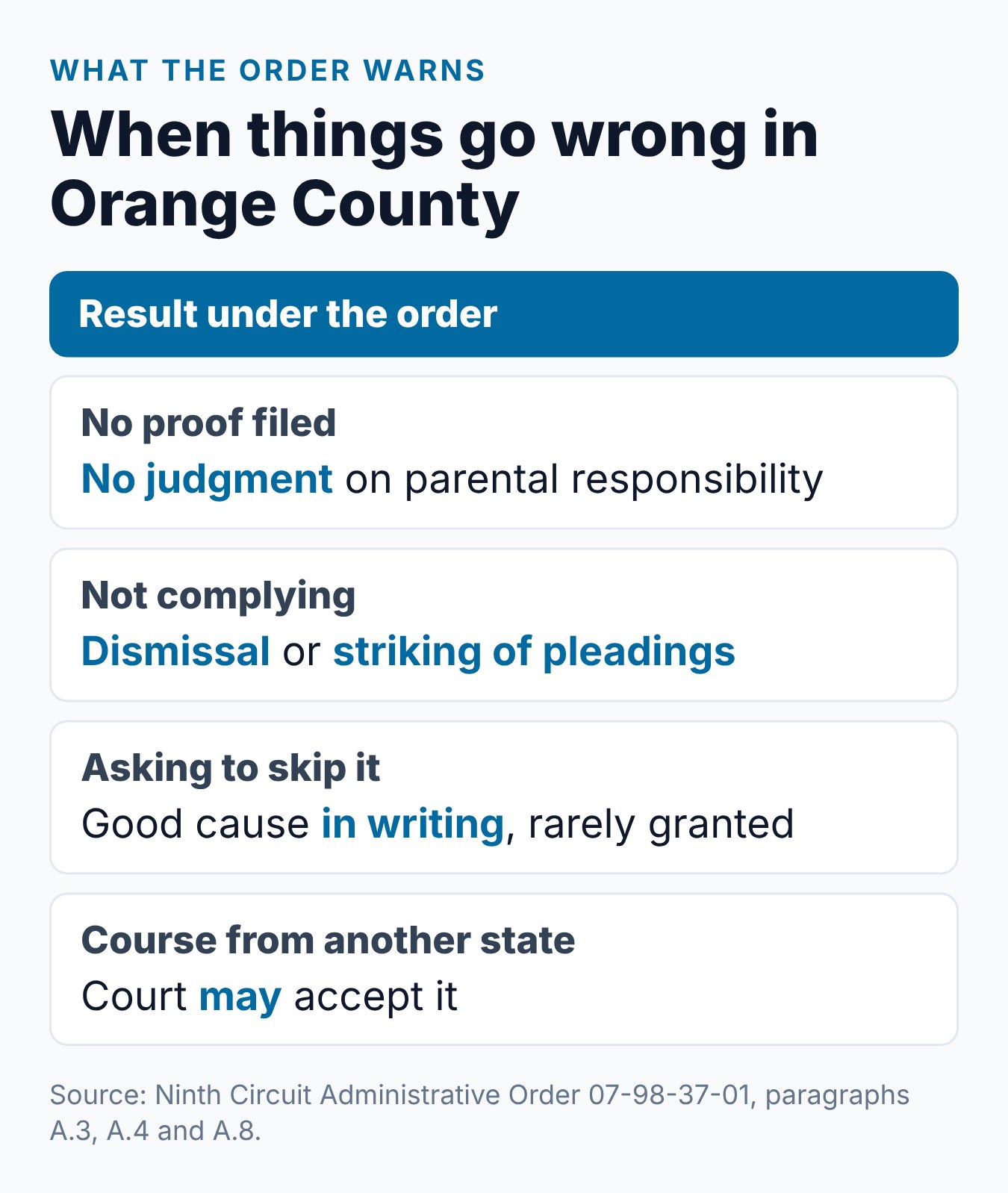
Paragraph A.3 is the strongest line in the order. It says no divorce or paternity judgment involving parental responsibility will be granted in the circuit without proof of compliance from the parties. The order’s own exceptions still apply.
A.2 also says each party files proof with the Clerk “prior to the entry of the final judgment.” So the course is not a step to save for the end. It can hold up the final judgment. Planning the class early keeps this step from delaying the end of your case.
Waivers Are Rare
State law lets the court excuse a party from the course, or from the deadline, for good cause. Paragraph A.4 adds how the Ninth Circuit treats that power.
The court may waive or change the requirement “upon good cause shown, in writing.” The order then adds that such waivers “shall not be liberally provided.”
In plain words, a waiver is not routine here. Parents cannot waive the course by agreeing.
If you think you have good cause, talk with a Florida family law attorney. See whether the requirement can be waived.
Certificates From Other States
A.4 also says the court “may accept” certificates of completion from out-of-state providers. The word is “may,” not “must.” A parent who lives in another state should ask the court before relying on a course from that state.
Course Standards in the Order
Paragraph A.5 ties the course to state approval. The order, written in 2007, names the approving agency as the Department of Children and Family Services. The approver listed on today’s state pages is the Florida Department of Children and Families (DCF).
A.5 says the course must be “a minimum of four (4) hours.” It must teach divorcing parents about the effects of divorce on parents and children.
DCF’s current rule 65C-32.002 fills in the details. The four hours include instruction, exercises and the end-of-course test. An online course must block anyone from finishing in under four hours.
Choosing a Course
Paragraph A.6 says the Clerk of the Circuit Court makes the list of approved providers available. Parties may attend the course “of their choice.”
Paragraph A.7 puts the job on each parent. Each party enrolls, completes the course and pays the fee. The order does not state a fee amount.
DCF’s provider list is the state’s current list. It shows each course’s languages, city, delivery method, indigent status and expiration date. Under rule 65C-32.005, approval lasts three years.
Cost and Help Paying
The order leaves the price to the provider. State law says a provider may charge “a reasonable fee” to each parent, and no state price is set.
If money is tight, look at the “Indigent Status” column on DCF’s list. DCF must also list at least one site per circuit with a sliding fee scale, if one is available. And a provider may not charge more when a parent needs extra time to pass the test.
What the Course Teaches
DCF’s rules list the topics every course must teach. They include talking with your children, talking with the other parent, and ideas for a parenting plan. See what the 4-hour class includes.
Is an Online Course Accepted?
The order does not address online courses. It refers to providers and “sites,” but it does not say a course must be in person or online.
Florida law requires DCF to approve at least one statewide internet course. Even so, some courts require in-person classes. So ask the Clerk or the court whether an online course works for your Orange or Osceola case.
Handing the Certificate to the Clerk
Paragraph A.8 says each party must give the Clerk a certificate of completion. Under A.6, the Clerk then dockets the completion when it receives each certificate.
Your provider issues the certificate. Under DCF rule 65C-32.004, it goes to each parent who completes the course and scores at least 70 percent on the test. It lists the course name, the provider’s name and contact information, the curriculum name if any, and the start and finish dates.
Test attempts are unlimited. Providers keep copies of certificates for five years.
Sanctions in the Order
A.8 lists what can happen if a party does not comply. It “may result in the Court’s dismissal of the action,” striking of pleadings, and other sanctions.
State law adds its own list. Under section 61.21(9), a parent who does not attend may be held in contempt, denied shared parental responsibility or time-sharing, or sanctioned in other ways. See what happens if you do not complete the class.
Questions for the Clerk
The order leaves some practical points open. These are fair questions for the Clerk’s office:
- How do I give my certificate to the Clerk in this case?
- Will the court accept an online course?
- Will the court accept a course I took in another state?
- How do I ask for civil indigent status?
Osceola County Parents
The same order covers Osceola County. A parent with a case filed in Osceola follows the same deadlines and the same Clerk step. Osceola parents can use the same DCF list, where the City column shows where each in-person course meets.
Special Needs and Attending Apart
If your children have special needs or emotional concerns, state law says the parents must pick a course built for that. DCF keeps a list of special-needs courses.
Parents do not have to take the course together. With a history of domestic violence, the court can stop them from taking it together.
Your words in class stay private from the case. State law says statements made in the course are not used to decide it, unless both parents agree in writing.
What We Found on the Official Pages
On the Ninth Circuit site we checked on October 26, 2026, the order was posted in a January 2026 file folder. It still carried its July 31, 2007 signature date.
The order did not mention online courses, fees or how to file in electronic form. Those questions go to the Clerk. The order also named no providers; it left the list to the Clerk and the state.
Common Mistakes to Avoid
Each point comes from the order or section 61.21:
- Counting on an easy waiver. The order says waivers “shall not be liberally provided.”
- Forgetting the Clerk. Each party gives the certificate to the Clerk.
- Assuming an out-of-state course counts. The court “may” accept it, not “must.”
- Starting late. The order says to begin “as expeditiously as possible.”
- Treating the course as a last step. No judgment on parental responsibility is granted without proof.
How Requirements Can Vary
Section 61.21 of the Florida Statutes sets the course requirement for the whole state, and DCF approves the courses. Each judicial circuit can still add its own steps, such as how to file the certificate or which class formats it accepts. The Fourth Circuit (Duval, Clay and Nassau counties), for example, requires an in-person class.
Laws, court orders and local rules can change. Check your court’s instructions, your county clerk’s website and DCF’s provider list before you enroll or file.
Frequently Asked Questions
Is the parenting class required in Orange County?
Yes, in a divorce with minor children and in a paternity case with parental responsibility issues. Order 07-98-37-01 makes it mandatory for all parties.
Where do I turn in my certificate in Orlando?
To the Clerk of the Circuit Court. Paragraph A.8 says each party gives the Clerk a certificate of completion, and the Clerk dockets it.
Can the court waive the class?
Only for good cause shown in writing. The order says waivers “shall not be liberally provided.”
Will the court accept a course from another state?
It may. Paragraph A.4 says the court “may accept” out-of-state certificates, so ask before you rely on one.
Does the order allow online classes?
The order does not say. Ask the Clerk or the court before you choose an online course.
What happens if I never finish?
The order allows dismissal of the action, striking of pleadings, or other sanctions. Without proof, no judgment on parental responsibility is granted.
How much does the class cost in Orlando?
The order does not set a price. Each provider sets its own “reasonable fee,” and DCF’s list shows which courses offer help for parents who cannot pay.
Does the order apply in Osceola County?
Yes. Order 07-98-37-01 covers both Orange and Osceola counties.
Conclusion
Orange and Osceola parents should finish the course within 45 days and hand the certificate to the Clerk, because the Ninth Circuit grants no judgment on parental responsibility without it. Before you choose DivorceParentingClass.net’s online Florida parent education course, confirm with the Clerk or the court that your case accepts an online course. For questions about a waiver or your own case, talk with a Florida family law attorney.
Related Articles
- Parenting Classes Florida by County: Court Certificate Guide
- Hillsborough County Parenting Class for Divorce
- Can the Parenting Course Florida Requires Be Waived?
- Skipping the Parenting Class Florida Divorce Courts Require
Sources
- Ninth Judicial Circuit — Administrative Order 07-98-37-01 (PDF)
- Florida Statutes § 61.21 — Parenting course
- Fla. Admin. Code R. 65C-32.002 — Course length and delivery
- Fla. Admin. Code R. 65C-32.004 — Test and certificate
- Fla. Admin. Code R. 65C-32.005 — Provider approval
- Florida DCF — Parent Education and Family Stabilization Course
- Florida DCF — Approved course provider list
- Florida DCF — Courses for children with special needs or emotional concerns
Billy Forte is the owner of DivorceParentingClass.net.
This article is general information, not legal advice. Court rules, local practice, and case facts can differ by county, judge, and case type in Florida. Use official court and state sources, and consult a qualified Florida family law attorney for legal guidance specific to your case.