
Updated October 2026 · Reviewed by Billy Forte
If you need parenting classes Jacksonville FL courts will count in a divorce, the key fact is this: the Fourth Judicial Circuit requires an in-person class. Its standing order and its Family Court Services FAQ point parents in Duval, Clay and Nassau counties to named local programs. Each parent must finish within 45 days and file the certificate in the court file.
Key Facts
- Format: the Fourth Circuit calls for an in-person class, not an online one. See the in-person rule.
- Named programs: the circuit’s FAQ lists three local in-class programs. See the three programs.
- Sign-up: register after you have a case number. See when to register.
- Deadline: 45 days from filing for the petitioner, or from service for the respondent. See the deadline.
- Proof: file the Certificate of Completion in the court file promptly. See filing the certificate.
- Skipping it: the court can hold a parent in contempt. See consequences.
The In-Person Rule
Duval County is part of Florida’s Fourth Judicial Circuit, along with Clay and Nassau counties. The circuit has a standing family law order for divorce cases. Paragraph 9 of that order covers the parenting course.
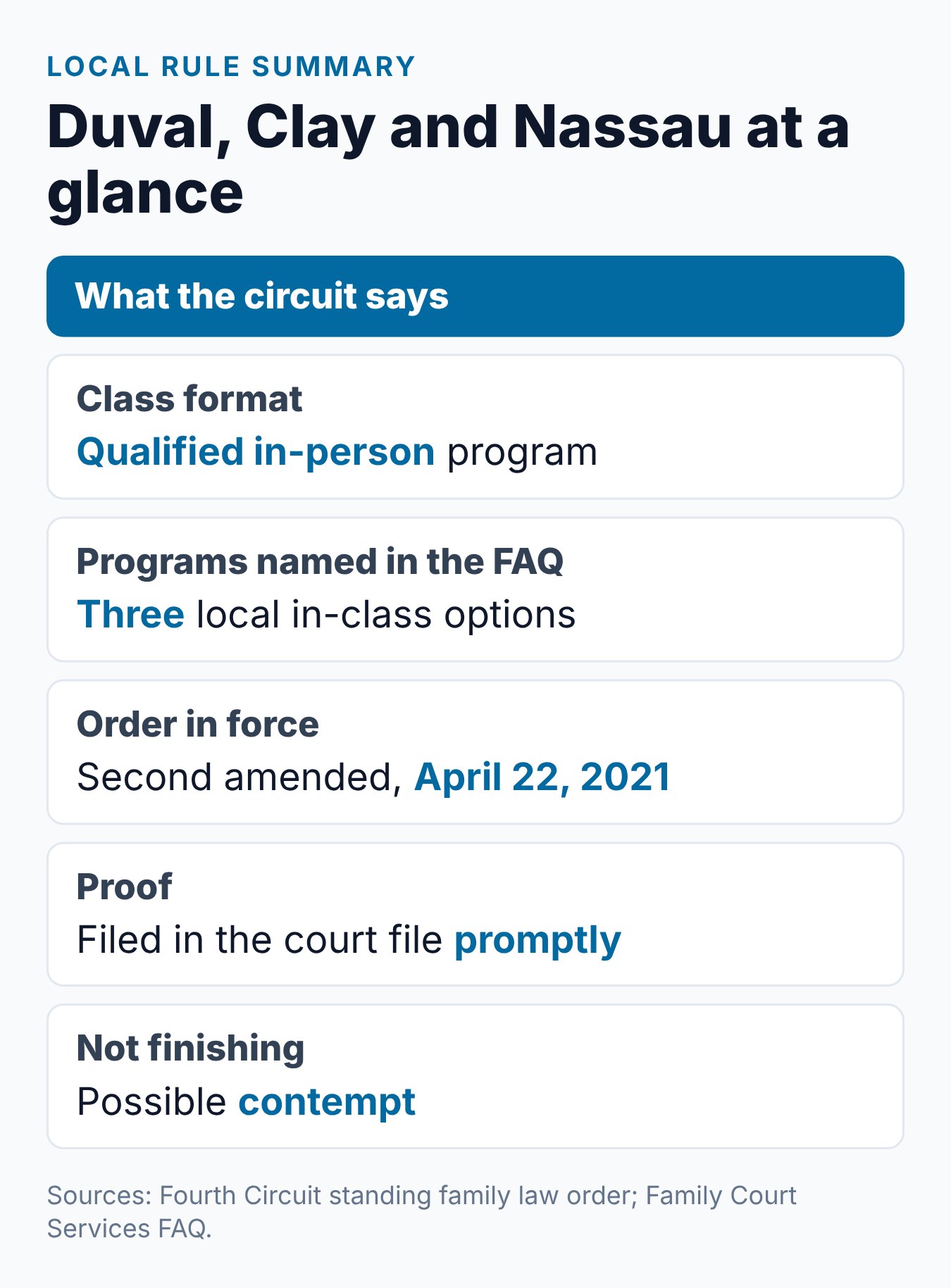
It says parties to a divorce with minor children “shall complete a four-hour parenting course.” It gives one example, the Putting Children First in Divorce Course. Then it adds the words “or a similar qualified inperson program.” (The order spells “in-person” as one word.)
So the order describes an in-person class. It does not name an online course as an option. We found no Fourth Circuit page that says an online course meets the order.
Which Cases the Order Covers
The current text is the second amended order. It was entered on April 22, 2021, and it applies to all petitions filed on or after that date. It replaced an order first entered on or about April 1, 2003.
The order is served with a petition for dissolution of marriage, separate maintenance or annulment. Paragraph 9 applies to the parties in a dissolution of marriage case “with minor children.”
How It Fits With State Law
Paragraph 9 opens by citing two things: “the administrative orders issued in the Fourth Judicial Circuit” and section 61.21. So the local rule sits on top of the state law. It does not replace it.
State law also covers paternity cases that involve parental responsibility. The circuit FAQ quotes that part of section 61.21. Paragraph 9 itself speaks only of divorce, so a parent in a paternity case should ask the court which class to take.
Parenting Classes Jacksonville FL Courts Name
The circuit’s Family Court Services FAQ answers the question “Why am I being required to take a parenting class?” It says, “The courses mandated by Administrative Order in the Fourth Judicial Circuit are” these three:
| Program name on the FAQ | Organization the FAQ lists |
|---|---|
| Children First in Divorce | Hope Haven Children’s Clinic |
| Separate Yet Together | First Coast Behavior Solutions |
| Great Kids through Great Co-Parenting | Jewish Family Community Services |
The FAQ does not list phone numbers, addresses, fees or class dates for these programs. Contact the program, or ask Family Court Services, for current details.
What the Capital Letters Say
The FAQ puts its key instruction in capital letters: “YOU MUST REGISTER FOR ONE OF THE FOLLOWING IN-CLASS PARENTING CLASSES.” That line sits right above the program list.
Lower on the page, a section headed “Certified Parenting Class” cites Administrative Order 1993-08. It points to DCF’s statewide provider list and says you “can choose from the local and online providers listed.” That line does not say an online course meets the Fourth Circuit’s order.
The order itself calls for an in-person program, and the capital-letter line says to register for an in-class one. So ask the court before you choose any class that is not on the named list.
When to Register
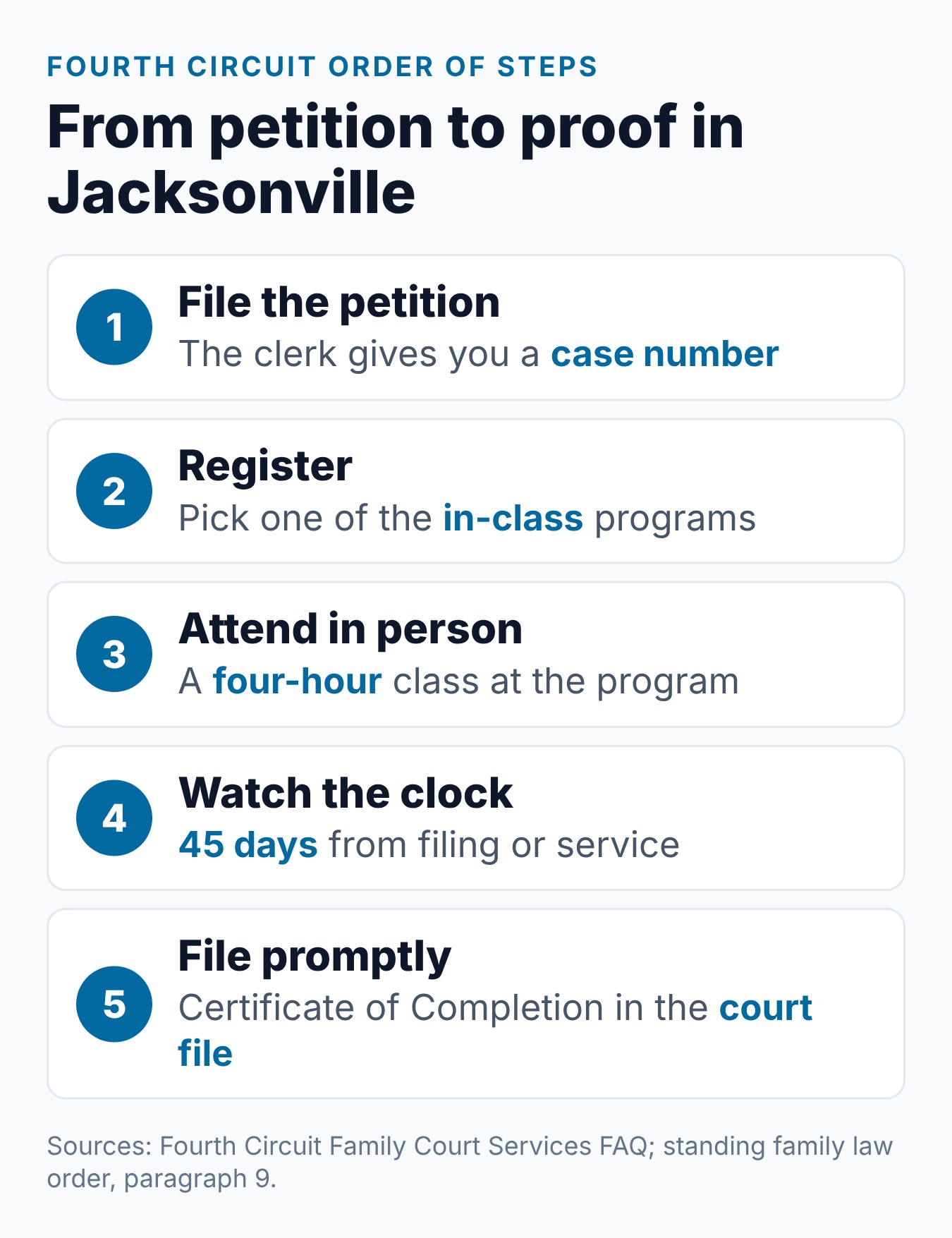
The FAQ sets out an order of steps. First, “YOU WILL BE GIVEN A CASE NUMBER AFTER YOU FILE YOUR DOCUMENTS.” Then, “When you have your case number you may register for one of the following classes.”
In other words, the circuit expects you to sign up after the case is filed. Keep your case number close when you call a program.
Questions to Ask a Program
Before you book a seat, a short call can save time. Useful questions include:
- Is this one of the programs named on the Fourth Circuit FAQ?
- Which class dates fall inside my 45 days?
- What is the fee, and is a sliding fee scale offered?
- Will my certificate show the dates I began and finished?
Florida law lets providers charge “a reasonable fee” per parent. DCF must list at least one site per circuit with a sliding fee scale, if one is available. The FAQ itself lists no fees.
The 45-Day Deadline
The standing order uses the same clock as section 61.21 of the Florida Statutes:
- Petitioner: within 45 days from the date the petition is filed.
- Respondent: within 45 days from the date the petition is served.
Here is a simple example. If a petition is filed on June 2, the petitioner’s 45th day is July 17. The respondent’s clock starts on the day of service, so it may end later.
Florida law also says each parent should begin “as expeditiously as possible.” In-class programs run on set dates. So look at class schedules soon after you get your case number.
Filing the Certificate
Paragraph 9 ends with one line: “Parties shall file the Certificate of Completion in the Court file promptly.” State law adds that each party files proof before the final judgment.
Each parent handles his or her own certificate. The clerk in Duval, Clay or Nassau can explain how to file it in your case. Your class certificate and your filing are two separate steps.
DCF’s rule 65C-32.004 lists what every certificate must show:
- the name of the course
- the provider’s name and contact information
- the curriculum’s unique name, if it has one
- the date you began and the date you finished
The provider must have a way to check that a certificate is real. It must also keep copies for five years.
If a Parent Does Not Finish
The FAQ warns, “The Court may hold any parent who fails to complete the course in contempt and impose appropriate sanctions.” The standing order’s closing notice also says that failure to obey it may be punished by contempt.
State law names more tools. Under section 61.21(9), a parent who skips the course may be denied shared parental responsibility or time-sharing, or “otherwise sanctioned.”
Only the court can excuse a parent from the course or the deadline, and only for good cause. Parents cannot agree to skip it. See whether the requirement can be waived.
The Statewide Rules Still Apply
The local rule adds to state law. It does not replace it. The Florida Department of Children and Families (DCF) approves Parent Education and Family Stabilization courses, providers and sites.
A few state rules apply to every class, in a room or not:
- Length: at least 4 hours, counting instruction, exercises and the end-of-course test (rule 65C-32.002).
- Test: a score of 70 percent passes. Attempts are unlimited, and missed material is reviewed before a retake.
- Together or apart: parents do not have to attend together. With a history of domestic violence, the court can bar it.
- Privacy: what parents say in class is not used in the case unless both agree in writing.
The class teaches set topics under DCF’s rules, such as communicating with your children and with the other parent. Our guide to what the 4-hour class includes lists them.
If your children have special needs or emotional concerns, the law says you must pick a course built for that. DCF keeps a special-needs course list. Ask the court how that list fits with the local in-person rule.
Clay and Nassau Counties
The standing order was signed in Nassau County, and it covers all three counties. A parent with a case in Clay or Nassau follows the same paragraph 9.
The FAQ’s program list is for the whole circuit. Your certificate goes in the court file of the county where your case is pending.
What We Found on the Official Pages
On the Fourth Circuit pages we checked on October 26, 2026, the standing order was the second amended version dated April 22, 2021. The FAQ named three in-class programs and cited Administrative Order 1993-08 in its certified-class section.
Neither page gave class fees or schedules. Neither page said an online course would satisfy the order. Both spelled the first host clinic as “Hope Have,” which we show here as Hope Haven.
Common Mistakes to Avoid
Each point below comes from the standing order, the circuit FAQ or section 61.21:
- Buying an online course for a Fourth Circuit case. The order calls for an in-person program.
- Registering before you have a case number. The FAQ says to register once you have one.
- Waiting until day 40. In-class programs run on set dates, and seats may not match your deadline.
- Stopping after the class. Finishing the class is one step; filing the certificate is another.
- Assuming one certificate covers both parents. Each party completes the course and files proof.
- Treating the class as optional. Only the court can excuse it, for good cause.
How Requirements Can Vary
Section 61.21 of the Florida Statutes sets the course requirement for the whole state, and DCF approves the courses. Each judicial circuit can still add its own steps, such as how to file the certificate or which class formats it accepts. The Fourth Circuit (Duval, Clay and Nassau counties), for example, requires an in-person class.
Laws, court orders and local rules can change. Check your court’s instructions, your county clerk’s website and DCF’s provider list before you enroll or file.
Frequently Asked Questions
Can I take an online parenting class for a Jacksonville divorce?
The Fourth Circuit’s order and FAQ point to in-person programs, and we found no circuit page that accepts an online course. The FAQ says you must register for one of its in-class classes. Ask the court before you choose anything else.
Which parenting classes does the Fourth Circuit name?
Its FAQ names Children First in Divorce, Separate Yet Together, and Great Kids through Great Co-Parenting. The standing order names the Putting Children First in Divorce Course as its example.
When should I sign up?
Sign up after you file and receive a case number. The FAQ says, “When you have your case number you may register.” The 45-day clock starts at filing or at service.
Do both parents have to take the class?
Yes. The order applies to the parties to a divorce with minor children. Parents do not have to attend the same session.
Where does the certificate go?
It goes in the court file. The order says to file the Certificate of Completion “promptly,” and state law requires proof before the final judgment.
Does this rule apply in Clay and Nassau counties?
Yes. The standing order covers Duval, Clay and Nassau, the three counties of the Fourth Judicial Circuit.
How much do the Jacksonville classes cost?
The Fourth Circuit pages we read list no fees for the three programs. State law allows “a reasonable fee” per parent, and DCF must list a sliding-fee site in each circuit if one is available. Ask the program for its current fee.
Can the court excuse me from the class?
Only a judge can, and only for good cause under section 61.21. Parents cannot waive it by agreement.
Conclusion
Jacksonville parents in a divorce with minor children should plan on an in-person class from the Fourth Circuit’s named list, finished within 45 days and filed promptly. Parents whose case is in a different Florida circuit can look at DivorceParentingClass.net’s online Florida parent education course, but only after they confirm that their court accepts an online course. If you are unsure which class your case needs, ask the court or a Florida family law attorney before you enroll.
Related Articles
- Parenting Classes Florida by County: Court Certificate Guide
- Parenting Classes Near Me or Online? Florida Divorce Guide
- Online Parenting Classes for Florida Divorce: DCF Rules
- How to Submit Your Parenting Class Certificate of Completion
Sources
- Fourth Judicial Circuit — Standing Family Law Order (PDF)
- Fourth Judicial Circuit — Family Court Services FAQ
- Florida Statutes § 61.21 — Parenting course
- Fla. Admin. Code R. 65C-32.002 — Course length and delivery
- Fla. Admin. Code R. 65C-32.004 — Test and certificate
- Florida DCF — Approved course provider list
- Florida DCF — Courses for children with special needs or emotional concerns
Billy Forte is the owner of DivorceParentingClass.net.
This article is general information, not legal advice. Court rules, local practice, and case facts can differ by county, judge, and case type in Florida. Use official court and state sources, and consult a qualified Florida family law attorney for legal guidance specific to your case.