
Updated October 2026 · Reviewed by Billy Forte
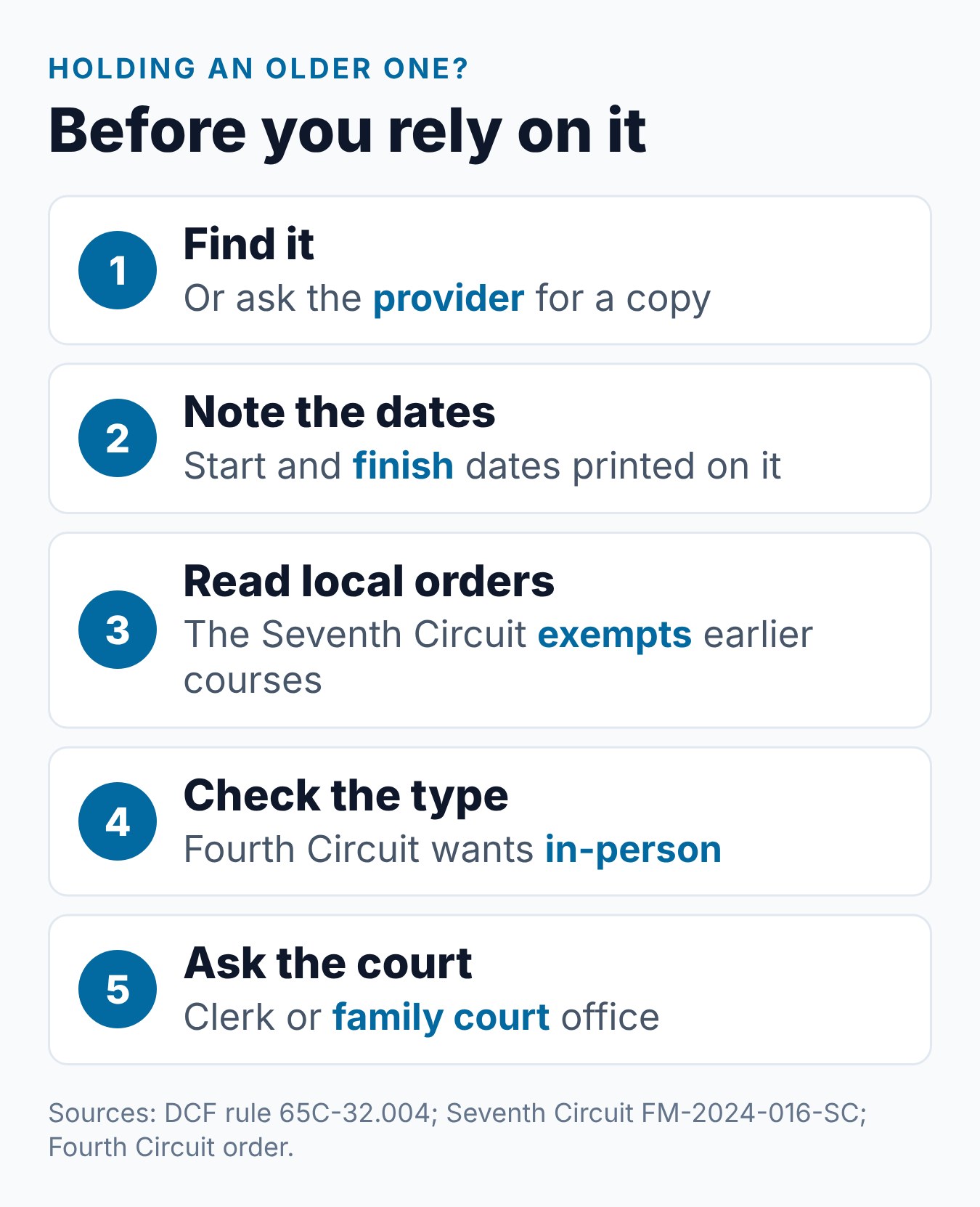
No Florida statute or DCF rule puts an expiration date on a court parenting class certificate. Instead, the court in your case decides what proof it will accept. So if your certificate comes from an earlier case or an earlier year, ask that court before you rely on it.
Key Facts
- State law: section 61.21 sets deadlines to finish the course, not an end date for the proof. See the statute.
- DCF rule: it lists what the certificate shows and sets no expiry. See the DCF rule.
- Courts decide: one circuit exempts parents who already filed a certificate. See court examples.
- Not expiry: provider approval lasts three years, and providers keep records for five. See time limits that are not expiry.
- Next step: ask your court about an older certificate. See how to ask.
Does a Court Parenting Class Certificate Have an End Date?
The official sources we read set no expiry for the certificate. They also set no time frame in which a course must be “recent.”
That does not mean every old certificate works in every case. It means the decision sits with the court, not with a state rule. Courts can write local orders, and judges rule on the case in front of them.
So the honest answer has two parts. State law gives no end date. Your court has the final word.
What the Statute Says
The course law is section 61.21, Florida Statutes. It requires the course in a divorce with minor children and in a paternity case that involves parental responsibility.
The law sets three timing rules:
- Begin early. Each party “shall begin the course as expeditiously as possible.”
- Finish on time. The petitioner has 45 days after filing, and the other party has 45 days after service.
- Prove it. Each party files proof with the court before the final judgment.
All three rules look forward from the case. None of them says how old a certificate may be. The statute is silent on expiry.
What the DCF Rule Says
DCF rule 65C-32.004 covers the test and the certificate. A provider gives the certificate to each parent who finishes the four-hour minimum course and scores at least 70 percent.
The rule lists what the certificate must show: the course name, the provider’s name and contact information, the curriculum name if any, and the start and finish dates. It does not list an expiration date. It also sets no deadline for issuing the certificate.
The rule’s silence matters. A provider cannot point to a state expiry rule, because there is none.
Time Limits That Are Not Expiry
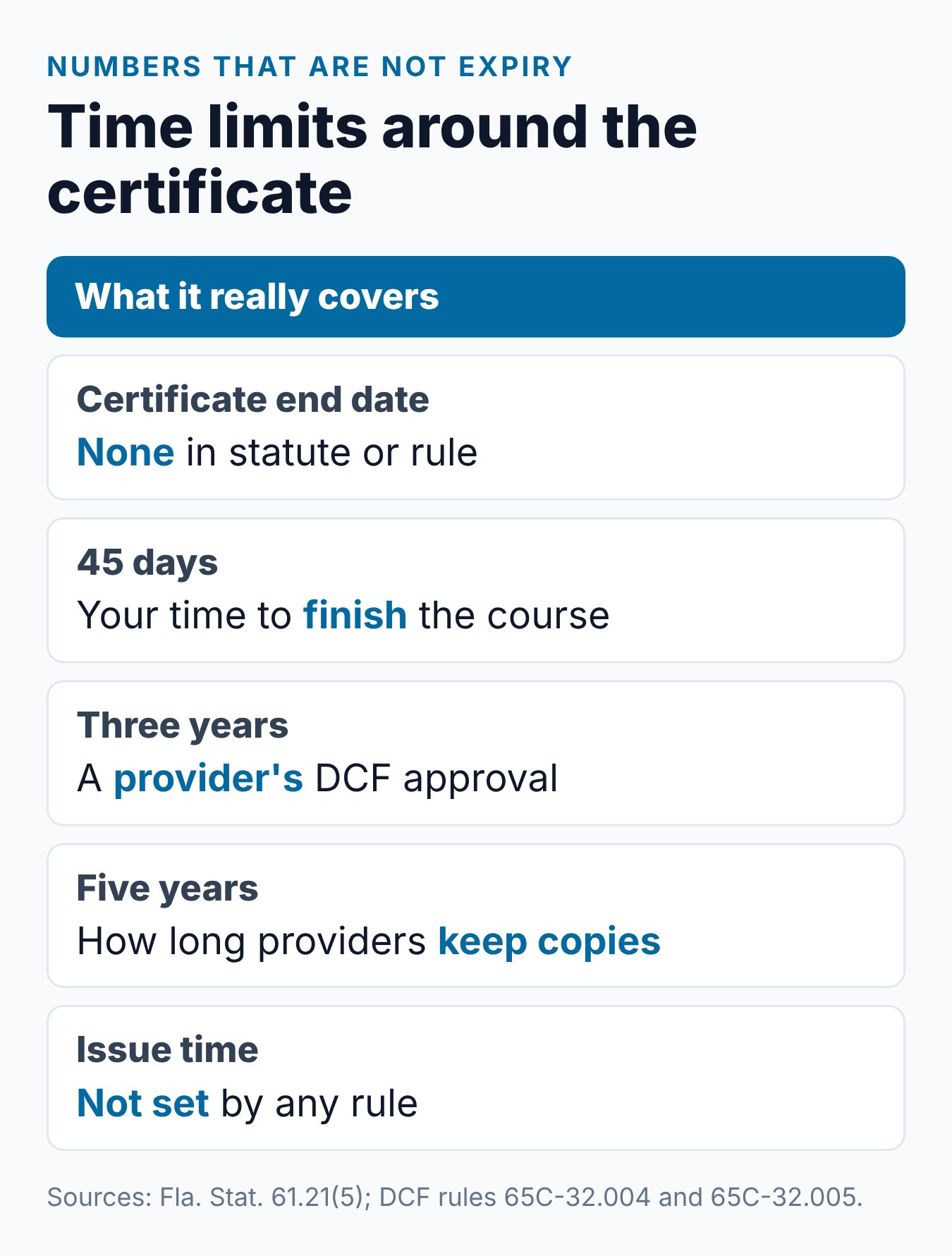
Three numbers show up in the rules. Each one is easy to mistake for an expiry date.
- 45 days. This is how long each party has to finish the course, counted from filing or service. It is a deadline for you, not a shelf life for the certificate.
- Three years. DCF rule 65C-32.005 says a provider’s approval “is valid for three (3) years.” That limit applies to the provider, not to your certificate.
- Five years. Providers keep “copies of all certificates of completion issued for five (5) years.” That is a record-keeping rule. It does not mean your proof stops working after five years.
Court Examples
Local orders show how courts handle earlier certificates. Here are three examples from official court pages:
| Circuit | What its order says | What it suggests for an older certificate |
|---|---|---|
| Seventh (Flagler, Putnam, St. Johns, Volusia) | Parties who already completed a course and filed certificates “are exempt” | Earlier proof can count there |
| Ninth (Orange, Osceola) | Out-of-state certificates “may be accepted by the Court” | The court decides case by case |
| Fourth (Duval, Clay, Nassau) | Requires an in-person class from a named list | The type of course matters, not only the date |
Seventh Circuit: Earlier Completion
The Seventh Circuit’s Order FM-2024-016-SC says parties who “have previously completed a parenting education course and have filed Certificates of Completion are exempt.” The order gives no age limit for that earlier course.
This is one circuit’s order. Other circuits may not have the same rule.
Ninth Circuit: Out-of-State Certificates
The Ninth Circuit’s Administrative Order 07-98-37-01 says, “Certificates of completion from out of state providers may be accepted by the Court.”
The key word is may. The court keeps the choice. The order says nothing about a certificate’s age.
Fourth Circuit: Course Type
The Fourth Circuit’s standing family law order calls for “a four-hour parenting course” from a named program “or a similar qualified inperson program.” Its Family Court Services FAQ lists three local in-class programs.
The same FAQ answer also points parents to DCF’s list of local and online providers. So ask the circuit’s Family Court Services which class applies to your case.
So in this circuit, the question is not only “how old is it?” The question is also “is it the right kind of course?”
Modification Cases
A modification case changes a final judgment that has a parenting plan or time-sharing schedule. Under section 61.21(6), the parties “may be required to complete a court-approved parenting course” before the modification order. In Florida, DCF approves the course itself.
The word “may” means the judge decides. The statute does not say whether a certificate from the first case is enough. Ask the court in the modification case.
A New Case After an Earlier One
A parent may hold a certificate from a case that was filed and later closed. The statute does not address that case type, and the DCF rule does not either.
The Seventh Circuit order is the only official source we found that speaks to earlier completion. Outside that circuit, ask your own court. Our guide on taking the course before filing covers the timing side of this question.
Why the Dates on the Certificate Still Matter
The certificate shows the date you began and the date you finished. Those dates let a court check your deadline. Did you finish within 45 days of filing or service?
So the dates do real work, even without an expiry rule. A court can compare them with your filing date and service date. Keep them accurate, and report any error to the provider before you file.
How to Ask Your Court
If you want to use an older certificate, ask first. Have these items ready:
- The certificate itself, with the provider’s name and dates.
- Your case number for the new case.
- The county and circuit of the new case.
- The type of case: divorce, paternity or modification.
Start with the Clerk of Court or the family court office. If the clerk cannot answer, ask how to raise the question with the judge. A Florida family law attorney can also advise you.
If the Court Asks for a New Course
The court may tell you to take it again. If so, the same state rules apply to the new course as to the first one:
- DCF approval. Pick a provider on DCF’s provider list.
- At least four hours. The time includes instruction, exercises and the end-of-course test.
- A passing score. You need at least 70 percent, with unlimited attempts.
- The right format. Check whether your court accepts an online course.
You get a new certificate with new dates when you finish. File that one in the new case.
Special Needs or Emotional Concerns
Section 61.21(4)(a) adds a rule for some families. If the children have identified special needs or emotional concerns, the parties “must select” a course designed for that need. DCF keeps a separate list of those courses.
So the type of an earlier course can matter. If your earlier certificate came from a general course, and your children have special needs, ask the court whether it will accept that proof.
Keep the Certificate Safe
Even without an expiry rule, a lost certificate causes delay. Keep a copy with your case papers after you file.
If it goes missing, start with the provider, which keeps copies for five years. Our page on getting another copy lists the steps. If a court turns down an older certificate, see what to do after a rejection.
Who Can Excuse the Course
Only a court can excuse a party from the course, or from the deadline, for good cause. That is section 61.21(4)(b). Parents cannot agree to skip it.
An older certificate is not an excuse. It is proof of a course already done. Whether that proof is enough is still the court’s call.
Where This Fits in the Certificate Process
Expiry is one small part of the proof process. First, you finish the course and get a certificate from the provider. Then you file it in your case before the final judgment.
Our guide to getting your Florida parenting class certificate walks through each of those steps. This page answers only the question of how long the proof lasts.
What We Found on the Official Pages
On the statute, DCF rule and court pages we checked on October 26, 2026, none set an expiry date for the certificate. None set a time by which a provider must issue it, either.
The only “years” we found were the three-year provider approval and the five-year record rule. Neither one limits how long a parent’s certificate can be used.
Common Mistakes to Avoid
Each item comes from section 61.21, a DCF rule or a court order above:
- Reading the five-year rule as an expiry. It is how long providers keep copies.
- Reading the three-year approval as an expiry. It applies to the provider.
- Assuming every circuit exempts earlier courses. We found that rule in one circuit.
- Ignoring the course type. The Fourth Circuit requires an in-person class from its list.
- Skipping the question. Ask the court before you rely on an older certificate.
- Treating parent agreement as an excuse. Only the court can excuse the course.
How Requirements Can Vary
Section 61.21 of the Florida Statutes sets the course requirement for the whole state, and DCF approves the courses. Each judicial circuit can still add its own steps, such as how to file the certificate or which class formats it accepts. The Fourth Circuit (Duval, Clay and Nassau counties), for example, requires an in-person class.
Laws, court orders and local rules can change. Check your court’s instructions, your county clerk’s website and DCF’s provider list before you enroll or file.
Frequently Asked Questions
Does a Florida parenting class certificate expire?
No Florida statute or DCF rule sets an expiry date. Courts decide what proof they accept, so ask your court about an older certificate.
Do courts require a recent course?
No official source we read says so. The statute sets deadlines measured from filing and service. It does not set an age limit for the certificate.
Can I reuse a certificate from an earlier case?
Maybe. The Seventh Circuit exempts parties who already completed a course and filed certificates. Other courts decide for themselves, so ask yours.
Does the provider’s DCF approval ending affect my certificate?
No official source we found answers that. DCF approvals last three years and apply to providers. Ask your court if this applies to you.
Will a court accept a certificate from another state?
The Ninth Circuit says out-of-state certificates “may be accepted by the Court.” That is the court’s choice, not a promise.
Do I need a new course for a modification case?
The court may require one under section 61.21(6). The statute does not say whether an earlier certificate is enough, so ask the court.
Who decides whether an older certificate counts?
The court in your case decides. Start by asking the Clerk of Court or the family court office how to raise the question.
How long does the provider keep my certificate?
DCF rule 65C-32.004 says providers keep copies of all certificates for five years. That is a record rule, not an expiry date.
Conclusion
A court parenting class certificate has no expiry date under Florida law or DCF rules, and each court decides what it accepts. If your certificate is older, or from another case, ask your court before you rely on it.
If you need a new course, see DivorceParentingClass.net’s online Florida parent education course. First confirm that your court accepts an online course.
Related Articles
- How to Get Your Florida Parenting Class Certificate
- Florida Parenting Class for Divorce: Taking It Before Filing
- Lost Your Parenting Certificate? How to Get a Florida Copy
- Parenting Classes for Court: Why Certificates Get Rejected
Sources
- Florida Statutes § 61.21 — Parenting course
- Fla. Admin. Code R. 65C-32.004 — Test and certificate
- Fla. Admin. Code R. 65C-32.005 — Provider approval
- Seventh Judicial Circuit — Order FM-2024-016-SC
- Ninth Judicial Circuit — Administrative Order 07-98-37-01 (PDF)
- Fourth Judicial Circuit — Standing Family Law Order (PDF)
- Fourth Judicial Circuit — Family Court Services FAQ
- Florida DCF — Approved course provider list
Billy Forte is the owner of DivorceParentingClass.net.
This article is general information, not legal advice. Court rules, local practice, and case facts can differ by county, judge, and case type in Florida. Use official court and state sources, and consult a qualified Florida family law attorney for legal guidance specific to your case.