
Updated October 2026 · Reviewed by Billy Forte
Yes, the Florida parenting course is still required when parents agree on everything, because section 61.21 applies to all parties to a divorce with minor children, whether they agree or not. Parents cannot waive it for each other, since only the court can excuse a parent, and only for good cause. A signed parenting plan does not take the place of the course, and the parents do not have to take it together.
Key Facts
- Agreement: it does not remove the course requirement. See why agreement is not a waiver.
- Excusal: only a judge can excuse a parent, for good cause. See the court’s role.
- Parenting plan: a plan is a separate document, not a substitute. See plan vs course.
- Attendance: parents may take the course apart. See together or apart.
- Written agreement: it matters for one thing, the use of course statements. See the one agreement the statute mentions.
Is the Florida Parenting Course Still Required If You Agree?
Yes. The rule is in section 61.21, Florida Statutes. It requires the Parent Education and Family Stabilization Course for “all parties to a dissolution of marriage proceeding with minor children.” It also covers paternity cases about parental responsibility.
The statute does not ask whether the parents agree. It asks whether there is a divorce with minor children, or a qualifying paternity case. If so, each parent takes a course approved by the Florida Department of Children and Families (DCF).
Why an Agreement Cannot Waive It
A duty set by law is not a term the parents negotiate. Subsection (4)(a) places the duty on each party. Subsection (5) then tells “each party” to file proof before the final judgment.
Neither parent owns the other parent’s duty. So neither parent can release the other from it. A clause in a settlement that says “the parties waive the parenting class” does not appear anywhere in the statute as a valid option.
The risks also stay with each parent. Under section 61.21(9), a parent who fails to attend may be held in contempt, denied shared parental responsibility or time-sharing, or otherwise sanctioned. An agreement between the parents does not shield either one from that.
Only a Judge Can Excuse
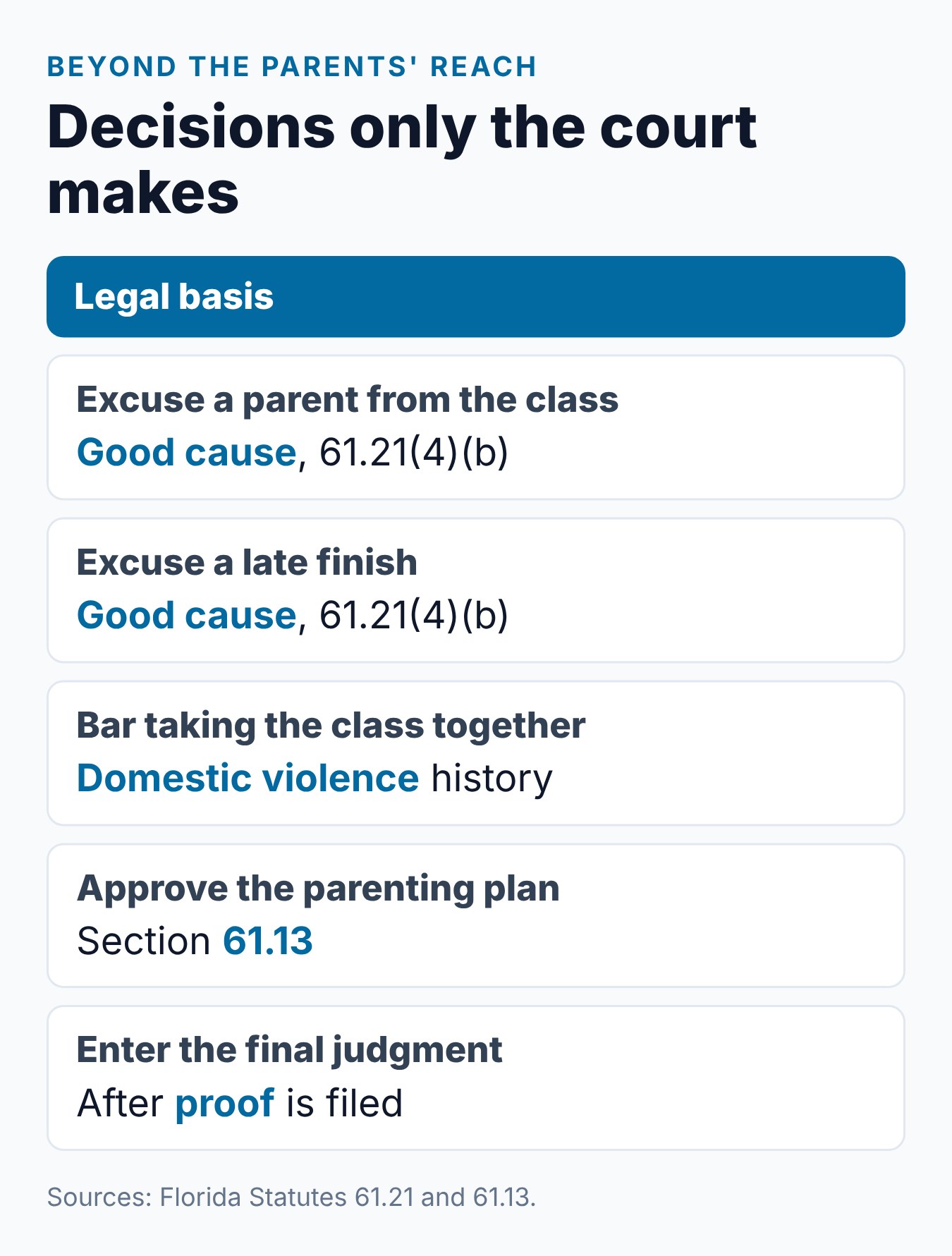
The statute gives the power to excuse to one place. Subsection (4)(b) says “the court may excuse a party from attending the parenting course, or from completing the course within the required time, for good cause.”
The statute does not define good cause. The Ninth Circuit’s order shows the bar can be high. The Ninth Circuit’s order 07-98-37-01 says waivers need good cause shown in writing and “shall not be liberally provided.” Our waiver guide covers the excusal rule in depth.
A Parenting Plan Is Not the Course
Agreeing parents may already have a parenting plan ready. That plan is important, but it is a different thing.
Section 61.046 defines a parenting plan as “a document created to govern the relationship between the parents relating to decisions that must be made regarding the minor child.” Under section 61.13, a plan approved by the court must at least address:
- how the parents share daily tasks for the child
- the time-sharing schedule
- health care and school matters
- how the parents will communicate with the child
The course is education under a different statute. It does not create or file a plan. Our plan vs course guide explains the difference.
Where the Plan and the Course Meet
The two do connect in one place. DCF rule 65C-32.003 requires every course to cover parenting time, “including suggestions about how to develop a parenting plan.”
So the course can help parents think about a plan. But a finished plan does not count as the course. Each parent still needs the course and a certificate.
What Agreement Can and Cannot Change
This table sorts course issues by who decides them:
| Issue | Can the parents settle it by agreeing? | Where the rule is |
|---|---|---|
| Whether the course is required | No | 61.21(4)(a) |
| Excusing a parent from the course | No; only the court, for good cause | 61.21(4)(b) |
| Terms of the parenting plan | The parents can propose them; the court approves the plan | 61.13 |
| Taking the course together or apart | Yes, unless the court bars joint attendance | 61.21(10) and (11) |
| Using course statements in the case | Only by written agreement of the parties | 61.21(8) |
What the Course Says About Working Together
Parents who agree may think the course has nothing to teach them. The required parts suggest otherwise. Rule 65C-32.003 lists these among the eight parts every course must cover:
- the permanency of the parental role and shared parenting
- communicating with the other parent
- communicating with the children
- divorce as a loss for the family
Those topics apply to parents who get along now and want to keep it that way. They also apply when an agreement later comes under strain.
Together or Apart
Agreeing parents may want to take the course at the same time. Section 61.21(10) says the parties are not required to attend together. So the choice is theirs, within limits.
The court can override that choice. If there is a history of domestic violence, the court may bar the parents from taking the course together, even without a motion. Some local rules also call for separate attendance, so check yours.
The One Agreement the Statute Mentions
There is one place where a written agreement changes the course rules. Section 61.21(8) says statements made in the course “shall not be considered” in the case. No report from the session becomes part of the record.
The exception is a written agreement. The parties may stipulate in writing to allow it. That agreement is about the use of statements, not about skipping the course.
Agreement Does Not Stop the Clock
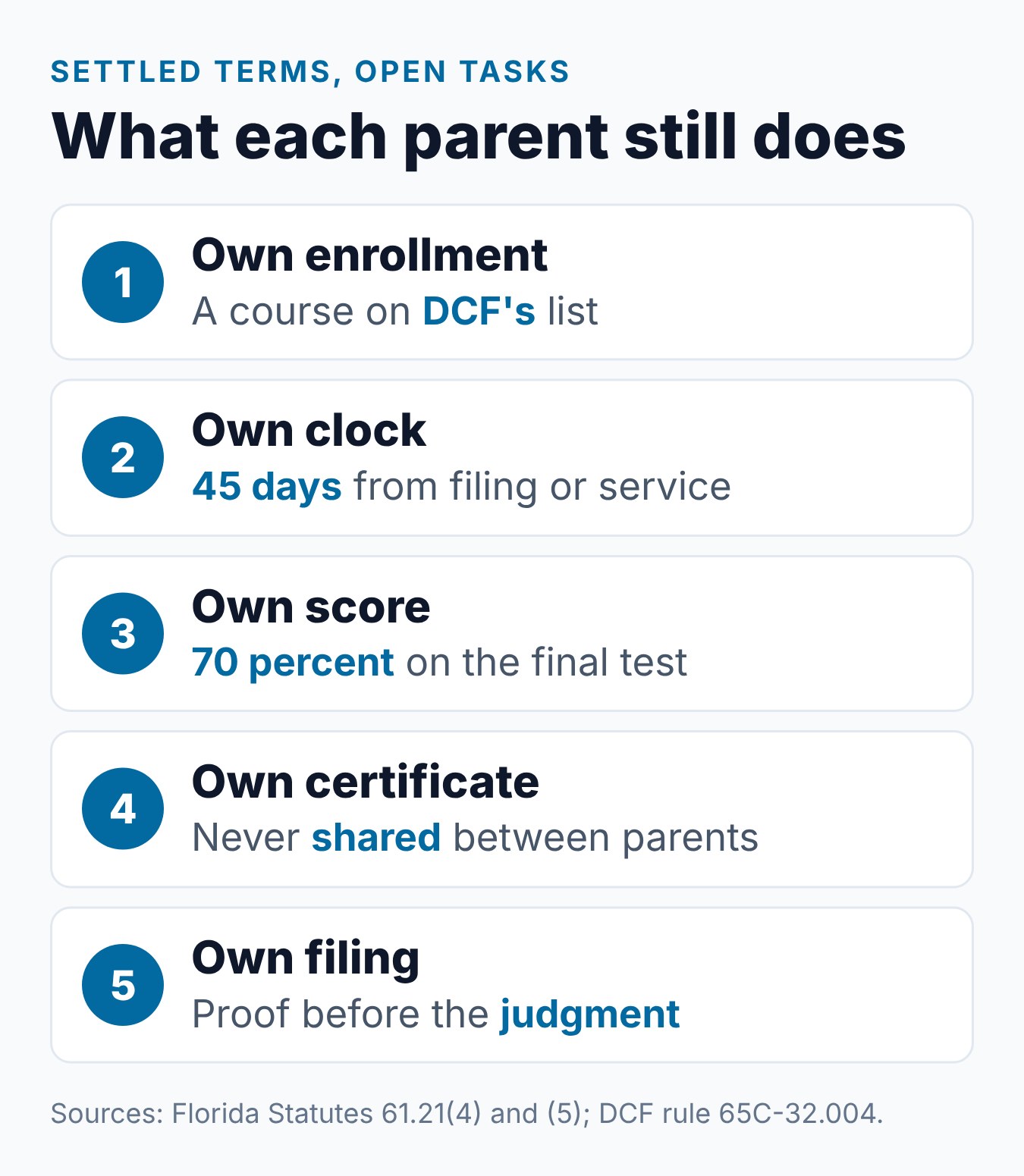
The 45-day deadlines apply in agreed cases too. The petitioner finishes within 45 days after filing. The other parent finishes within 45 days after service.
Each parent should also “begin the course as expeditiously as possible.” A settlement does not pause those dates. Our timing guide shows how they work.
Agreement Does Not Change Local Rules
Circuit rules apply to agreeing parents too. Two official sources show local steps a settlement cannot remove:
- Fourth Circuit (Duval, Clay, Nassau). The standing family-law order calls for a four-hour course from a qualified in-person program.
- Miami-Dade. The court’s FAQ says a child aged 6 to 17 “must attend a 3½ hour class for children of divorcing parents.”
Parents cannot agree their way around these steps. Ask the court about any local rule you are unsure of.
Special Needs Still Shape the Course
Agreement does not change which course fits the family. If the children have identified special needs or emotional concerns, section 61.21(4)(a) says the parties must select a course built for that.
DCF keeps a list of special-needs courses. The court may also order extra courses on these needs under section 61.21(12).
Agreed Paternity Cases
Parents who were never married can also agree on everything. If their paternity case involves parental responsibility, section 61.21(4)(a) still requires the course. Agreement does not change that.
One Certificate per Parent
Under DCF rule 65C-32.004, a certificate goes to each participant who finishes at least 4 hours and scores at least 70 percent. It shows the course name, the provider’s name and contact information, and the dates the parent began and finished.
The certificate belongs to the parent who earned it. Agreeing parents cannot share one. Each parent files their own proof with the court.
Ways Agreeing Parents Can Coordinate
Agreement cannot remove the course, but it can make the course easier to manage. Parents who get along can:
- share their deadline dates, since filing and service start different clocks
- check the court’s format rules together, such as an in-person rule
- confirm that each course is on DCF’s provider list
- tell each other when their certificate is filed
These steps do not change any rule. They just help both parents finish before the final judgment.
If the Agreement Changes Later
Agreements can shift after the divorce. A parent may later ask the court to change the parenting plan or the time-sharing schedule.
In that case, section 61.21(6) says the court may require a parenting course before it enters the modification order. So the course can come up again, even for parents who once agreed on everything.
What We Found on the Official Pages
On the court pages checked on October 26, 2026, none of the pages in this review offered a waiver based on the parents’ agreement. Two circuit orders mention a waiver request. The Ninth Circuit wants good cause shown “in writing,” and the Seventh Circuit mentions “a proper motion.”
It said waivers need good cause “in writing.” It did not list any reasons that count as good cause.
DCF’s rules and pages also had nothing on agreement. They describe the course, the test and the certificate, and they apply the same way to every parent who takes it.
Common Mistakes to Avoid
Each item is based on section 61.21, section 61.13 or a DCF rule:
- Writing a waiver into the settlement. Only the court can excuse a parent.
- Treating the parenting plan as the course. They are separate requirements.
- Sharing one certificate. Each parent earns and files their own.
- Ignoring the deadline because the case is settled. The 45-day clocks still run.
- Assuming joint attendance is required. Parents may attend apart.
- Agreeing to use course statements without writing it down. The statute requires a written agreement.
How Requirements Can Vary
Section 61.21 of the Florida Statutes sets the course requirement for the whole state, and DCF approves the courses. Each judicial circuit can still add its own steps, such as how to file the certificate or which class formats it accepts. The Fourth Circuit (Duval, Clay and Nassau counties), for example, requires an in-person class.
Laws, court orders and local rules can change. Check your court’s instructions, your county clerk’s website and DCF’s provider list before you enroll or file.
Frequently Asked Questions
Can we skip the parenting course if we agree on everything?
No. Section 61.21 applies to all parties to a divorce with minor children. Only the court can excuse a parent, and only for good cause.
Does our parenting plan count as the course?
No. A parenting plan is a document about decisions for the child. The course is a separate DCF-approved education requirement.
Do we have to take the course together?
No. The law says parents are not required to attend together. The court can also bar joint attendance if there is domestic violence.
Can we put a waiver in our settlement agreement?
The statute gives no way for parents to waive the course. Only the judge can excuse a parent for good cause. Ask a family law attorney about your case.
Can just one of us take the course if we agree?
No. The statute places the duty on each party. Each parent finishes a course, earns a certificate, and files proof.
Will what we say in the course be used in our case?
Not unless both of you agree in writing. Section 61.21(8) keeps course statements and reports out of the case otherwise.
Does agreeing on time-sharing change the course?
No. A time-sharing schedule belongs in the parenting plan under section 61.13. The course is a separate requirement under section 61.21.
Does agreeing change our deadlines?
No. The petitioner has 45 days after filing and the other parent has 45 days after service, settled or not.
Conclusion
The Florida parenting course stays on each parent’s list even when you agree on everything, and only a judge can excuse it. Finish a DCF-approved course, keep it separate from your parenting plan, and file your own proof before the final judgment. You can take DivorceParentingClass.net’s online Florida parent education course, but first confirm that your court accepts an online course.
Related Articles
- Florida Parenting Class Requirement: Who Takes It and When
- Uncontested Divorce Parenting Class Florida: Is It Required?
- Can the Parenting Course Florida Requires Be Waived?
- Parenting Plan Florida Rules vs. the Parent Education Course
Sources
- Florida Statutes § 61.21 — Parenting course
- Florida Statutes § 61.046 — Definitions
- Florida Statutes § 61.13 — Parenting plans and time-sharing
- Fla. Admin. Code R. 65C-32.003 — Required course content
- Fla. Admin. Code R. 65C-32.004 — Test and certificate
- Florida DCF — Courses for children with special needs or emotional concerns
- Ninth Judicial Circuit — Administrative Order 07-98-37-01 (PDF)
- Eleventh Judicial Circuit — Divorce Education Program FAQ
- Fourth Judicial Circuit — Standing Family Law Order (PDF)
Billy Forte is the owner of DivorceParentingClass.net.
This article is general information, not legal advice. Court rules, local practice, and case facts can differ by county, judge, and case type in Florida. Use official court and state sources, and consult a qualified Florida family law attorney for legal guidance specific to your case.