
Updated October 2026 · Reviewed by Billy Forte
Court ordered parenting classes in Florida are not only for divorce: section 61.21 also requires the Parent Education and Family Stabilization Course in paternity cases that involve parental responsibility. If parents later go back to court to change the plan or schedule, the judge may order it too. Florida law says “parental responsibility” and “time-sharing” where people may say “custody,” so this guide uses those terms.
Key Facts
- Paternity: the course is required when the case involves parental responsibility. See paternity cases.
- Paternity deadlines: the other party’s 45 days start at one of three events. See paternity deadlines.
- Modification: the court may require the course before a modification order. See modification cases.
- Miami-Dade: its program also covers change-in-custody petitions. See Miami-Dade.
- Florida terms: the law uses parental responsibility and time-sharing, not custody. See Florida’s words.
Court Ordered Parenting Classes Beyond Divorce
The course rule is in section 61.21, Florida Statutes. Divorce with minor children is the best-known case. But the statute reaches further.
It names three situations:
- Divorce with minor children. All parties must take the course.
- Paternity with parental responsibility issues. The parties must take the course.
- Modification of a parenting plan or time-sharing schedule. The court may require it.
In each case, the course is the same one. The Florida Department of Children and Families (DCF) approves it, and it lasts at least 4 hours.
Florida’s Words for Custody
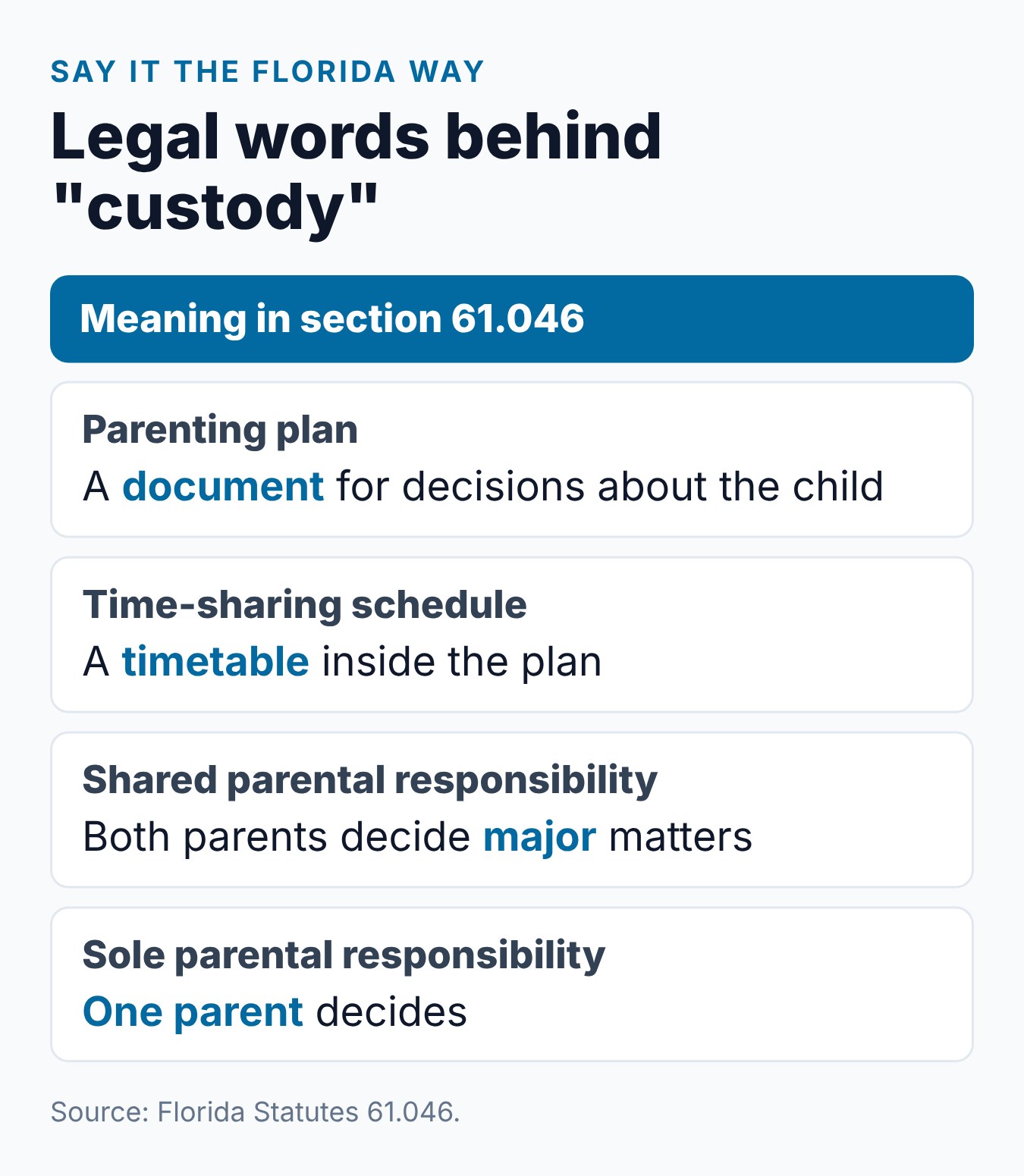
Florida law does not use “custody” for these decisions. Section 61.046 defines the terms courts use instead:
- Parenting plan. “A document created to govern the relationship between the parents relating to decisions that must be made regarding the minor child.”
- Time-sharing schedule. “A timetable that must be included in the parenting plan.”
- Shared parental responsibility. Both parents keep full parental rights and responsibilities and make major decisions together.
- Sole parental responsibility. “A court-ordered relationship in which one parent makes decisions regarding the minor child.”
So what people call a custody case is, in Florida law, a case about who decides and who has time with the child. The words differ, but the course rule is the same.
Paternity Cases
A paternity case decides who a child’s legal father is. Section 61.21(4)(a) requires the course for the parties to “a paternity action that involves issues of parental responsibility.”
The key words are “parental responsibility.” If the case decides who makes major decisions for the child, the course applies. The statute has no exception for quick or agreed cases.
The proof rule matches divorce. Each parent finishes the course and files proof before the final judgment. The judge needs that proof before the case can end.
A parent who skips it faces the same risks as in a divorce. The court may find contempt or deny time-sharing. Our guide on missing the course lists them.
Paternity Deadlines
Paternity cases use a different trigger for the second parent. This table shows the statute’s deadline rules:
| Party in a paternity case | The 45 days start after |
|---|---|
| Petitioner | Filing the petition |
| Any other party | An acknowledgment of paternity by that party |
| Any other party | An adjudication of paternity of that party |
| Any other party | An order granting time-sharing to, or support from, that party |
In a divorce, the other party’s clock starts at service. In paternity, it starts at one of the events above. Ask the clerk which event applies in your case.
What the Trigger Words Mean
The three events can sound hard. In plain words:
- Acknowledgment. Both parents sign a form, notarized or witnessed, that names the father (section 742.10).
- Adjudication. A judge rules on who the father is.
- Order for time-sharing or support. A judge gives a parent time with the child, or orders support from that parent.
The clock starts after the event that applies to that parent. So two parents in one case can have very different dates. Write your own date down when it happens.
Steps for Unmarried Parents
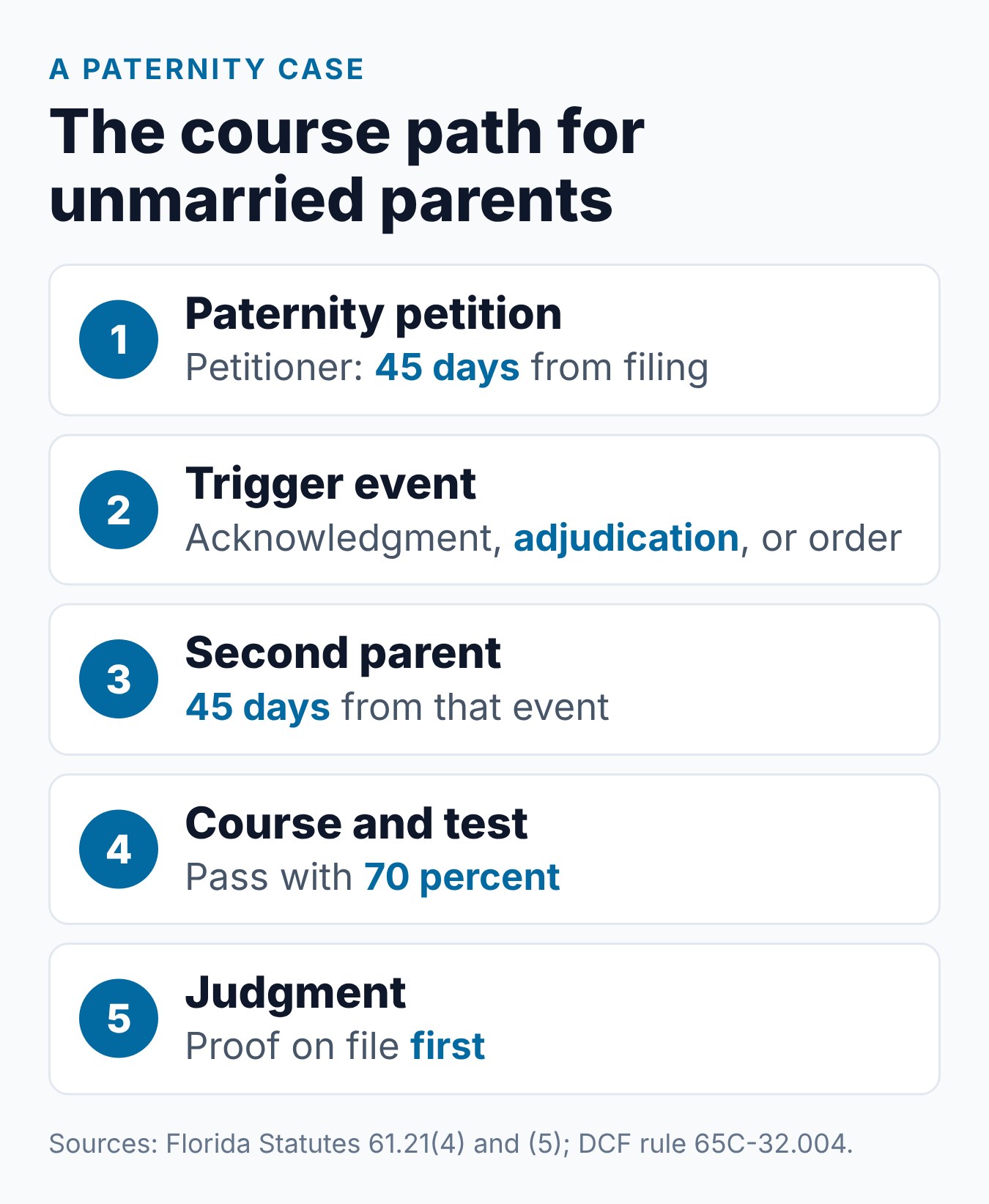
Here is the course path in a paternity case, step by step:
- Check the case. Does it decide parental responsibility? If yes, the course applies.
- Find your start date. Filing for the petitioner, or the trigger event for the other parent.
- Pick a course. Use DCF’s list, or its special-needs list if your child needs it.
- Take the course. Plan for at least 4 hours.
- Pass the test. You need 70 percent, and you can try again.
- File proof. Do it before the final judgment.
Modifying a Parenting Plan or Time-Sharing
After a divorce or paternity case ends, parents may go back to court to change the plan. Section 61.21(6) covers that. It says the parties to that kind of case “may be required” to take a parenting course.
The course would come before the court enters the modification order. The word “may” gives the judge the choice. Read your court papers, and ask the clerk if they mention a course.
The rules on plans themselves are in section 61.13. Florida presumes that equal time-sharing is in a child’s best interests, but that presumption can be rebutted. Our time-sharing guide explains how the course relates to time-sharing.
Miami-Dade: Change-in-Custody Petitions
One circuit spells out a wider reach. The Eleventh Circuit’s divorce education FAQ applies its program when a parent has “filed a petition for divorce, paternity or change in custody” and has a child under 18.
The page adds two local rules:
- Parents. “Both you and your spouse must attend a 4 hour parenting course,” and you may attend separately.
- Children. A child aged 6 to 17 “must attend a 3½ hour class for children of divorcing parents.”
These rules apply in Miami-Dade. Other circuits may not have them, so check your own court.
How the Ninth Circuit Words It
The Ninth Circuit covers Orange and Osceola counties. Its order 07-98-37-01 applies to divorces with minor children and to paternity cases with parental responsibility issues.
It uses the statute’s 45-day deadlines. It also says the court will not grant those judgments without proof. Each party gives a certificate of completion to the Clerk of the Circuit Court.
Both Parents, Each on Their Own
In paternity cases, as in divorce, each party takes the course. They do not have to go together. Section 61.21(10) says so.
If there has been domestic violence, the court can stop the parents from taking it together. It can do this on its own. What a parent says in the class stays out of the case unless both agree in writing.
What Stays the Same in Every Case Type
The case type changes who must take the course and when the clock starts. The course rules do not change:
- Approval. DCF approves the course, the providers and the sites.
- Length. At least 4 hours, including the end-of-course test.
- Test. At least 70 percent to pass, with unlimited attempts under DCF rule 65C-32.004.
- Excusal. Only the court can excuse a party, for good cause.
- Sanctions. A parent who fails to attend may face contempt or denial of shared parental responsibility or time-sharing.
Special Needs and Extra Courses
In any covered case, the children’s needs can change the course. If the children have identified special needs or emotional concerns, the parties must select a course built for those needs. DCF keeps a special-needs course list.
Section 61.21(12) adds another tool. The court may require a parent to attend educational courses about children with special needs or emotional concerns. Those come in addition to the Parent Education and Family Stabilization Course.
Where to Find a Course
The same course list serves every case type. You do not need a special paternity class. Start with the DCF provider list, which shows each approved course.
Then check your court’s rules on format. The Fourth Circuit (Duval, Clay and Nassau) calls for an in-person class. Other courts may differ, so ask before you pay.
Child Welfare Cases Are Separate
Some parents hear about court ordered parenting classes in a child welfare case. That is a different process. In those cases, section 39.6012 says the case plan lists the tasks the parent must do and the services to be provided.
Section 61.21 does not govern those case plans. Our guide on DCF-approved classes and the divorce class explains the difference.
Questions for the Clerk
The clerk can explain local steps, but not give legal advice. In a paternity or modification case, you might ask:
- Does my case involve parental responsibility, so the course applies?
- Which event starts my 45 days?
- In a modification, has the judge ordered the course?
- How do I file my certificate in this court?
For advice on your own case, talk to a Florida family law attorney.
What We Found on the Official Pages
We checked the court pages on October 26, 2026. Only Miami-Dade’s FAQ named change-in-custody petitions. The Ninth Circuit’s order and the statute named divorce and paternity cases.
None of the pages we read set a separate deadline for modification cases. The statute leaves that to the court’s order.
Common Mistakes to Avoid
Each item is based on Florida statutes or a court page:
- Thinking the course is divorce-only. Paternity cases about parental responsibility are covered.
- Using the divorce deadline in paternity. The other party’s clock starts at different events.
- Ignoring a modification order. The court may require the course before the order.
- Searching only for “custody.” Florida law uses parental responsibility and time-sharing.
- Missing a children’s class. Miami-Dade requires one for ages 6 to 17.
- Mixing up dependency case plans. Those follow section 39.6012, not section 61.21.
How Requirements Can Vary
Section 61.21 of the Florida Statutes sets the course requirement for the whole state, and DCF approves the courses. Each judicial circuit can still add its own steps, such as how to file the certificate or which class formats it accepts. The Fourth Circuit (Duval, Clay and Nassau counties), for example, requires an in-person class.
Laws, court orders and local rules can change. Check your court’s instructions, your county clerk’s website and DCF’s provider list before you enroll or file.
Frequently Asked Questions
Do I need the parenting class in a Florida paternity case?
Yes, if the case involves parental responsibility. Section 61.21 requires the course for the parties to that kind of paternity case.
When is the deadline in a paternity case?
The petitioner has 45 days after filing. Any other party has 45 days after an acknowledgment of paternity, an adjudication of paternity, or an order granting time-sharing or support.
Do I need the class to change time-sharing?
Maybe. In a modification of a parenting plan or time-sharing schedule, the court may require the course. Check your court papers.
Do unmarried parents have to take the class?
If they are in a paternity case about parental responsibility, yes. The statute treats those cases like divorces with minor children for the course.
Is “custody” the same as time-sharing?
Florida law uses “parental responsibility” for decision-making and “time-sharing” for the schedule. “Custody” is the everyday word for both.
Does Miami-Dade require more?
Yes. Its FAQ covers divorce, paternity and change-in-custody petitions. A child aged 6 to 17 must also attend a 3½-hour children’s class.
Is this the same as a parenting class in a DCF child welfare case?
No. In dependency cases, the case plan lists the parent’s tasks and services under section 39.6012. That is a separate process from section 61.21.
Conclusion
Court ordered parenting classes in Florida cover paternity cases as well as divorce, and a judge may order one when a plan or schedule changes. Check your case type, your start date and any local rule, such as Miami-Dade’s class for kids. You can take DivorceParentingClass.net’s online Florida parent education course, but first confirm that your court accepts an online course.
Related Articles
- Florida Parenting Class Requirement: Who Takes It and When
- Florida Divorce Parenting Class Requirement: Who It Covers
- Florida Custody Laws: Time Sharing and the Parenting Course
- DCF Approved Parenting Classes and the Florida Divorce Class
Sources
- Florida Statutes § 61.21 — Parenting course
- Florida Statutes § 61.046 — Definitions
- Florida Statutes § 61.13 — Parenting plans and time-sharing
- Florida Statutes § 39.6012 — Case plan tasks and services
- Fla. Admin. Code R. 65C-32.004 — Test and certificate
- Florida DCF — Approved course provider list
- Florida DCF — Courses for children with special needs or emotional concerns
- Eleventh Judicial Circuit — Divorce Education Program FAQ
- Ninth Judicial Circuit — Administrative Order 07-98-37-01 (PDF)
Billy Forte is the owner of DivorceParentingClass.net.
This article is general information, not legal advice. Court rules, local practice, and case facts can differ by county, judge, and case type in Florida. Use official court and state sources, and consult a qualified Florida family law attorney for legal guidance specific to your case.