
Updated October 2026 · Reviewed by Billy Forte
Yes, the divorce parenting class Florida law requires still applies in an uncontested divorce, because section 61.21 covers “all parties to a dissolution of marriage proceeding with minor children” and lists no exception for uncontested cases. Both spouses must finish the course and file proof before the final judgment, and only the court can excuse a spouse for good cause. If you have no minor children, this rule does not apply to your divorce.
Key Facts
- Uncontested cases: the statute has no exception for them. See the statute’s words.
- Both spouses: “all parties” means the spouse who files and the spouse who is served. See both spouses.
- Proof: each spouse files proof before the final judgment. See filing proof.
- Excusal: only the court can excuse a spouse, for good cause. See excusal.
- No minor children: the rule does not reach a divorce without them. See no minor children.
Divorce Parenting Class Florida Rules for Uncontested Cases
People use “uncontested” for a divorce where the spouses agree on the terms. That word does not appear in section 61.21, Florida Statutes. The statute looks at one fact instead: whether the divorce involves minor children.
If it does, the Parent Education and Family Stabilization Course is required. The Florida Department of Children and Families (DCF) approves the course, and it lasts at least 4 hours. Agreement between the spouses does not change any part of that.
No Exception in the Statute
Subsection (4)(a) is short and broad. “All parties to a dissolution of marriage proceeding with minor children” must complete the course before the court enters a final judgment.
The statute names one way out, and it is not agreement. Subsection (4)(b) says “the court may excuse a party” for good cause. Nothing in the section treats a settled case differently from a disputed one.
Here is how the main course rules compare:
| Course rule | Contested divorce | Uncontested divorce |
|---|---|---|
| Course needed for each spouse with minor children | Yes | Yes |
| Petitioner’s deadline | 45 days after filing | 45 days after filing |
| Respondent’s deadline | 45 days after service | 45 days after service |
| Proof filed before the final judgment | Yes | Yes |
| Who can excuse a spouse | Only the court, for good cause | Only the court, for good cause |
Both Spouses Take It
“All parties” means both spouses. The petitioner files the case.
The respondent receives it. Each one is a party, so each one takes the course.
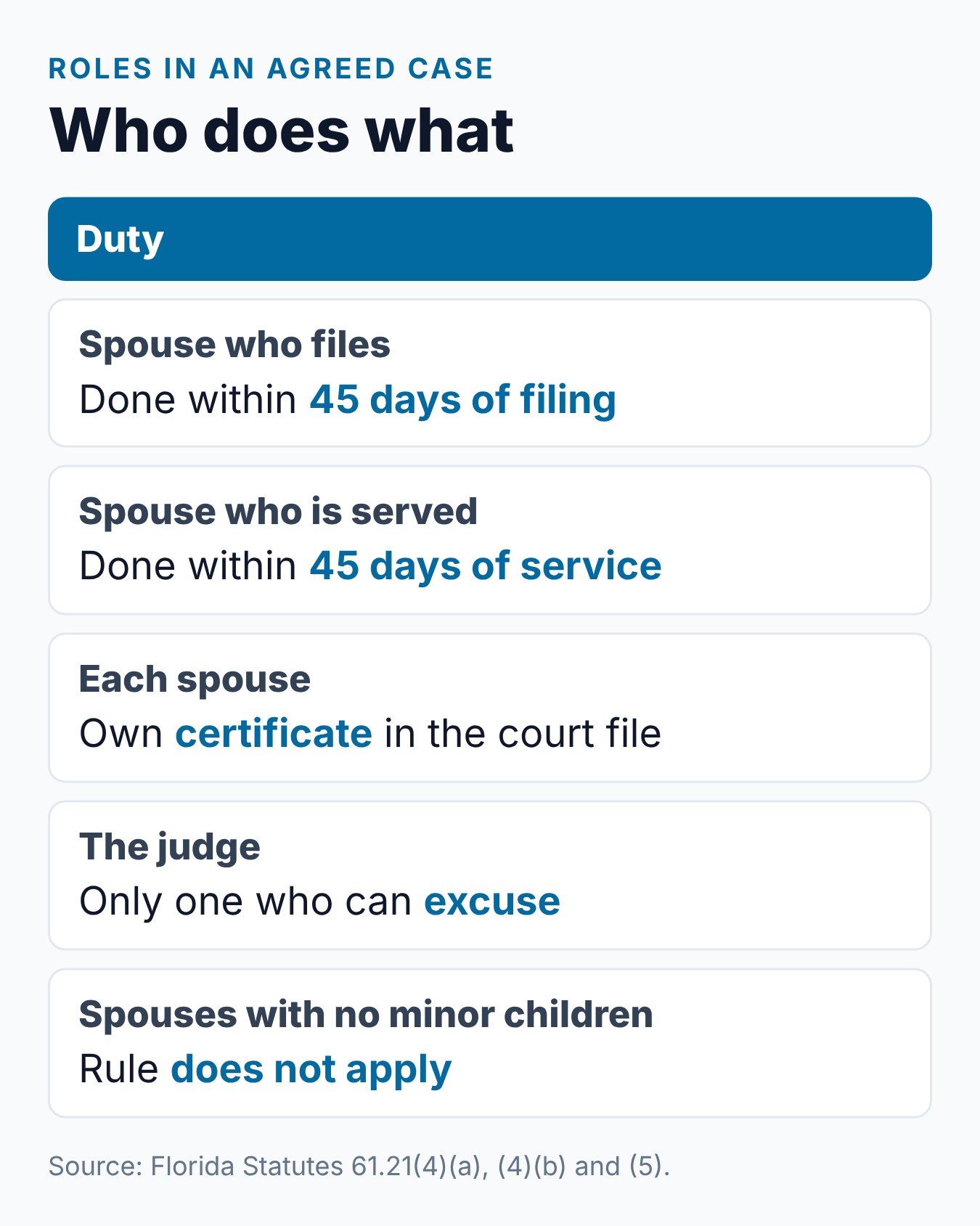
One spouse’s certificate does not count for the other. The provider issues a certificate to “each participant” who finishes and passes, under DCF rule 65C-32.004. So two spouses need two certificates.
Both Spouses File Proof
Subsection (5) says “each party” must file proof with the court before the final judgment. Court pages say the same thing in their own words:
- Palm Beach. The Fifteenth Circuit’s checklist for divorce with children lists the “Certificate of Completion of Parent Education Class” for both “Petitioner and Respondent.”
- Broward. The Broward County Clerk says “the parties shall separately attend” the course, and each party files a Certificate of Attendance.
- Orange and Osceola. The Ninth Circuit’s order 07-98-37-01 makes each party responsible for giving a certificate to the Clerk.
None of these pages makes an exception for agreed cases.
The Course Can Be the Last Open Item
In an agreed case, the spouses may settle the terms early. Yet the judgment still depends on the course. Subsection (4)(a) says the course comes “before the entry by the court of a final judgment.”
So the course can become the one task that holds up a settled case. The Ninth Circuit’s order says no divorce judgment involving parental responsibility “shall be granted in this Circuit” without proof. Starting early keeps the course from being the last item left.
Deadlines Still Apply
An uncontested case uses the same clocks as any other divorce. The petitioner has 45 days after filing. The respondent has 45 days after service of the petition.
The statute also says each party “shall begin the course as expeditiously as possible.” That instruction does not depend on agreement. Our timing guide shows how to count the days.
Only the Court Can Excuse
A judge can excuse a spouse from the course, or from finishing on time, for good cause. That power belongs to the court alone. The statute does not define good cause.
Spouses who agree on everything still cannot excuse each other. A signed settlement does not act as an excusal. Our guide on parents who agree covers that point in depth.
Divorces With No Minor Children
The rule turns on minor children. A divorce between spouses who have no minor children is outside section 61.21(4)(a). In that case, the statute does not require the course.
The answer does not depend on whether the case is contested. A disputed divorce without minor children is still outside the rule. A friendly divorce with minor children is still inside it.
Agreed Paternity Cases
The same logic applies outside divorce. Subsection (4)(a) also covers “a paternity action that involves issues of parental responsibility.” It does not exempt paternity cases where the parents agree.
The deadlines differ a little. The petitioner has 45 days after filing.
The other party’s 45 days start after an acknowledgment of paternity, an adjudication of paternity, or an order granting time-sharing or support. Our paternity and time-sharing guide explains those triggers.
Taking the Course Separately
Friendly spouses sometimes ask whether they can take the class together. The law allows it but does not require it. Section 61.21(10) says the parties are not required to attend together.
Broward’s Clerk goes further and says the parties “shall separately attend.” If there is a history of domestic violence, the court may stop spouses from taking the course together. So check your local rule before you plan a joint class.
What the Course Offers Agreeing Spouses
The course is not a test of whether spouses get along. DCF rule 65C-32.003 sets the same eight required parts for every course. They include:
- communicating with the children
- communicating with the other parent
- the developmental stages of childhood
- parenting time, with “suggestions about how to develop a parenting plan”
Those parts apply to friendly and disputed cases alike. The rule also requires information on domestic violence, child abuse and the hotlines.
What You Say Stays Out of the Case
Spouses who have settled may worry that the course could reopen issues. Section 61.21(8) addresses that. Statements made in the course “shall not be considered” in the case, and no report from the session goes into the record.
There is one exception. The parties can agree in writing to allow it. Without that written agreement, the course stays separate from the court file.
Fees for Two Spouses
Because each spouse takes the course, each one may pay a fee. Section 61.21(7) allows “a reasonable fee” for “each parent attending the course.” The state does not set a price.
DCF must list at least one site per circuit with a sliding fee scale, if available. Providers also may not charge more for the extra time or instruction needed to pass the test.
Planning the Course in an Agreed Case
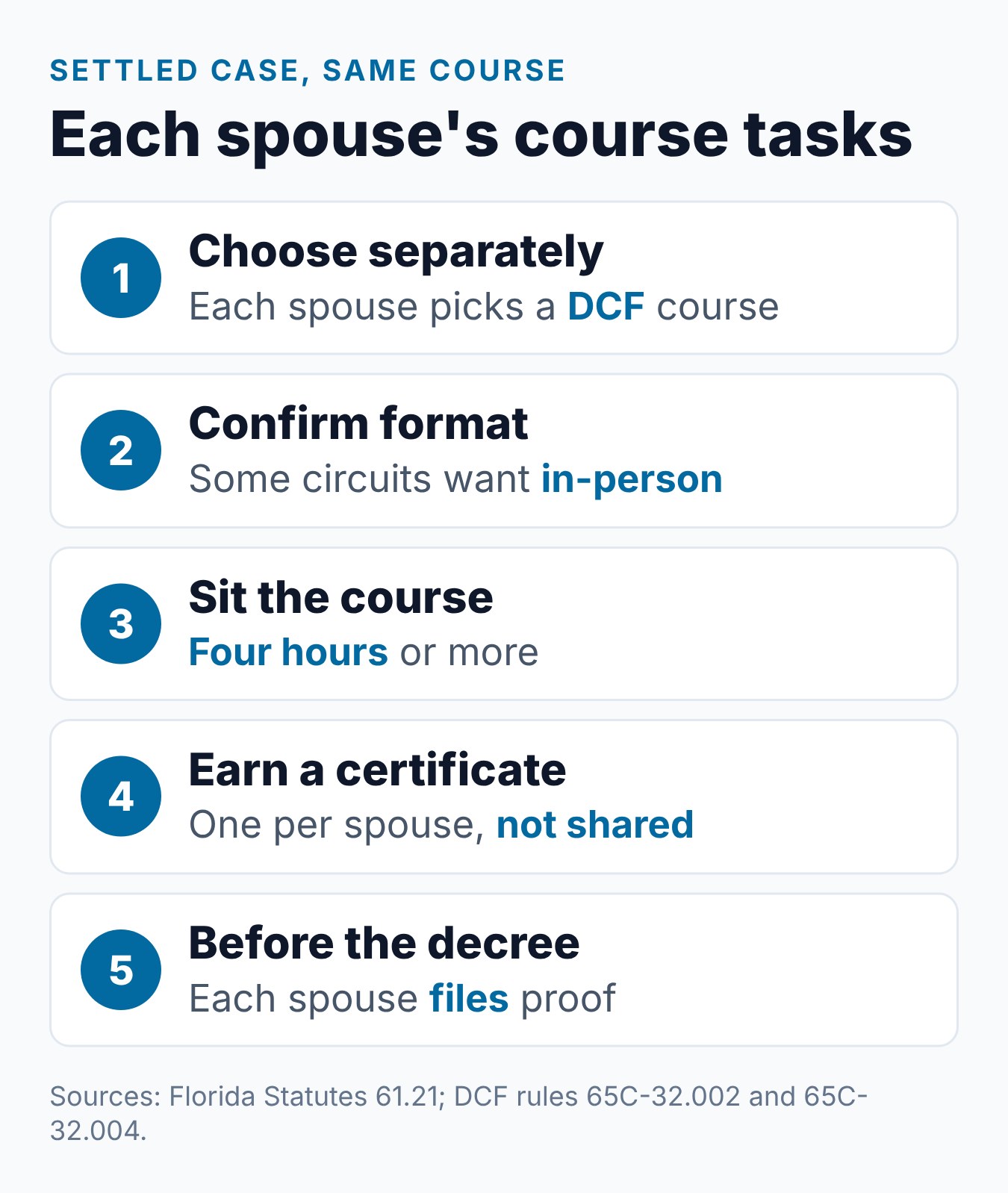
Agreement can make the rest of the case simpler, but each spouse still has course tasks. Use this list:
- Pick a course on DCF’s list. The DCF provider list shows approved courses.
- Check the format. Some courts require in-person classes, such as the Fourth Circuit.
- Set aside at least 4 hours. DCF rule 65C-32.002 counts the test inside the 4 hours.
- Pass the test. You need 70 percent, with unlimited attempts.
- File your own proof. Each spouse files before the final judgment.
If a child has special needs or emotional concerns, the statute calls for a special-needs course. DCF keeps a separate list of those courses.
Questions for the Clerk
The clerk cannot give legal advice, but can explain local steps. These questions fit an agreed case:
- How does this court want each spouse to file the certificate?
- Does this court accept online or correspondence courses?
- Does this circuit add a local step, such as an enrollment date?
- Is anything else needed before the judge can sign the final judgment?
Write down the answers and the date you asked. That way both spouses work from the same information.
Why the Law Reaches Agreed Cases
Section 61.21(1) gives the Legislature’s reasons for the course. It says parents benefit from early, general education about the court process, how families adjust, and community resources. Those findings do not limit the benefit to disputed cases.
The findings also note that children can suffer lasting harm, especially when conflict goes on for a long time. Our guide on why the class is required explains these findings.
What We Found on the Official Pages
On the court and clerk pages checked on October 26, 2026, none of the pages in this review used the word “uncontested” when describing the course. Each one described the course as a duty of each party in a case with minor children.
The Palm Beach checklist listed the certificate for both the petitioner and the respondent. It gave no deadline of its own.
Common Mistakes to Avoid
Each item is based on section 61.21, a DCF rule or a court page:
- Thinking agreement removes the class. The statute has no uncontested exception.
- Sharing one certificate. Each spouse needs a separate certificate.
- Leaving the course for last. The judgment waits for proof.
- Planning a joint class without checking. Broward says the parties attend separately.
- Taking the class with no minor children. The rule only covers divorces with minor children.
- Assuming any class works. The course must be approved by DCF.
How Requirements Can Vary
Section 61.21 of the Florida Statutes sets the course requirement for the whole state, and DCF approves the courses. Each judicial circuit can still add its own steps, such as how to file the certificate or which class formats it accepts. The Fourth Circuit (Duval, Clay and Nassau counties), for example, requires an in-person class.
Laws, court orders and local rules can change. Check your court’s instructions, your county clerk’s website and DCF’s provider list before you enroll or file.
Frequently Asked Questions
Do we need the parenting class if our divorce is uncontested?
Yes, if you have minor children. Section 61.21 covers all parties to a divorce with minor children and has no exception for uncontested cases.
Do both spouses have to take it?
Yes. “All parties” includes the petitioner and the respondent. Each spouse needs a separate certificate and files separate proof.
Can we agree to skip the class?
No. Only the court can excuse a party, and only for good cause. A settlement between spouses is not an excusal.
Can we take the class together?
The law does not require it. Some courts, such as Broward, say the parties attend separately, and the court can bar joint attendance if there is domestic violence.
What if we have no children together?
Then section 61.21 does not require the course. The rule only covers divorces with minor children and certain paternity cases.
Does an uncontested case change the online rules?
No. Format rules come from your court, not from whether you agree. The Fourth Circuit (Duval, Clay and Nassau) requires an in-person class, so check your court’s instructions.
Will the class slow down our divorce?
It can if it is left to the end, because the judgment waits for proof. Start soon after filing or service to avoid that.
Conclusion
The divorce parenting class Florida courts require does not go away when a divorce with minor children is uncontested. Each spouse finishes a DCF-approved course and files proof before the final judgment, unless the court excuses that spouse for good cause. You can take DivorceParentingClass.net’s online Florida parent education course, but first confirm that your court accepts an online course.
Related Articles
- Florida Parenting Class Requirement: Who Takes It and When
- Florida Parenting Course: Still Required If Parents Agree?
- Florida Divorce Parenting Class Requirement: Who It Covers
Sources
- Florida Statutes § 61.21 — Parenting course
- Fla. Admin. Code R. 65C-32.002 — Course length and delivery
- Fla. Admin. Code R. 65C-32.003 — Required course content
- Fla. Admin. Code R. 65C-32.004 — Test and certificate
- Florida DCF — Approved course provider list
- Florida DCF — Courses for children with special needs or emotional concerns
- Fifteenth Judicial Circuit — Divorce with children checklist (PDF)
- Broward County Clerk of Courts — Family
- Ninth Judicial Circuit — Administrative Order 07-98-37-01 (PDF)
Billy Forte is the owner of DivorceParentingClass.net.
This article is general information, not legal advice. Court rules, local practice, and case facts can differ by county, judge, and case type in Florida. Use official court and state sources, and consult a qualified Florida family law attorney for legal guidance specific to your case.