
Updated October 2026 · Reviewed by Billy Forte
Parenting classes West Palm Beach parents need for a divorce with children are the statewide Parent Education and Family Stabilization Course, and the Fifteenth Judicial Circuit’s divorce checklist lists a “Certificate of Completion of Parent Education Class” for both spouses. The checklist does not add a local deadline or filing method. Florida law supplies those rules: 45 days to finish, and proof filed before the final judgment.
Key Facts
- Local source: the Family Division checklist for a divorce with dependent or minor children. See the checklist.
- Who files: both the petitioner and the respondent. See the parent education line.
- Deadline: none on the checklist; state law gives 45 days. See statewide rules.
- Approval: DCF approves the course, not the circuit. See choosing a course.
- Online: the checklist does not say. See online classes.
The Fifteenth Circuit Checklist
Palm Beach County is in Florida’s Fifteenth Judicial Circuit. The circuit’s Family Division posts a checklist for a divorce with children. It is built around Family Law Form 12.901(b)(1), the “Petition for Dissolution of Marriage with Dependent or Minor Children.”
The checklist cites section 61.052 of the Florida Statutes. It shows no date or revision number.
The Parent Education Line
One item on the list is the “Certificate of Completion of Parent Education Class.” The checklist names the “Petitioner and Respondent” as the ones who file it.
That is the only local rule on the course that we found. The checklist gives no deadline and no other details for this item.
What Else Is on the Checklist
The course certificate sits among more than a dozen other papers. Here is how the checklist assigns some of them:
| Fifteenth Circuit checklist item | Who the checklist names |
|---|---|
| Financial Affidavit | Petitioner and Respondent |
| Notice of Social Security Number | Petitioner and Respondent |
| Marital Settlement Agreement, if all issues are agreed | Both parties, signed and notarized |
| UCCJEA Affidavit | Petitioner or Respondent |
| Child Support Guidelines Worksheet | Petitioner or Respondent |
| Parenting Plan, if agreed | Both parties, signed by both |
| Certificate of Compliance with Mandatory Disclosure | Both parties, unless they agree not to exchange |
| Certificate of Completion of Parent Education Class | Petitioner and Respondent |
The checklist also lists service papers, an answer and a default step. It says the list is the minimum and that more documents may be needed. It adds that legal advice should come from an attorney.
Two Basic Requirements
The checklist opens with two conditions for this kind of case:
- Either spouse must have lived in Florida for at least 6 months before filing.
- Both parties must agree the marriage is irretrievably broken.
It also says the respondent’s answer is due within 20 days of service. If no answer comes, a default can follow.
Parenting Classes West Palm Beach: What the Checklist Leaves Out
The checklist tells you that both spouses need the certificate. It does not tell you:
- when the course must be finished
- where or how to file the certificate
- whether an online course is accepted
- which providers to use
The checklist says it is meant to help get the case ready for a final hearing. So the certificate is one of the papers to have in place before then. For the missing details, state law and the court’s own instructions apply.
The Statewide Rules That Fill the Gaps
Section 61.21 sets the core rules for every county:
- Clock for the filer: the petitioner completes the course within 45 days of filing the petition.
- Clock for the other spouse: the respondent completes it within 45 days of being served.
- Proof: each party files proof of completion with the court before the final judgment.
- Start early: the law says to begin “as expeditiously as possible.”
A short example helps. If the respondent is served on March 3, day 45 is April 17.
The law covers more than divorce. In a paternity case that involves parental responsibility, the course is also required. In a case that changes a parenting plan or time-sharing schedule, the court may require it.
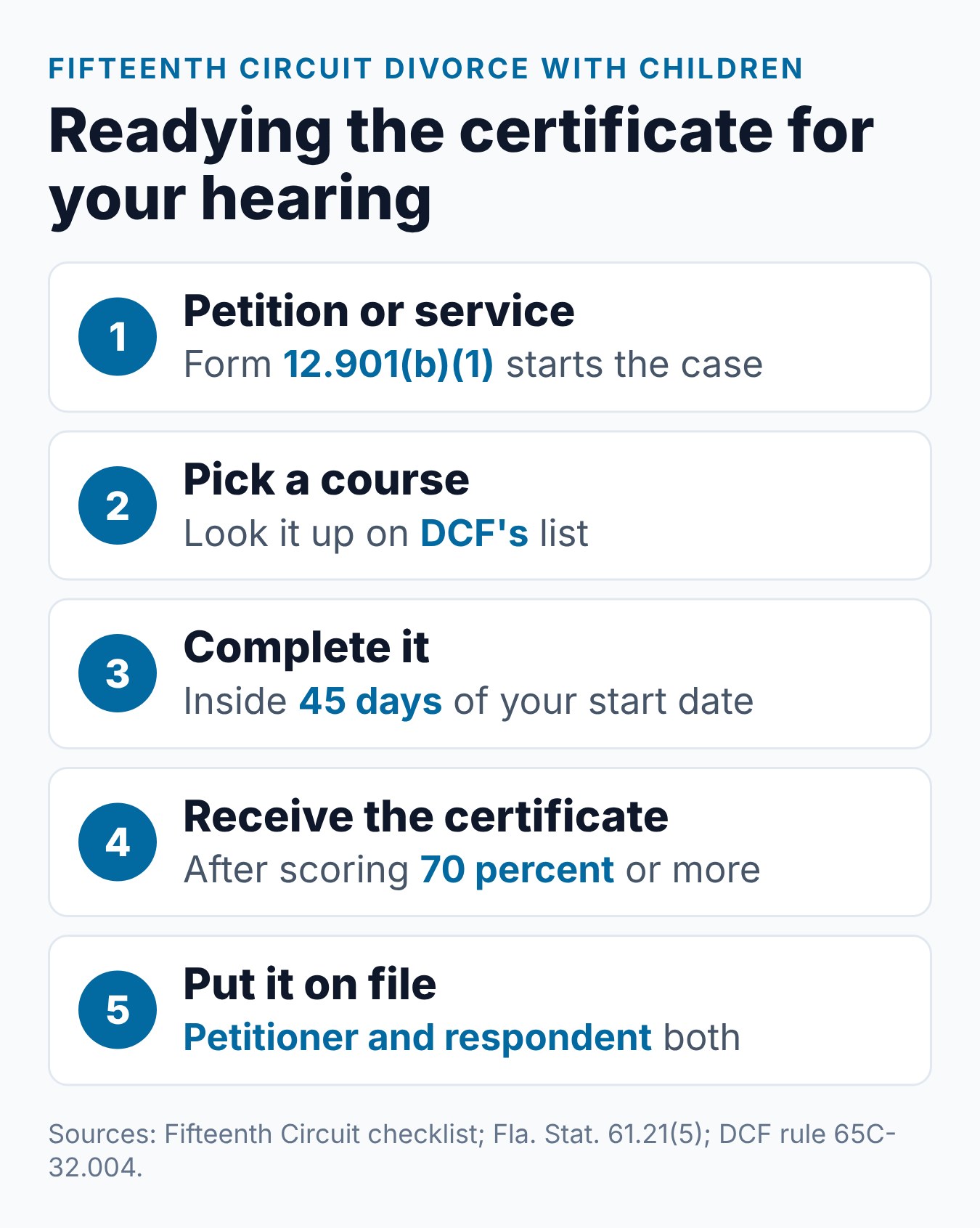
Where the Course Fits Among the Papers
The checklist is a list of papers, not a timeline. It does not number the items by date. Still, the course clock starts early in the case.
For the filing spouse, the 45 days begin when the petition is filed. For the other spouse, they begin at service.
Both events come near the start of the checklist. Other items, such as the parenting plan and the settlement agreement, are marked “if agreed” on the checklist.
So the course is one item you can act on without waiting for the other spouse. Each spouse handles his or her own course.
What the Course Covers
DCF’s rules list eight required parts. They run from divorce as a loss to talking with children and planning parenting time. Our guide on what the 4-hour class includes walks through each one.
Course vs Parenting Plan
The checklist lists both a parenting plan and the course certificate. They are not the same thing.
Under section 61.046, a parenting plan is “a document created to govern the relationship between the parents relating to decisions that must be made regarding the minor child.” Section 61.13 says an approved plan must at least cover daily tasks, the time-sharing schedule, health care, school matters and how parents talk with the child.
The course is an education requirement. It teaches ideas for building a plan, but it does not write or file one for you. See parenting plan vs the parent course.
Choosing an Approved Course
The Florida Department of Children and Families (DCF) approves the course, its providers and its sites. The circuit does not.
DCF’s provider list shows each course’s provider, languages, city, delivery method, indigent status and expiration date. Under rule 65C-32.005, an approval lasts three years.
DCF’s rule 65C-32.002 sets a minimum of four hours. That time includes the lessons, the exercises and the end-of-course test.
The same rule sets a few duties for every provider:
- Check each student’s identity.
- Stop online students from finishing in less than four hours.
- Let online and mail students reach an instructor.
- Answer questions about the content within one business day.
If your children have special needs or emotional concerns, state law says to choose a course made for them. DCF keeps a special-needs list.
Paying for the Course
No state price exists. Providers may charge “a reasonable fee” per parent.
DCF must list at least one sliding-fee site in each circuit, if one is available. A provider also may not charge extra when you need more time to pass the test.
Attending Apart and Keeping It Private
Spouses do not need to sit in the same class. Section 61.21 says the parties are not required to attend together. Where there is a history of domestic violence, the court can bar joint attendance without a motion from either spouse.
The class is also a safe place to speak. Statements made during the course are not considered in deciding the case. No report from the class goes into the record, unless the parties agree in writing.
Online Classes in Palm Beach
The checklist does not say whether an online course counts. We also could not read the circuit’s list of administrative orders, because the site blocks automated reading. So we cannot tell you of any Palm Beach order on the course format.
Florida law requires at least one statewide internet course. But not every court accepts online courses.
The Fourth Circuit, for one, requires an in-person class. Ask the court or the Clerk before you choose an online course for a Palm Beach case.
The Certificate Itself
The checklist calls it a “Certificate of Completion.” DCF’s rule 65C-32.004 sets what goes on it:
- the course name
- the provider’s name and contact information
- the curriculum’s unique name, if any
- the start date and the finish date
You get it after the full course and a test score of at least 70 percent. Test attempts are unlimited, and missed material is reviewed first. Providers keep copies for five years, so ask yours if you lose the original.
Questions for the Palm Beach Clerk
The checklist leaves practical points open. You can ask the Clerk’s office:
- How do I file the parent education certificate in my case?
- Does the court accept an online course?
- Is there a local order on the course I should read?
- What else should be filed before the final hearing?
Missing the Course
Under section 61.21(9), the court may hold a parent who skips the course in contempt. That parent may also be denied shared parental responsibility or time-sharing, or face other sanctions.
Only the court can excuse a parent, and only for good cause. An agreement between spouses does not remove the course.
What We Found on the Official Pages
On the Fifteenth Circuit checklist we checked on October 26, 2026, the parent education certificate was listed for both the petitioner and the respondent. The checklist had no date and set no deadline for the course.
We found no Palm Beach order on the course. The circuit’s order index blocks automated reading, so we could not search it.
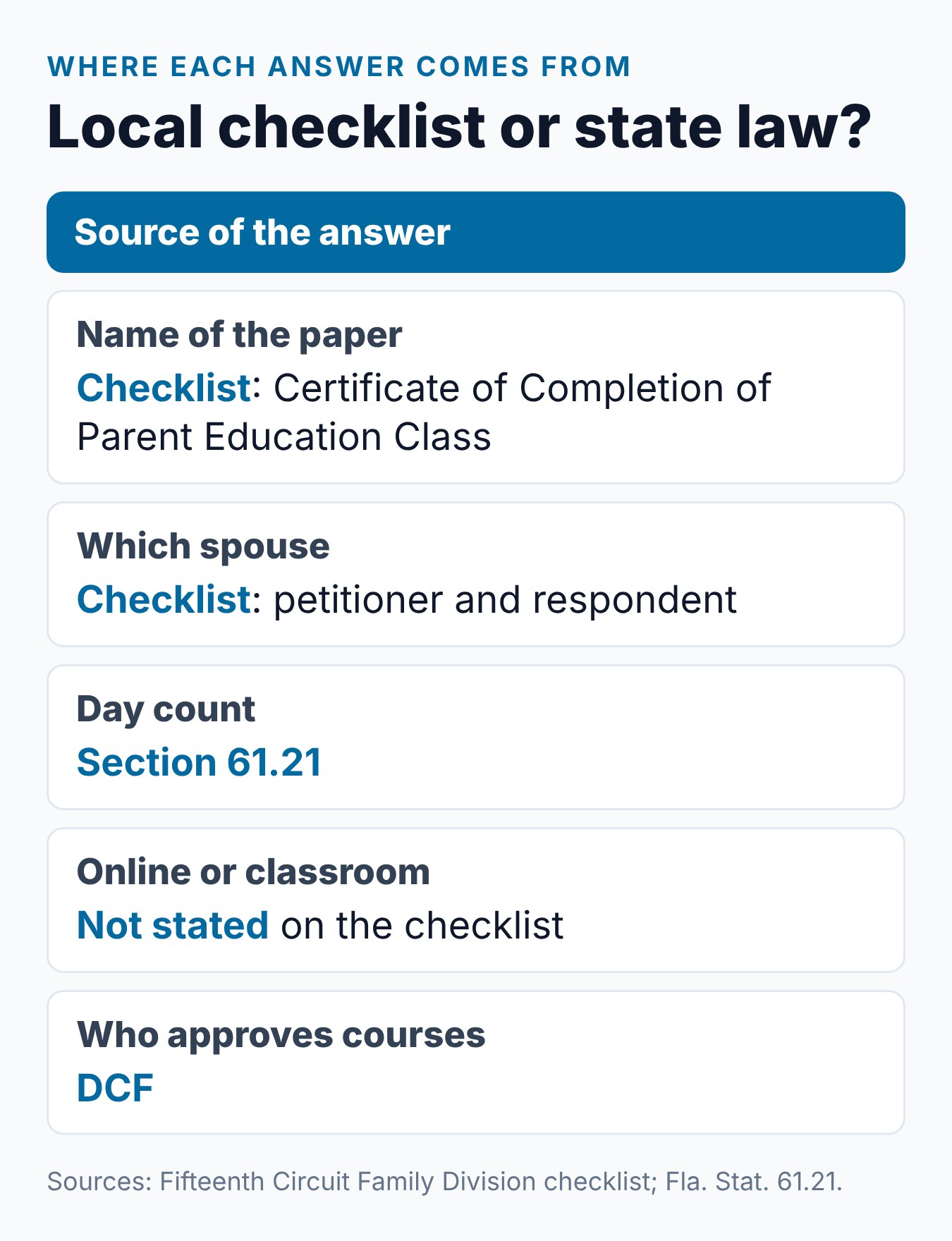
Common Mistakes to Avoid
Each point comes from the checklist or from section 61.21:
- Thinking only the petitioner needs it. The checklist names both spouses.
- Treating the parenting plan as the course. They are separate items on the checklist.
- Waiting for the final hearing. State law gives 45 days.
- Choosing a course not on DCF’s list. Only DCF-approved courses meet section 61.21.
- Assuming online counts. The checklist does not say; ask first.
How Requirements Can Vary
Section 61.21 of the Florida Statutes sets the course requirement for the whole state, and DCF approves the courses. Each judicial circuit can still add its own steps, such as how to file the certificate or which class formats it accepts. The Fourth Circuit (Duval, Clay and Nassau counties), for example, requires an in-person class.
Laws, court orders and local rules can change. Check your court’s instructions, your county clerk’s website and DCF’s provider list before you enroll or file.
Frequently Asked Questions
Do both spouses need a parenting class certificate in Palm Beach?
Yes. The Fifteenth Circuit checklist lists the “Certificate of Completion of Parent Education Class” for the petitioner and the respondent.
How long do I have to finish the class?
State law gives the petitioner 45 days after filing. The respondent has 45 days after service.
Is there a Palm Beach order on the class?
We found none. The checklist is the only local source we could read on the course.
Can I take the class online for a West Palm Beach divorce?
The checklist does not say. Ask the court or the Clerk before you choose an online course.
Is the parenting plan the same as the class?
No. The parenting plan is a document about your children. The class is an education requirement with its own certificate.
Does the checklist cover paternity cases?
No. This checklist is for a petition for dissolution of marriage with dependent or minor children. State law still requires the course in a paternity case that involves parental responsibility, so ask the Clerk about that case type.
Is what I say in the class private?
Yes, in the case itself. Section 61.21 keeps statements made in the course out of the decision, unless both parties agree in writing.
Who approves the class?
The Florida Department of Children and Families (DCF). Check the course on DCF’s provider list before you pay.
Conclusion
Palm Beach spouses should each finish an approved course within 45 days and have the certificate ready for the court, as the Fifteenth Circuit checklist expects. If you are considering DivorceParentingClass.net’s online Florida parent education course, confirm first that the court accepts an online course for your case. For questions about the other checklist items, ask the Clerk or a Florida family law attorney.
Related Articles
- Parenting Classes Florida by County: Court Certificate Guide
- Parenting Classes Fort Lauderdale: Broward County Guide
- Florida Divorce Checklist for Parents With Minor Children
- Parenting Plan Florida Rules vs. the Parent Education Course
Sources
- Fifteenth Judicial Circuit — Divorce with children checklist (PDF)
- Florida Statutes § 61.21 — Parenting course
- Florida Statutes § 61.046 — Definitions
- Florida Statutes § 61.13 — Parenting plans and time-sharing
- Fla. Admin. Code R. 65C-32.002 — Course length and delivery
- Fla. Admin. Code R. 65C-32.004 — Test and certificate
- Fla. Admin. Code R. 65C-32.005 — Provider approval
- Florida DCF — Approved course provider list
- Florida DCF — Courses for children with special needs or emotional concerns
Billy Forte is the owner of DivorceParentingClass.net.
This article is general information, not legal advice. Court rules, local practice, and case facts can differ by county, judge, and case type in Florida. Use official court and state sources, and consult a qualified Florida family law attorney for legal guidance specific to your case.