
Updated October 2026 · Reviewed by Billy Forte
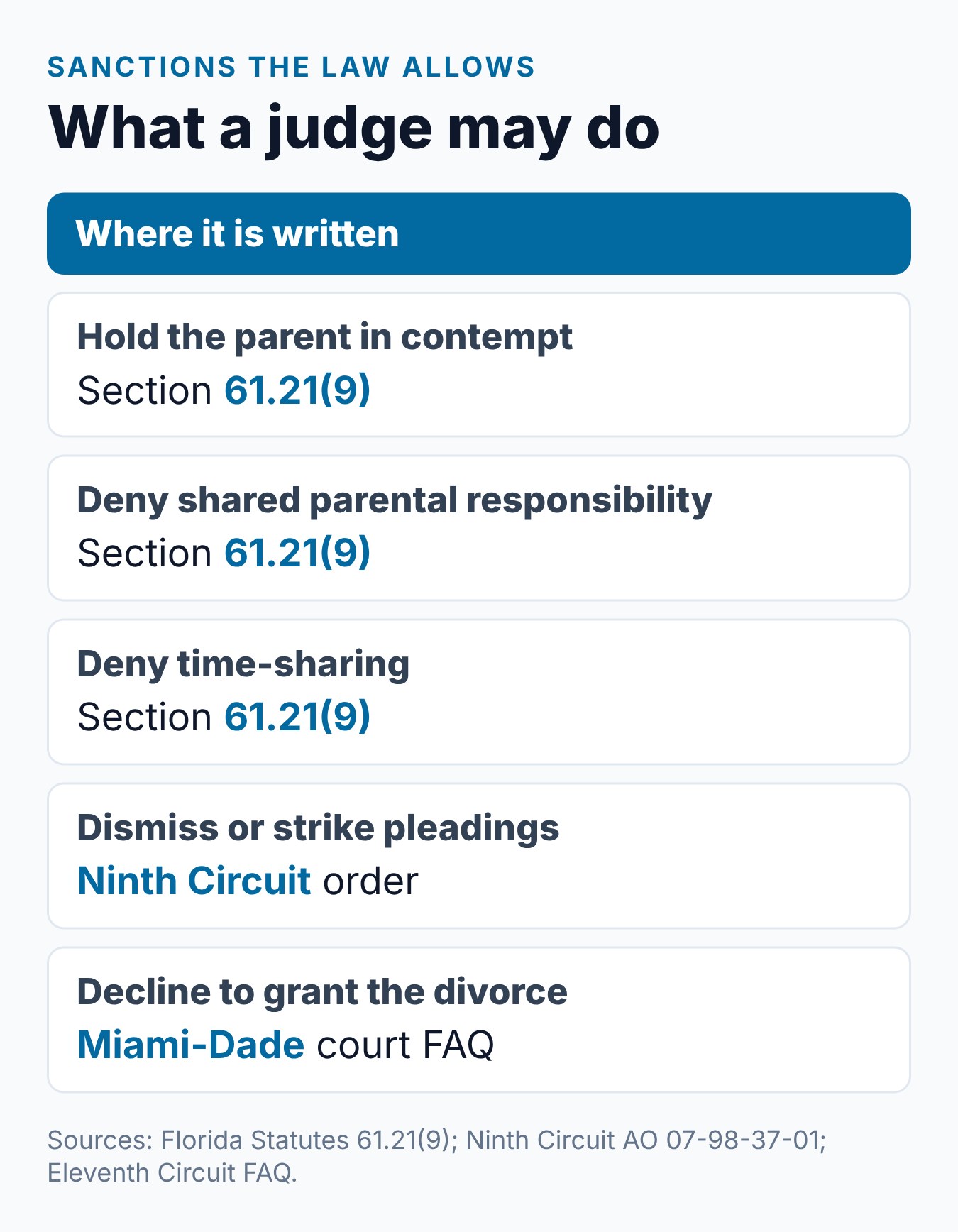
Skipping the parenting class Florida divorce courts require can hold up your whole case, because each parent must file proof of completion before the judge enters the final judgment. Section 61.21(9) also lets the court hold a parent in contempt, deny shared parental responsibility or time-sharing, or impose other sanctions. If you missed the 45-day deadline, finish the course as soon as you can and ask the court or a family law attorney about next steps.
Key Facts
- Final judgment: proof must be filed before the court enters it. See the final judgment waits.
- Contempt: the court may hold a parent who skips the course in contempt. See contempt.
- Parenting rights: a parent may be denied shared parental responsibility or time-sharing. See parenting rights.
- Local orders: the Ninth Circuit adds dismissal or striking of pleadings. See local orders.
- Late finish: only the court can excuse a late finish, for good cause. See if you already missed it.
Skipping the Parenting Class Florida Divorce Courts Require
The rule comes from section 61.21, Florida Statutes. It requires the Parent Education and Family Stabilization Course for all parties to a divorce with minor children. It also covers paternity cases about parental responsibility.
The statute names two kinds of results for a parent who does not take the course:
- A blocked judgment. Proof must be filed “prior to the entry of the final judgment.”
- Sanctions. Subsection (9) lists contempt, denial of shared parental responsibility or time-sharing, and other sanctions.
The sections below take each result in turn.
The Final Judgment Waits
Subsection (4)(a) says each covered party must complete the course “before the entry by the court of a final judgment.” Subsection (5) adds that each party “shall file proof of compliance” before that judgment.
In plain terms, the course is a step the case cannot skip. Even when everything else is ready, the judgment depends on that proof. The Ninth Circuit’s order says it directly: no divorce or paternity judgment involving parental responsibility “shall be granted in this Circuit” without proof.
Contempt of Court
The first sanction in subsection (9) is contempt. The court “may hold any parent who fails to attend a required parenting course in contempt.”
Contempt is the court’s power to respond when someone does not follow its rules or orders. The statute does not say what a contempt finding leads to in a course case. So it is a question for the judge in your case, and a family law attorney can explain it.
Shared Parental Responsibility and Time-Sharing
The second sanction goes to the heart of a parenting case. A parent who fails to attend “may be denied shared parental responsibility or time-sharing.”
Florida law defines these terms in section 61.046:
- Shared parental responsibility. Both parents keep full parental rights and responsibilities and make major decisions together.
- Sole parental responsibility. “A court-ordered relationship in which one parent makes decisions regarding the minor child.”
- Time-sharing schedule. “A timetable that must be included in the parenting plan.”
So skipping a 4-hour course can put a parent’s decision-making role and schedule at risk. That is why the course is worth finishing early.
“Otherwise Sanctioned”
The last words of subsection (9) are broad. The parent may be “otherwise sanctioned as the court deems appropriate.”
The statute does not list those other sanctions. It leaves them to the judge. Some local orders name more, as the next section shows.
What Local Courts Add
Circuit courts repeat the statute and sometimes add to it. These official sources name results for not finishing:
| Court | Result named for not finishing | Official source |
|---|---|---|
| Ninth Circuit (Orange, Osceola) | Dismissal of the action, striking of pleadings, or other sanctions | Order 07-98-37-01 |
| Ninth Circuit (Orange, Osceola) | No judgment on parental responsibility without proof | Order 07-98-37-01 |
| Eleventh Circuit (Miami-Dade) | The judge “may choose not to grant the divorce” or may find contempt | Court FAQ |
| Fourth Circuit (Duval, Clay, Nassau) | Contempt, or other “appropriate sanctions” | Family Court Services FAQ |
You can read the Ninth Circuit’s order 07-98-37-01 and Miami-Dade’s divorce education FAQ. The Fourth Circuit’s Family Court Services FAQ says the court may hold a parent who does not finish in contempt.
Paternity and Modification Cases
The sanctions are not limited to divorce. Subsection (9) applies to “any parent who fails to attend a required parenting course.” That wording reaches paternity cases about parental responsibility, where the course is also required.
In a modification case, the court may order the course under subsection (6). Once a judge orders it, it becomes a required course for that case. Our paternity and time-sharing guide covers both case types.
“May” Means the Judge Decides
Subsection (9) uses the word “may” for each sanction. It lists what the court can do, not what it must do in every case.
That means no article can tell you the result in your case. The judge looks at the facts. For that reason, ask the court or a family law attorney rather than guessing.
Late Is Not the Same as Never
Two problems can arise. A parent can finish after the 45-day deadline, or a parent can never take the course at all.
The statute treats the deadline and the course as separate things. Subsection (4)(b) lets the court excuse a party “from attending the parenting course, or from completing the course within the required time, for good cause.” So the court can excuse lateness without excusing the course.
A late finish still lets you file proof before the final judgment. Never finishing leaves the judgment blocked unless the court excuses you.
Failing the Test Is Not Skipping
Some parents worry that a low test score counts as not finishing. DCF rule 65C-32.004 answers that:
- Unlimited attempts. “Participants shall have an unlimited number of attempts to pass the end of course test.”
- Review first. A score below 70 percent means reviewing the missed material before a retake.
- No extra fees. Providers may not charge more for extra time or instruction.
The certificate goes to each parent who finishes at least 4 hours and scores 70 percent or more. A parent who keeps working can reach that score.
If You Already Missed It
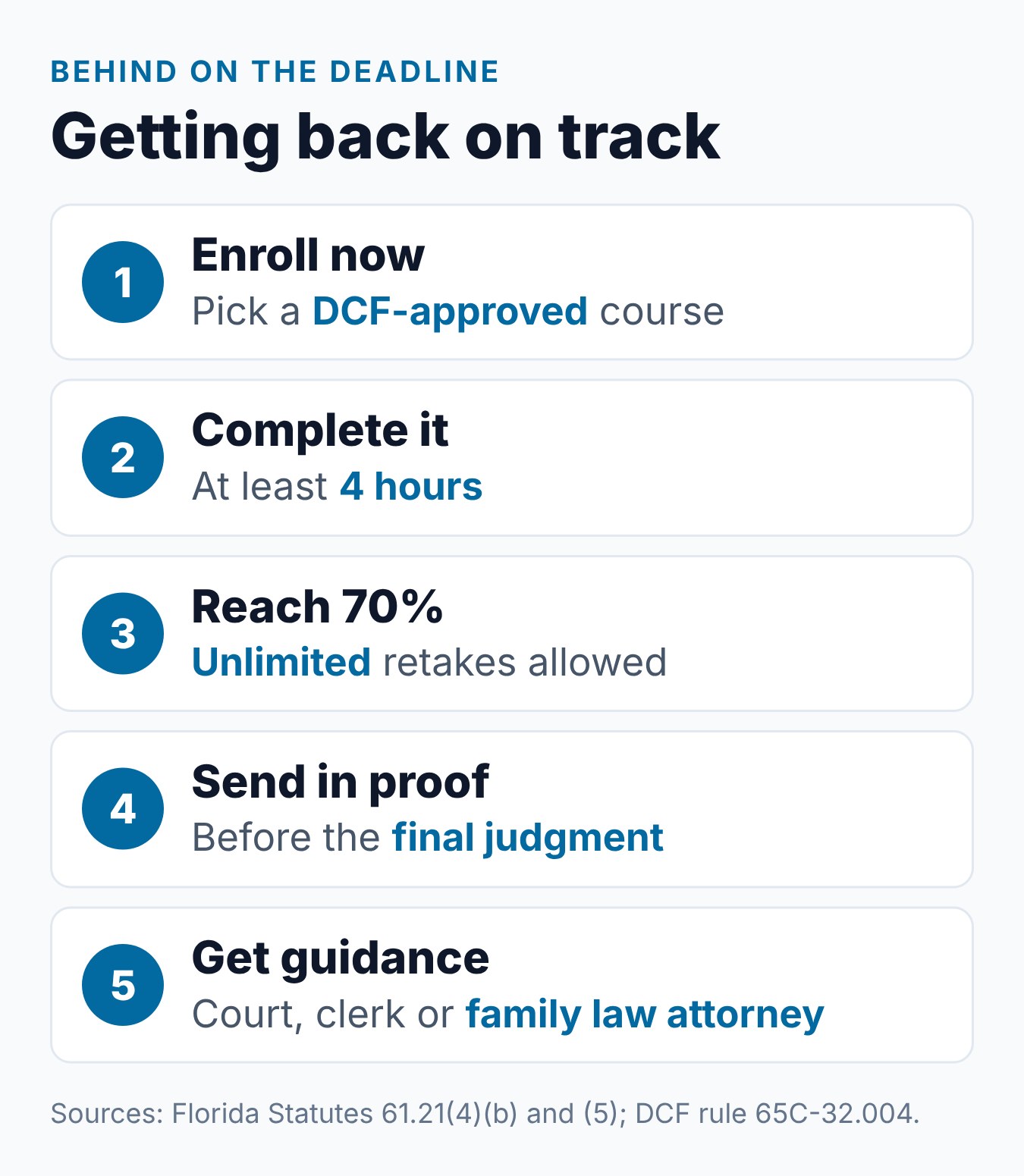
Missing the deadline does not end the requirement. These steps follow the statute:
- Finish the course. Take a DCF-approved course as soon as you can.
- Pass the test. Score at least 70 percent; retakes are allowed.
- Get the certificate. It comes from the provider after you pass.
- File proof. Follow your clerk’s instructions before the final judgment.
- Ask for guidance. The court or a family law attorney can explain your options.
Only the court can excuse the deadline, for good cause. Our waiver guide explains that rule. Never ignore a court order or deadline while you sort it out.
Proof Counts as Much as Finishing
A finished course with no proof on file leaves the same gap. The statute ties the judgment to filed proof, not just to the class.
Courts describe the filing step in their own words:
- Broward. The Broward County Clerk says each party is responsible for “immediately filing” the Certificate of Attendance in the court file.
- Ninth Circuit. Each party is responsible for giving a certificate of completion to the Clerk of the Circuit Court.
- Fourth Circuit. The standing order says to file the Certificate of Completion in the court file “promptly.”
Keep a copy of your certificate after you file it. The provider must also keep copies for five years.
When the Other Parent Has Not Finished
Each parent carries a separate duty. The statute says “each party” files proof, and the sanctions apply to “any parent who fails to attend.”
So your duty does not change if the other parent falls behind. Finish your own course and file your own proof. If the other parent’s delay affects your case, ask a family law attorney what the court can do.
Questions to Bring to an Attorney
A family law attorney can apply the rules to your case. These questions can help you use that time well:
- Has the court set a hearing or trial date that the course must come before?
- Does my circuit’s order add steps, such as a set filing method?
- Would the court consider excusing my late finish for good cause?
- How do I show the court that I have now finished?
The clerk can explain filing steps but cannot give legal advice. The judge makes the final call on any sanction.
What We Found on the Official Pages
On the court pages checked on October 26, 2026, the Ninth Circuit’s order was the only one that named dismissal or striking of pleadings. It also said waivers “shall not be liberally provided.”
Miami-Dade’s FAQ said the judge may refuse the divorce or hold a parent in contempt. The Fourth Circuit’s FAQ told parents they must register for one of its in-class programs.
The same FAQ answer also points parents to DCF’s list of local and online providers. So ask the circuit’s Family Court Services which class applies to your case.
Common Mistakes to Avoid
Each item is based on section 61.21, a DCF rule or a court order:
- Thinking the judgment will come anyway. Proof must be filed first.
- Treating a failed test as the end. Attempts are unlimited.
- Waiting for the other parent. Each parent has a separate duty.
- Assuming a late finish is useless. You can still file proof before the judgment.
- Agreeing to skip it with your ex. Only the court can excuse a party.
- Finishing but not filing. The court needs the proof in its file.
How Requirements Can Vary
Section 61.21 of the Florida Statutes sets the course requirement for the whole state, and DCF approves the courses. Each judicial circuit can still add its own steps, such as how to file the certificate or which class formats it accepts. The Fourth Circuit (Duval, Clay and Nassau counties), for example, requires an in-person class.
Laws, court orders and local rules can change. Check your court’s instructions, your county clerk’s website and DCF’s provider list before you enroll or file.
Frequently Asked Questions
What is the penalty for not taking the parenting class in Florida?
Section 61.21(9) lets the court hold the parent in contempt, deny shared parental responsibility or time-sharing, or impose other sanctions. The judge decides which, if any, apply.
Can my divorce be finalized without the class?
Not under the statute’s normal rule. Each party must file proof of completion before the final judgment, unless the court excuses that party for good cause.
I missed the 45-day deadline. Can I still take the course?
Yes. Finish the course as soon as you can and file proof. Then ask the court or a family law attorney about the late finish.
Can the court dismiss my case?
In the Ninth Circuit (Orange and Osceola), the order says failure may lead to dismissal or striking of pleadings. Other courts may differ, so check your circuit’s rules.
Does failing the test count as not completing?
No. DCF rules give unlimited attempts and require a review of missed material before each retake. The certificate comes once you score at least 70 percent.
Do the same sanctions apply in a paternity case?
Yes. Subsection (9) covers any parent who fails to attend a required course. Paternity cases about parental responsibility require the course.
Will I lose time-sharing if I miss the class?
The court may deny time-sharing or shared parental responsibility, but the statute says “may,” not “must.” The judge decides based on the case.
What if my ex never takes the class?
Each parent has a separate duty to finish and file proof. Take care of your own course, and ask a family law attorney how the court may respond.
Conclusion
Skipping the parenting class Florida divorce courts require can block your final judgment and expose you to contempt or limits on parental responsibility and time-sharing. If you are late, finish the course, file proof, and ask the court or an attorney about next steps. You can take DivorceParentingClass.net’s online Florida parent education course, but first confirm that your court accepts an online course.
Related Articles
- Florida Parenting Class Requirement: Who Takes It and When
- Can the Parenting Course Florida Requires Be Waived?
- When to Take a Parenting Class for Divorce in Florida
Sources
- Florida Statutes § 61.21 — Parenting course
- Florida Statutes § 61.046 — Definitions
- Fla. Admin. Code R. 65C-32.004 — Test and certificate
- Ninth Judicial Circuit — Administrative Order 07-98-37-01 (PDF)
- Eleventh Judicial Circuit — Divorce Education Program FAQ
- Fourth Judicial Circuit — Family Court Services FAQ
- Broward County Clerk of Courts — Family
Billy Forte is the owner of DivorceParentingClass.net.
This article is general information, not legal advice. Court rules, local practice, and case facts can differ by county, judge, and case type in Florida. Use official court and state sources, and consult a qualified Florida family law attorney for legal guidance specific to your case.