
Updated October 2026 · Reviewed by Billy Forte
Before you buy or file one of the parenting classes for court in Florida, check five things: current DCF approval, a format your court accepts, a special-needs course if your children need one, the items DCF requires on the certificate, and your name if it is shown. If a court still rejects a certificate, ask the clerk or the court why and follow its instructions. Complaints about a provider go to DCF at Parentstabilizationcourse@myflfamilies.com.
Key Facts
- Approval: the provider must be on DCF’s list, and approvals last three years. See check 1.
- Format: some courts require an in-person class. See check 2.
- Special needs: some families must take a special-needs course. See check 3.
- The paper: the certificate must show the items in DCF rule 65C-32.004. See check 4.
- After a rejection: ask why, then follow the court’s instructions. See what to do.
Five Checks Before You Buy or File
No official page we read lists reasons courts reject certificates. What the rules do give is a list of things a valid course and certificate must have. Checking those first lowers the risk of a problem.
| Check | Where to look | Official basis |
|---|---|---|
| Provider is DCF-approved and current | DCF provider list, Exp. Date column | Section 61.21(3); rule 65C-32.005 |
| Format fits your court | Your circuit’s order or FAQ | Fourth Circuit standing order |
| Special-needs course, if needed | DCF special-needs list | Section 61.21(4)(a) |
| Certificate shows required items | The certificate itself | Rule 65C-32.004 |
| Name and case match | Your court papers | Your clerk’s instructions |
Check 1: DCF Approval Is Current
Florida’s Department of Children and Families (DCF) approves the course, its providers and its sites. That is in section 61.21, Florida Statutes. People search for “court-approved” classes, but in Florida the approval comes from DCF.
DCF’s provider list says, “The providers listed are approved by the Florida Department of Children and Families.” Its table includes an Exp. Date column.
That date matters. Under DCF rule 65C-32.005, approval “is valid for three (3) years.” DCF’s provider page adds that approvals “must be renewed.” Check the date before you pay.
Also look at the course materials. Rule 65C-32.006 says the notice of DCF approval “shall be included in all course materials.”
Why “Court-Approved” Can Mislead
Florida courts used to approve parenting courses at the circuit level. A 2003 change in the law removed the rule that the circuit approve parenting courses. Today, section 61.21 gives DCF the job of approving them.
The Sixth Circuit’s Administrative Order 2003-039 rescinded its old order for that reason.
The statute still uses the words “court-approved parenting course” in two places. Even so, the list that counts is DCF’s. A class that calls itself approved by a court is not the test; a current spot on DCF’s list is.
Check 2: A Format Your Court Accepts
Florida law requires DCF to approve at least one statewide course on the internet and one by correspondence. But not every court accepts every format.
The Fourth Circuit covers Duval, Clay and Nassau counties. Its standing family law order calls for a named course “or a similar qualified inperson program.” Its Family Court Services FAQ says, “YOU MUST REGISTER FOR ONE OF THE FOLLOWING IN-CLASS PARENTING CLASSES.”
The same FAQ answer also points parents to DCF’s list of local and online providers. So ask the circuit’s Family Court Services which class applies to your case.
So a DCF-approved online course may still not meet that circuit’s order. Read your own circuit’s instructions before you choose a format.
Check 3: A Special-Needs Course If Needed
Section 61.21(4)(a) adds a rule for some families. If the children have identified special needs or emotional concerns, the parties “must select” a course designed for those needs.
DCF keeps a separate list of those courses. If this rule applies to your family, a general course may not meet it. Ask the court if you are unsure.
Check 4: The Required Certificate Items
DCF rule 65C-32.004 lists what the certificate must show:
- The name of the course.
- The provider’s name and contact information.
- The curriculum name, if any.
- The date you began and the date you finished.
A certificate is issued only to a parent who completes at least four hours and scores at least 70 percent. Our page on what the certificate must show explains each item.
Check 5: Your Name and Your Case
If your certificate shows your name, make sure it matches the name in your case. The DCF rule does not require the name, so ask the provider if it is missing. A mismatch can make it hard for the clerk to tie the paper to you.
The DCF rule does not require a case number on the certificate. Follow your clerk’s instructions on how to show the case number when you file.
Signs a Course Follows DCF Rules
DCF rule 65C-32.002 sets delivery rules for every approved course. You can watch for these signs as you take it:
- A four-hour minimum. Online courses must have a way to stop anyone from finishing in under four hours.
- An identity check. All courses must include a way to verify who is taking them.
- Instructor access. Online and mail courses must let you contact the instructor, and content questions get an answer within one business day.
- An approval notice. Course materials must show DCF’s approval.
A course that skips these steps does not follow the DCF rules. That is worth knowing before you file its certificate.
Filing Points to Rule Out
Some problems have nothing to do with the course itself. Review these filing points from the statute and court orders:
- Timing. Each party finishes within 45 days of filing or service, and files proof before the final judgment.
- Who filed. Each party files his or her own proof.
- Where it went. Proof belongs in the court file for your case.
Our guide on filing the certificate covers what four courts say about filing.
If the Court Rejects Your Certificate
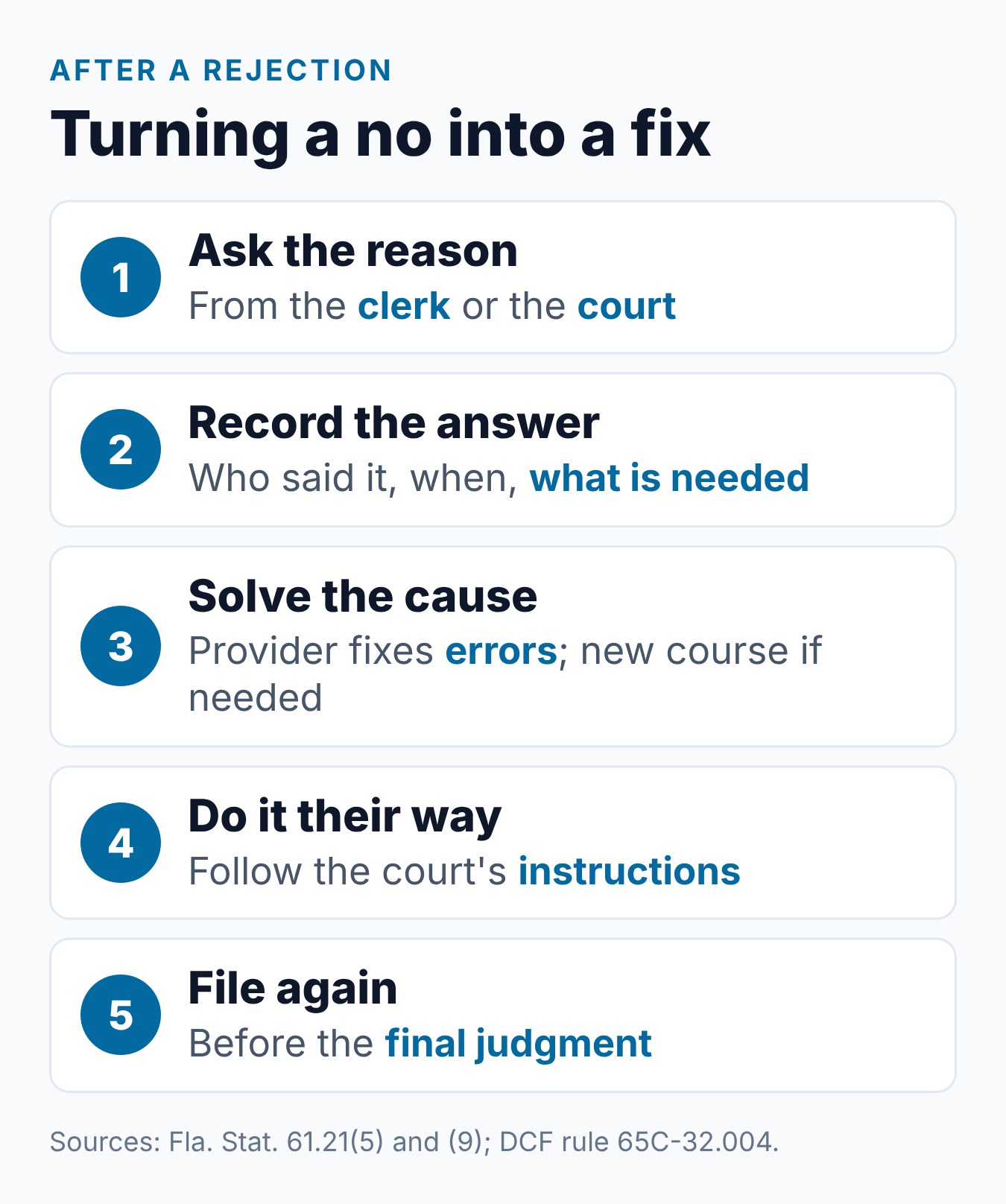
Stay calm and get facts first. Then take these steps:
- Ask why. Ask the clerk or the court what the problem is.
- Write it down. Note who told you, when, and what they need.
- Fix the cause. A wrong name or date goes to the provider. A wrong format or course type may mean a new course.
- Follow the instructions. Do what the clerk or court tells you, in the way it tells you.
- Refile. File the corrected proof in your case before the final judgment.
Do not guess at the fix. The court’s answer decides what you need to do.
When a New Course Is Needed
If the court says you need a different course, choose one that meets every check above. Pick a provider on DCF’s list with a current date, in a format your court accepts.
The DCF rules give some protection on the test. Attempts are unlimited, missed material is reviewed before a retake, and providers may not charge extra fees for added time or instruction to pass.
Keep Records While You Fix It
Hold on to every paper while the problem is open. Keep the certificate, your receipt, and your notes from the clerk.
If the certificate itself goes missing, the provider can help, since the DCF rule makes providers keep copies for five years. See how to get another copy.
When to Contact DCF
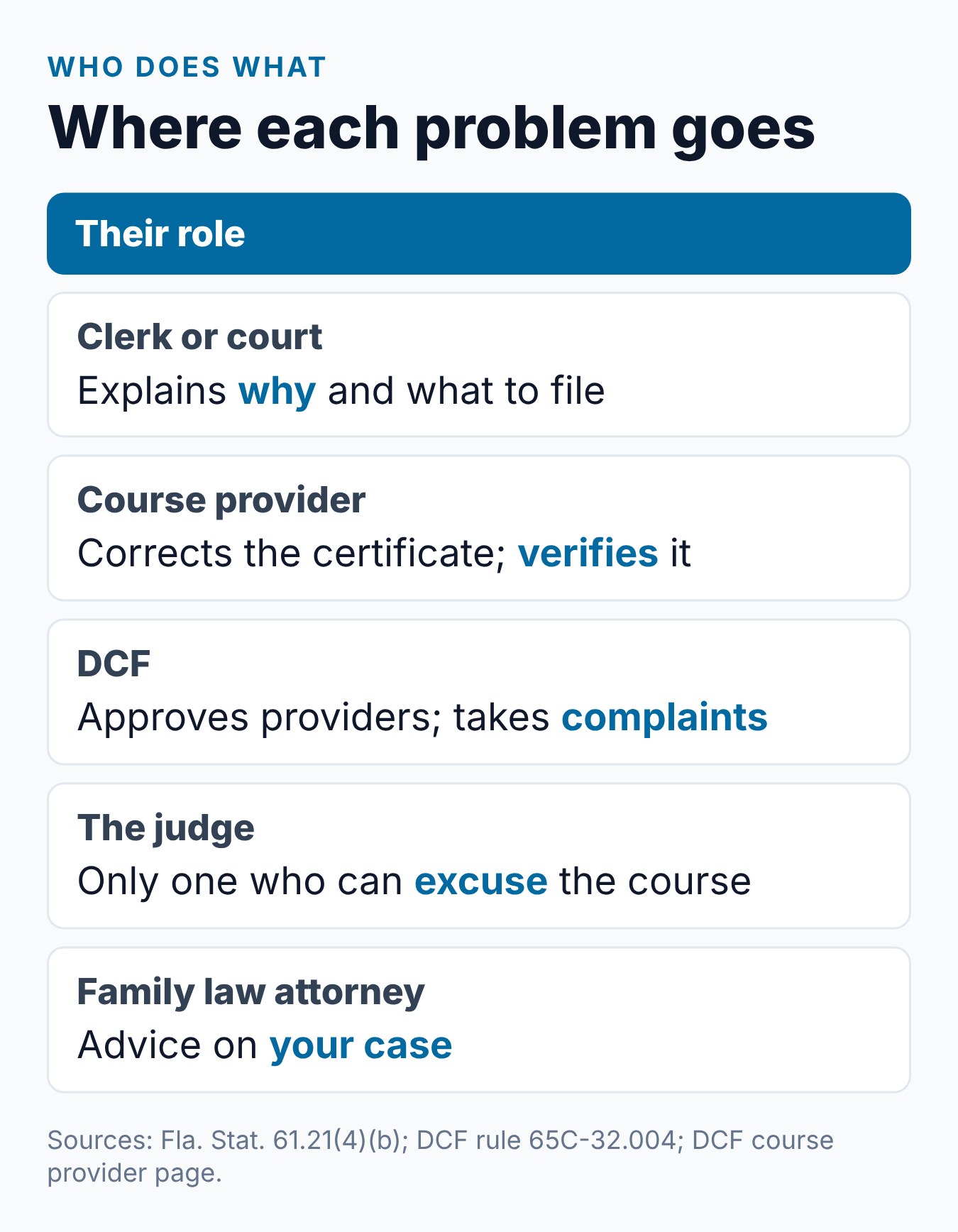
DCF is “responsible for approving providers, instructors, and course curriculum,” says its course provider page. The same page lists Parentstabilizationcourse@myflfamilies.com for complaints.
Contact DCF if you have a complaint about a provider. DCF does not decide your court case, so keep the court informed as well.
Deadlines Still Apply
A rejected certificate does not pause the rules. Under section 61.21(9), a court may hold a parent who fails to attend a required course in contempt, deny shared parental responsibility or time-sharing, or impose other sanctions.
Some courts add their own steps. The Ninth Circuit’s parenting class order says failure “may result in the Court’s dismissal of the action, striking of pleadings, and/or other appropriate sanctions.” So act quickly once you learn of a problem.
Only the Court Can Excuse the Course
If you cannot meet the requirement, only the court can excuse you, for good cause. That is section 61.21(4)(b). The Ninth Circuit adds that such waivers “shall not be liberally provided.”
Parents cannot agree to skip the course. If you think you have good cause, a Florida family law attorney can explain your options.
How This Fits the Certificate Process
A rejection is a problem at the end of a longer process. First you choose an approved course and finish it. Then the provider issues the certificate, and you file it in your case.
Our guide to getting your Florida parenting class certificate covers each of those steps. Getting the early steps right lowers the chance of a problem at the end.
What We Found on the Official Pages
On the DCF and court pages we checked on October 26, 2026, we found no official list of reasons a certificate is rejected. We did find the rules a course and certificate must meet, and those are the checks above.
DCF’s provider page still listed Parentstabilizationcourse@myflfamilies.com as its complaint contact. The provider list still showed an expiration date column for each provider. DCF’s special-needs page listed two approved courses for families of children with special needs or emotional concerns.
Common Mistakes to Avoid
Each item comes from section 61.21, a DCF rule or a court order above:
- Skipping the Exp. Date. DCF approvals last three years.
- Assuming online fits everywhere. The Fourth Circuit requires an in-person class.
- Missing the special-needs rule. Some families must take a special-needs course.
- Filing with a wrong name. Fix it with the provider first.
- Guessing at the fix. Ask the clerk or court what it needs.
- Asking DCF to rule on your case. DCF handles provider complaints; the court decides your case.
How Requirements Can Vary
Section 61.21 of the Florida Statutes sets the course requirement for the whole state, and DCF approves the courses. Each judicial circuit can still add its own steps, such as how to file the certificate or which class formats it accepts. The Fourth Circuit (Duval, Clay and Nassau counties), for example, requires an in-person class.
Laws, court orders and local rules can change. Check your court’s instructions, your county clerk’s website and DCF’s provider list before you enroll or file.
Frequently Asked Questions
Why would a Florida court reject a parenting class certificate?
No official list of reasons exists. Check that the provider is DCF-approved and current, the format fits your court, the course type fits your family, and the certificate shows the required items.
What should I do first if it is rejected?
Ask the clerk or the court why, and write down the answer. Then follow its instructions.
Are parenting classes for court approved by the court?
In Florida, DCF approves the course, providers and sites under section 61.21. Your court decides what proof it accepts in your case.
How do I check a provider’s approval date?
Look at the Exp. Date column on DCF’s provider list. Approvals are valid for three years.
Where do I complain about a provider?
DCF’s course provider page lists Parentstabilizationcourse@myflfamilies.com for complaints.
Do I have to pay again to retake the test?
Not for passing the test. The DCF rule says providers may not charge extra fees for added time or instruction needed to pass.
Can a court turn down a DCF-approved online course?
It can if its own order requires another format. The Fourth Circuit requires an in-person class from its local list. Check your court’s instructions before you enroll.
Can parents agree to skip the course instead?
No. Only the court can excuse a party, for good cause, under section 61.21(4)(b).
Conclusion
Parenting classes for court in Florida must come from a DCF-approved provider, in a format your court accepts, with a certificate that shows the required items. If a court rejects yours, ask why, fix the cause, and follow its instructions.
To compare options, see DivorceParentingClass.net’s online Florida parent education course. Before you enroll, confirm that your court accepts an online course.
Related Articles
- How to Get Your Florida Parenting Class Certificate
- Certificate of Completion Parenting Class: What It Must Show
- How to Submit Your Parenting Class Certificate of Completion
- Lost Your Parenting Certificate? How to Get a Florida Copy
Sources
- Florida Statutes § 61.21 — Parenting course
- Fla. Admin. Code R. 65C-32.004 — Test and certificate
- Fla. Admin. Code R. 65C-32.005 — Provider approval
- Fla. Admin. Code R. 65C-32.006 — Approval process
- Florida DCF — Approved course provider list
- Florida DCF — Course provider process
- Florida DCF — Courses for children with special needs or emotional concerns
- Fourth Judicial Circuit — Standing Family Law Order (PDF)
- Fourth Judicial Circuit — Family Court Services FAQ
- Ninth Judicial Circuit — Administrative Order 07-98-37-01 (PDF)
Billy Forte is the owner of DivorceParentingClass.net.
This article is general information, not legal advice. Court rules, local practice, and case facts can differ by county, judge, and case type in Florida. Use official court and state sources, and consult a qualified Florida family law attorney for legal guidance specific to your case.