
Updated October 2026 · Reviewed by Billy Forte
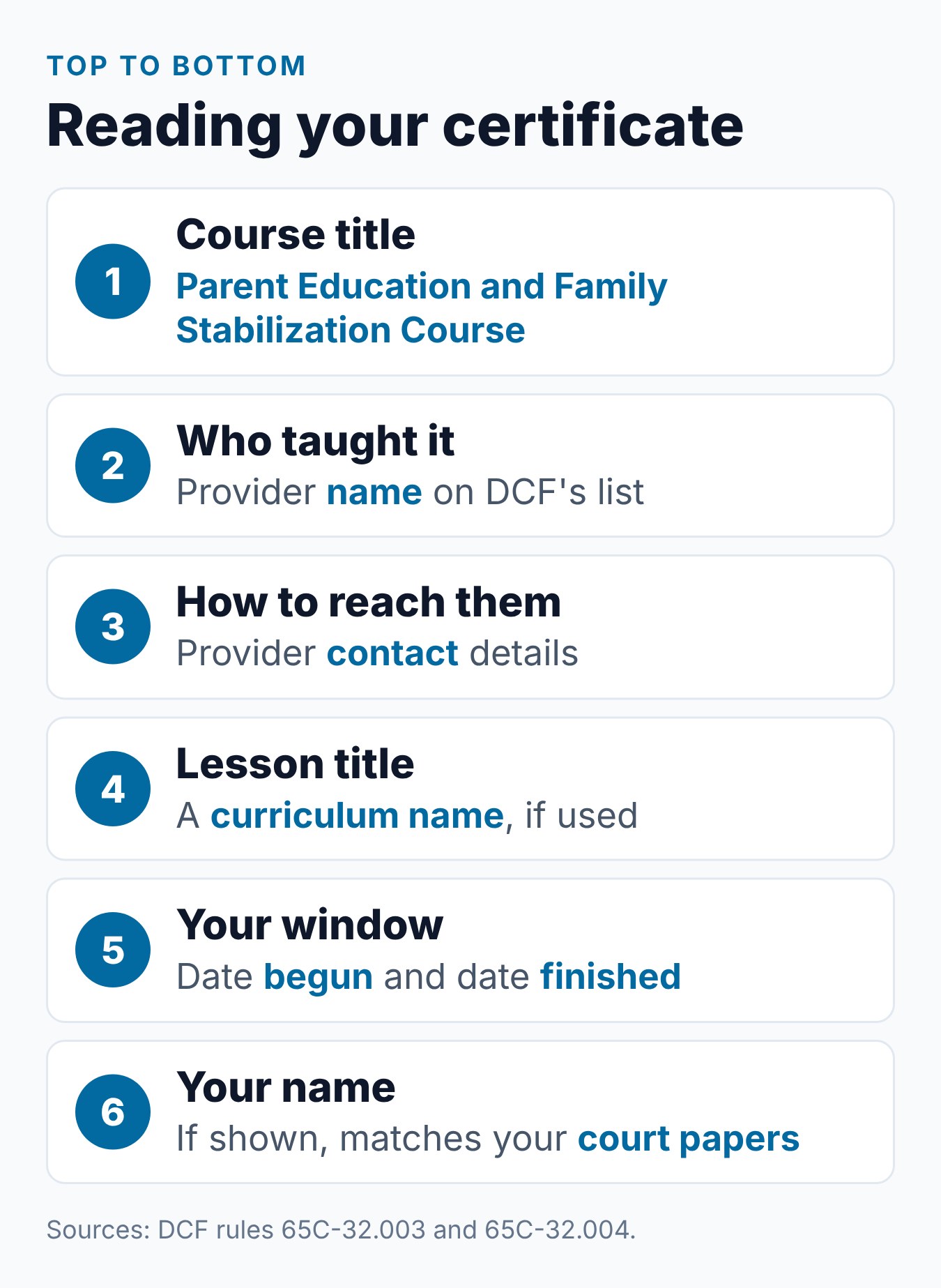
If you are checking a certificate of completion parenting class providers issue in Florida, DCF rule 65C-32.004 says it must show the course name, the provider’s name and contact information, the curriculum name if any, and the dates you began and finished. The rule does not list a case number or a court, so follow your court’s filing instructions for those. If your certificate shows your name, also make sure it is spelled the way it appears in your case.
Key Facts
- Required items: course name, provider name and contact information, curriculum name if any, and start and finish dates. See what the rule requires.
- Left out: the rule lists no case number, court or judge. See what the rule does not list.
- Your name: check the spelling against your court papers. See check your name.
- Case number: some courts tie sign-up to it, so follow local steps. See the case number question.
- Verification: providers must be able to confirm a certificate is real. See how a court can verify it.
What a Certificate of Completion Parenting Class Must Show
The content of the certificate is set by DCF rule 65C-32.004. It says the certificate “shall include the name of the course, the provider’s name and contact information, the unique name of the curriculum, if applicable, and the date the parent began the course and the date the parent finished the course.”
Here is each item and why it helps you:
| Required item | What it means | Why it helps |
|---|---|---|
| Course name | The state name of the course | Shows it is the course section 61.21 requires |
| Provider name | The company or agency that ran the course | Lets anyone match it to DCF’s list |
| Provider contact information | How to reach the provider | Lets the court or you confirm the record |
| Curriculum name, if any | A provider’s own title for its lessons | Explains a second name on the page |
| Date you began | The first day of your course | Shows when you started |
| Date you finished | The day you completed it | Lets a court check your 45-day deadline |
The Course Name
DCF rule 65C-32.003 says courses must be named the “Parent Education and Family Stabilization Course.” That is the name in section 61.21, Florida Statutes, too.
Courts can use other words for the proof itself. The Broward Clerk calls it a “Certificate of Attendance.” The Palm Beach divorce checklist calls it a “Certificate of Completion of Parent Education Class.” Both refer to proof of the same state course.
The Provider’s Name and Contact Information
The provider is the DCF-approved company or agency that taught your course. Its name on the certificate should match a name on DCF’s provider list.
The contact information gives a way to reach the provider. That matters if a clerk, a judge or you need to confirm the record later.
The Curriculum Name
Rule 65C-32.003 lets a provider give its curriculum a unique name. If it does, the certificate shows that name as well.
So you may see two names on one certificate. One is the state course name.
The other is the provider’s title for its lessons. Seeing both is allowed by the rule.
The Start and Finish Dates
The certificate shows the date you began and the date you finished. These dates connect the course to your deadline.
Under section 61.21(5), the petitioner finishes within 45 days after filing the petition. The other party finishes within 45 days after service.
For example, a petition filed on March 1 gives the petitioner until April 15. The finish date on the certificate shows whether you met that window.
What the Rule Does Not List
The rule’s list is short. Several things people expect are not on it:
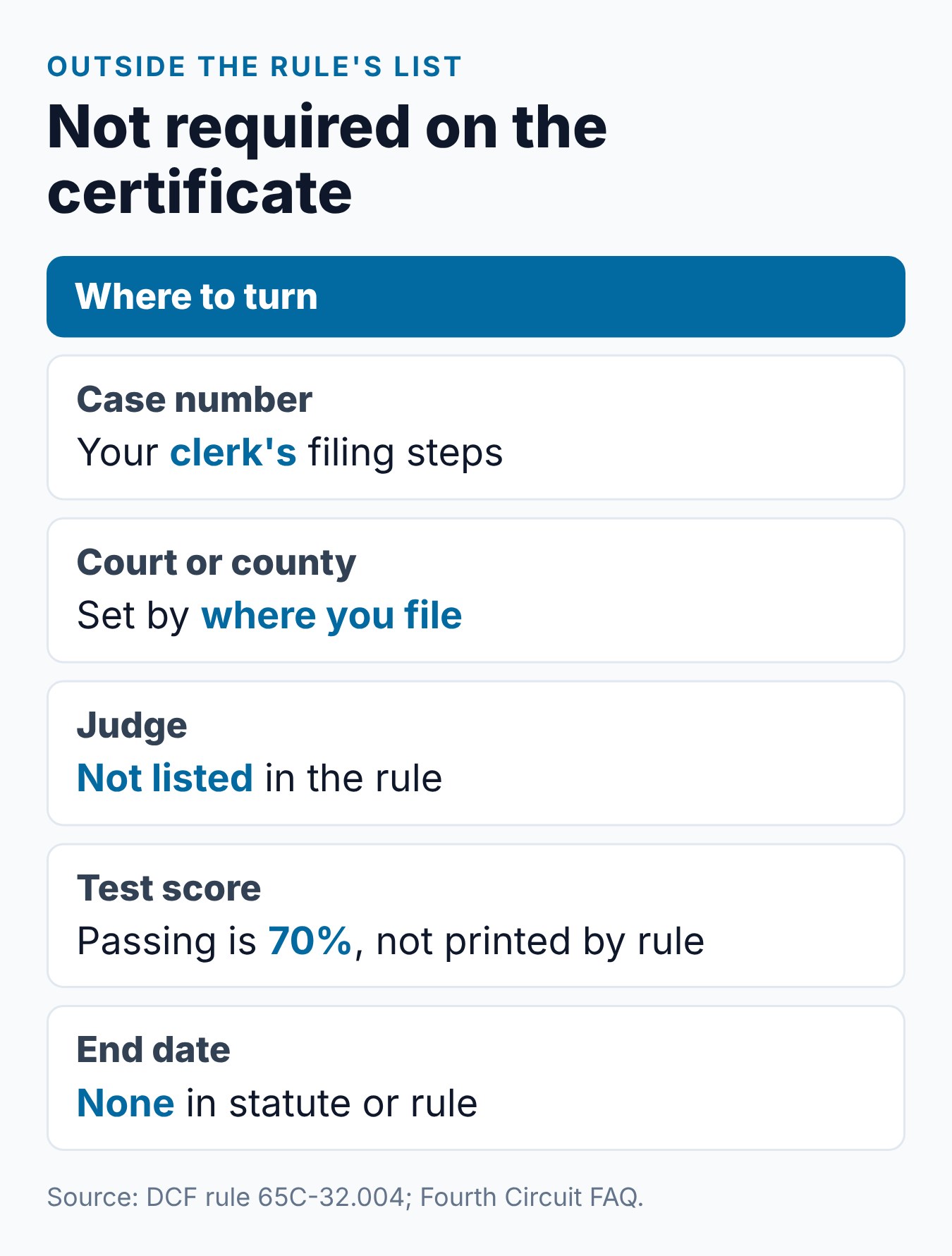
- A case number. The rule does not require one.
- The court or county. The rule does not name either one.
- The judge. Not listed.
- Your test score. The rule requires a passing score to earn the certificate, but not that the score appear on it.
- An expiry date. No statute or rule sets one.
- The parent’s name. The rule’s list does not mention it, though a certificate that shows it helps the court match it to you.
A provider may add more than the rule requires. The list above is only the state minimum.
Check Your Name
If your certificate shows your name, that name helps the clerk link it to your case. If it is misspelled, or if it differs from the name on your court papers, the clerk may have trouble matching it.
Check these points before you file:
- Is your first and last name spelled right?
- Does it match the name used in your petition or other court papers?
- If your name changed, does the certificate use the name in your case?
If you find an error, contact the provider before you file. The provider’s contact information should be on the certificate.
The Case Number Question
The DCF rule does not put a case number on the certificate. Some courts still link the course to your case in other ways.
The Fourth Circuit’s Family Court Services FAQ says, “When you have your case number you may register for one of the following classes.” That circuit covers Duval, Clay and Nassau counties, and it lists in-person classes.
The same FAQ answer also points parents to DCF’s list of local and online providers. So ask the circuit’s Family Court Services which class applies to your case.
When you file the certificate, your filing will need to be tied to your case. Follow your court’s instructions on how to show the case number when filing. Your clerk can tell you the method.
How a Court Can Verify It
DCF rule 65C-32.004 says, “Providers must have a means of verifying certificate authenticity.” It also requires providers to keep participant lists and copies of all certificates for five years.
Together, these rules give a court a way to check a certificate. The provider’s contact information is on the page. DCF’s provider list shows a phone and website column for each provider.
So a real certificate can be confirmed with the provider that issued it. That is one reason the provider’s details must be on it.
Who Gets a Certificate
Under the rule, a certificate goes to each participant who:
- Completes a course of at least four hours.
- Scores at least 70 percent on the end-of-course test.
Each parent who finishes gets a certificate. The rule gives unlimited attempts to pass, with a review of missed material before a retake. Parents do not have to take the course together, so the dates on two parents’ certificates can differ.
Where the Rule Comes From
Section 61.21(3) lets DCF write rules for the course. DCF’s rules are in chapter 65C-32 of the Florida Administrative Code. The test and certificate rule, 65C-32.004, took effect on June 5, 2016.
That rule applies to every DCF-approved provider. So the same minimum list applies whether you take the course in a classroom, online or by mail.
Other Course Papers Are Not the Certificate
You may get more than one paper from a course. Rule 65C-32.003 says each participant gets a written disclaimer that the course is “intended for educational purposes only” and is not therapy. Course material must also tell you to “consult with a licensed attorney for answers to specific legal questions.”
Those papers are useful, but they are not proof of completion. The certificate is the paper that shows the required items and the dates. Make sure that is the one you file.
If an Item Is Missing
Compare your certificate with the table above. If an item is missing or wrong, contact the provider before you file. Ask for a corrected certificate.
If the court has already raised a question, ask the clerk or court what it needs. Our page on what to do if a certificate is rejected lists the checks to make.
A Quick Check Before Filing
Run through this list with the certificate in hand:
- The course name is the Parent Education and Family Stabilization Course, or the provider’s curriculum name appears with it.
- The provider’s name matches a provider on DCF’s list.
- The contact information is there.
- The start and finish dates are correct.
- Your name matches your court papers.
- You know how your clerk wants the case number shown.
What the Certificate Does Not Prove
The certificate proves you finished a DCF-approved course. It does not prove that you filed it with the court. Filing is a separate step.
It also does not prove that your court accepts the format. The Fourth Circuit, for example, requires an in-person class from its list. Our guide on filing the certificate covers the court side.
What We Found on the Official Pages
On the DCF rule page we checked on October 26, 2026, the certificate list had the items in the table above and nothing more. It did not mention a case number, a court, a judge or a score.
On the court pages we read, the proof had three names: “Certificate of Attendance,” “certificate of completion” and “Certificate of Completion of Parent Education Class.” None of those pages listed extra items that must appear on it. The Fourth Circuit FAQ was the only page we found that tied the course to the case number, and it did so at sign-up, not on the certificate.
Common Mistakes to Avoid
Each item comes from the DCF rules, section 61.21 or a court page above:
- Expecting a case number on it. The rule does not require one.
- Worrying about two course names. A curriculum name is allowed.
- Filing with a misspelled name. Fix it with the provider first.
- Ignoring the dates. They show whether you met the 45-day deadline.
- Assuming the certificate files itself. Each party files proof with the court.
- Treating any parenting class as the same. The course must be the DCF-approved state course.
How Requirements Can Vary
Section 61.21 of the Florida Statutes sets the course requirement for the whole state, and DCF approves the courses. Each judicial circuit can still add its own steps, such as how to file the certificate or which class formats it accepts. The Fourth Circuit (Duval, Clay and Nassau counties), for example, requires an in-person class.
Laws, court orders and local rules can change. Check your court’s instructions, your county clerk’s website and DCF’s provider list before you enroll or file.
Frequently Asked Questions
What must a Florida parenting class certificate show?
DCF rule 65C-32.004 lists the course name, the provider’s name and contact information, the curriculum name if any, and the dates you began and finished.
Does my case number need to be on the certificate?
The rule does not require it. Follow your court’s instructions on how to show the case number when you file. The Fourth Circuit tells parents to register once they have a case number.
Does the certificate list the court or county?
The rule does not require either one. Your filing places the certificate in the right court file.
Why are there two names on my certificate?
The rule lets providers give their curriculum a unique name. So you may see the state course name and the provider’s title.
What if my name is wrong?
Contact the provider before you file. Its contact information should be on the certificate.
Is my test score on the certificate?
The rule does not require it. You must score at least 70 percent to earn the certificate, so having one shows you passed.
Do both parents share one certificate?
No. The rule gives a certificate to each participant who finishes and passes. Parents do not have to take the course together, so each one gets a separate certificate with his or her own dates.
How can a court tell the certificate is real?
Providers must have a means of verifying certificates and must keep copies for five years. The court or clerk can contact the provider.
Conclusion
A certificate of completion parenting class form in Florida must show the course name, provider details, any curriculum name, and your start and finish dates. Check your name, then follow your clerk’s instructions for the case number when you file.
To take the course, see DivorceParentingClass.net’s online Florida parent education course. Confirm first that your court accepts an online course.
Related Articles
- How to Get Your Florida Parenting Class Certificate
- How to Submit Your Parenting Class Certificate of Completion
- Parenting Classes for Court: Why Certificates Get Rejected
- Lost Your Parenting Certificate? How to Get a Florida Copy
Sources
- Fla. Admin. Code R. 65C-32.004 — Test and certificate
- Fla. Admin. Code R. 65C-32.003 — Required course content
- Florida Statutes § 61.21 — Parenting course
- Fourth Judicial Circuit — Family Court Services FAQ
- Broward County Clerk of Courts — Family
- Fifteenth Judicial Circuit — Divorce with children checklist (PDF)
- Florida DCF — Approved course provider list
Billy Forte is the owner of DivorceParentingClass.net.
This article is general information, not legal advice. Court rules, local practice, and case facts can differ by county, judge, and case type in Florida. Use official court and state sources, and consult a qualified Florida family law attorney for legal guidance specific to your case.