
Updated October 2026 · Reviewed by Billy Forte
If you are looking for a 4 hour co parenting class quiz in Florida, the DCF rules require only one end-of-course test, and they neither require nor ban quizzes during the lessons. Whether a course adds quizzes is up to the provider. What DCF does require in every course is a way to verify who is taking it, plus a final test with a 70 percent passing mark and unlimited tries.
Key Facts
- Final test: one end-of-course test is required in every approved course. See the required test.
- Quizzes: DCF rules do not mention them; the provider decides. See quizzes.
- Identity checks: every course must have a way to verify who is taking it. See identity checks.
- Teaching mix: courses must use more than one method, and exercises count toward the 4 hours. See exercises.
- Passing: 70 percent on the final test, with unlimited tries. See the final test.
Is There a 4 Hour Co Parenting Class Quiz in Florida?
“Co-parenting class” is a phrase parents search for. In Florida law, the required course is the Parent Education and Family Stabilization Course. The Florida Department of Children and Families (DCF) approves each course under section 61.21, Florida Statutes.
That course lasts at least 4 hours and ends with a test. The state rules say nothing about quizzes before that test. So a “quiz” in one course may not exist in another.
Each parent who must take the course completes it and gets a certificate. Parents do not have to take it together. That includes all parties to a divorce with minor children and the parties to a paternity case involving parental responsibility.
One Required Test at the End
DCF rule 65C-32.004 is the rule on testing. It says each course “shall include an end of course test.” It does not call for any other test.
The word “end” matters. The required test comes after the lessons, not during them. It is “designed to demonstrate” that the parent understood the course’s learning goals.
That one test is also the gate to the certificate. A parent gets a certificate only after finishing at least 4 hours and scoring 70 percent or more.
Quizzes: Not Required and Not Banned
We read DCF rules 65C-32.002, 65C-32.003 and 65C-32.004 for any word on quizzes. None of them requires a quiz, and none forbids one. The rules are silent.
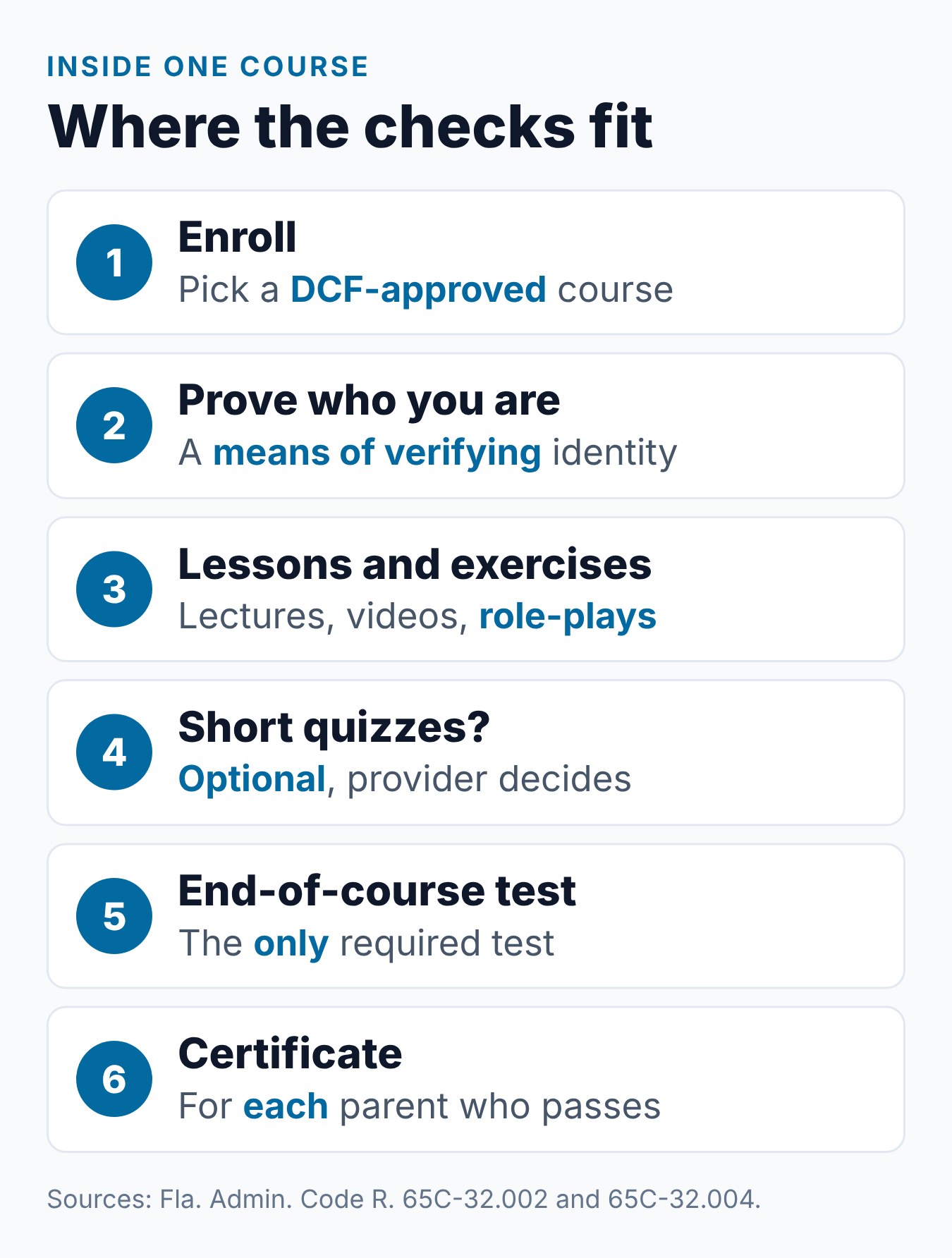
That leaves the choice to each provider. A provider may add short checks after lessons, or it may use only the final test. Either way, the course must still meet every DCF rule.
The rules also do not say whether quiz scores count toward anything. Only the end-of-course score is tied to the certificate. If a course has quizzes, ask the provider what they are for.
Exercises and Activities in the 4 Hours
Rule 65C-32.002 does describe how a course is taught. It says the course must use a mix of methods, such as lectures, group discussions, role-plays, videos or other activities.
The rule also lists what fills the 4 hours: “instruction, participant exercises and an end of course test.” So exercises are a named part of the course time. The rule does not say whether a quiz counts as an exercise.
In short, you should expect some activities beyond reading or watching. Their form is up to the provider.
Identity Checks in Every Course
Here the rule is clear. Rule 65C-32.002 says, “All courses shall include a means of verifying the identity of participants.” That covers classroom, online and correspondence courses alike.
The rule does not say how to verify identity or when. Each provider picks its own method.
DCF approves a course only if it meets the statute and the rules. So the check you meet in one course may look different in another.
Why does this matter? The certificate goes to “each participant” who finishes and passes.
Providers must also be able to verify that a certificate is real. Identity checks help make sure the certificate goes to the parent who did the work.
What You Say in Course Activities
Exercises and role-plays can ask you to share. Florida law protects what you say. Section 61.21(8) says statements made in any course session “shall not be considered” in deciding your case.
No report from a session becomes part of the court record either. The one exception is when the parties agree in writing. So course activities are for learning, not for building a case.
Taking It Apart From the Other Parent
Parents do not have to take the course together. Each parent signs up, passes the identity checks and takes the final test on his or her own. Each one also gets a separate certificate.
If there is a history of domestic violence, the judge may stop the parents from taking the course together. The judge can do this even if neither parent asks.
How the Final Test Works
The end-of-course test follows a short set of DCF rules:
- Passing mark: at least 70 percent.
- Tries: unlimited.
- Before a retake: the instructor reviews what you missed; online, the course points you to the section.
- Fees: none added for the extra time or teaching.
No official source sets the number of questions or says whether the test is open book. For those points, see is the final test open book. For retakes in depth, see can you fail the class.
Correspondence Courses Follow the Same Rules
Not every course is a class or a website. Florida law requires DCF to approve at least one statewide course by correspondence. DCF rule 65C-32.001 groups correspondence and internet courses together as “distance learning.”
The same test and identity rules apply. A correspondence course still ends with the end-of-course test and still needs a way to verify who is taking it. You must also be able to reach an instructor, who answers content questions within one business day.
Quizzes and the 4-Hour Minimum
Quizzes, if a course has them, do not change the minimum. Every course lasts at least 4 hours, counting the lessons, the exercises and the final test. Online courses must stop anyone from finishing in under 4 hours.
So a course with quizzes is not shorter or longer by rule. The 4-hour floor is the same either way. For timing, see how long the course takes.
If Your Children Have Special Needs
Some parents need a different course. If the children have special needs or emotional concerns, section 61.21(4)(a) says the parents “must select” a course built for that. DCF keeps a separate list of these courses.
Ask that provider the same questions about quizzes and identity checks. Its own course page or staff can tell you how it runs.
Required or Up to the Provider?
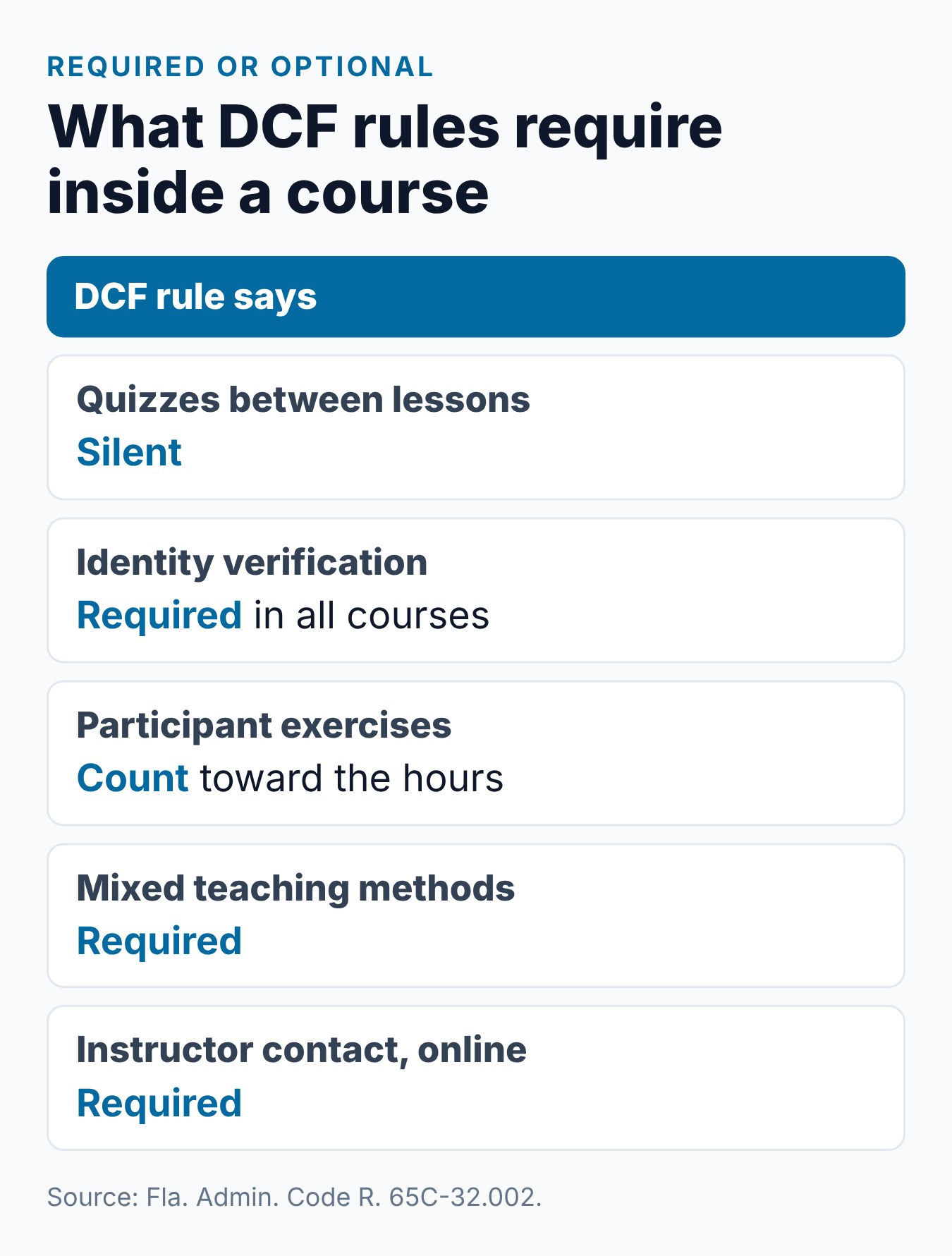
This table sorts the checks you may meet in a course into those DCF requires and those it leaves open.
| Feature inside the course | Required by a DCF rule? |
|---|---|
| Final end-of-course test | Yes, in every course (65C-32.004) |
| Quizzes between lessons | Not addressed by any rule |
| A way to verify identity | Yes, in all courses (65C-32.002) |
| Participant exercises | Yes, counted in the 4 hours |
| A mix of teaching methods | Yes (65C-32.002) |
| A way to reach an instructor | Yes, for online and correspondence courses |
Questions to Ask Before You Enroll
The provider is the only source for how its own course runs. These questions cover the points the rules leave open:
- Does the course have quizzes, and do they affect anything?
- What activities or exercises are part of the lessons?
- How and when does the course check my identity?
- What do I need on hand for the identity check?
- How do I reach an instructor with a content question?
Online and correspondence providers must answer content questions within one business day. You can check any provider’s DCF approval on DCF’s provider list.
What the Lessons Cover
Whatever checks a course uses, the lessons must cover eight parts set by rule 65C-32.003. They run from divorce as loss to parenting time. Abuse and neglect information is required too.
The final test draws on that material. See what the course covers for the full outline.
Check Your Court Before You Start
Quizzes and identity checks do not decide whether your court accepts a course. Format does. Florida law requires at least one statewide internet course and one correspondence course, but not every court accepts them.
The Fourth Judicial Circuit (Duval, Clay and Nassau) requires an in-person class. The circuit’s standing family law order calls for “a similar qualified inperson program.” Its Family Court Services FAQ names three local programs. Check your own court’s instructions first.
The same FAQ answer also points parents to DCF’s list of local and online providers. So ask the circuit’s Family Court Services which class applies to your case.
After the Final Test
A passing score leads to the certificate of completion. It shows the course name, the provider’s name and contact details, the curriculum name if any, and your start and finish dates.
You then file proof with the court before the final judgment. The petitioner must finish within 45 days after filing, and the other party within 45 days after service.
What We Found on the Official Pages
On the DCF rule pages we checked on October 26, 2026, rule 65C-32.004 required one end-of-course test and did not mention quizzes. Rule 65C-32.002 still required identity checks in all courses, as amended effective April 17, 2016.
DCF’s course page, updated April 8, 2026, described the courses as “a minimum of 4 hours.” It did not describe quizzes or tests.
Common Mistakes to Avoid
Each point comes from section 61.21 or a DCF rule:
- Expecting quizzes in every course. No rule requires them.
- Treating a quiz score as the pass mark. Only the end-of-course test is tied to the certificate.
- Skipping the identity steps. Every course must verify who is taking it.
- Rushing the exercises. They are part of the 4-hour minimum.
- Picking a course before checking your court. Some circuits require in-person classes.
How Requirements Can Vary
Section 61.21 of the Florida Statutes sets the course requirement for the whole state, and DCF approves the courses. Each judicial circuit can still add its own steps, such as how to file the certificate or which class formats it accepts. The Fourth Circuit (Duval, Clay and Nassau counties), for example, requires an in-person class.
Laws, court orders and local rules can change. Check your court’s instructions, your county clerk’s website and DCF’s provider list before you enroll or file.
Frequently Asked Questions
Does the Florida co-parenting class have quizzes?
It depends on the provider. DCF rules require one end-of-course test and do not mention quizzes, so some courses may have them and others may not.
Is there a final test?
Yes. Every DCF-approved course must include an end-of-course test. You need at least 70 percent to get a certificate.
Do quiz scores count toward passing?
No DCF rule ties quiz scores to the certificate. The rule ties the certificate to the 4 hours and a passing score on the end-of-course test.
Why does the course check my identity?
DCF rule 65C-32.002 requires every course to include a way to verify who is taking it. The method is up to the provider.
Are identity checks only for online courses?
No. The rule says “all courses,” so classroom and correspondence courses need a method too.
What if I miss the final test mark?
You review the missed material and try again. Attempts are unlimited, and no extra fee is allowed for the added time.
Can the other parent and I take the course together?
Florida law does not require it, and the Broward Clerk says parties attend separately. Each parent takes the final test and gets a certificate. A judge may stop parents from taking it together if there is a history of domestic violence.
Conclusion
So is there a 4 hour co parenting class quiz in Florida? DCF rules require one final test and identity checks, while quizzes are a provider choice.
You can ask about both at DivorceParentingClass.net’s online Florida parent education course. First, confirm that your court accepts an online course.
Related Articles
- How Long Are Parenting Classes for Divorce in Florida?
- Is the Florida Parenting Course Final Test Open Book?
- Can You Fail a Parenting Class? Florida Retake Rules
- What Are Parenting Classes? Florida Course Topics Explained
Sources
- Fla. Admin. Code R. 65C-32.002 — Course length and delivery
- Fla. Admin. Code R. 65C-32.004 — Test and certificate
- Fla. Admin. Code R. 65C-32.003 — Required course content
- Florida Statutes § 61.21 — Parenting course
- Florida DCF — Parent Education and Family Stabilization Course
- Florida DCF — Approved course provider list
- Florida DCF — Courses for children with special needs or emotional concerns
- Fla. Admin. Code R. 65C-32.001 — Definitions
- Fourth Judicial Circuit — Family Court Services FAQ
- Broward County Clerk of Courts — Family
- Fourth Judicial Circuit — Standing Family Law Order (PDF)
Billy Forte is the owner of DivorceParentingClass.net.
This article is general information, not legal advice. Court rules, local practice, and case facts can differ by county, judge, and case type in Florida. Use official court and state sources, and consult a qualified Florida family law attorney for legal guidance specific to your case.