
Updated October 2026 · Reviewed by Billy Forte
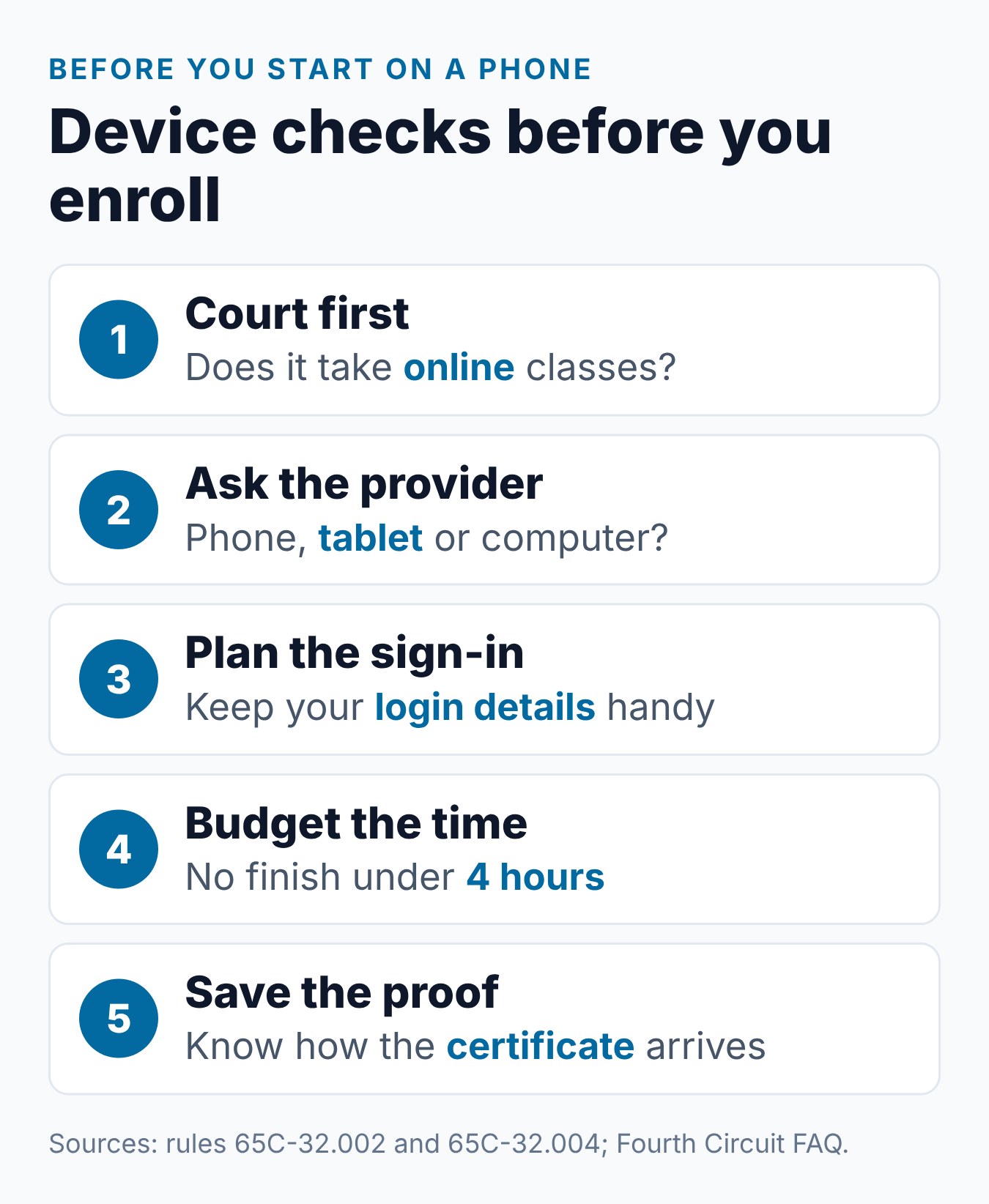
Florida law and DCF rules do not say which devices you can use for a Florida parenting course online, so whether a phone or tablet works depends on the provider. What the rules do set is how every online course must run: at least four hours, a check on who is taking it, and a way to reach an instructor. Check the provider’s device needs and your court’s rules on online classes before you start.
Key Facts
- Devices: no Florida law or DCF rule names a device. See what the rules say.
- Time lock: online courses must stop anyone finishing in under four hours. See what every online course must do.
- Identity: every course must verify who is taking it. See identity checks.
- Instructor: content questions must be answered within one business day. See reaching the instructor.
- Court: some courts, like the Fourth Circuit, require an in-person class. See check your court.
What the Rules Say About Devices
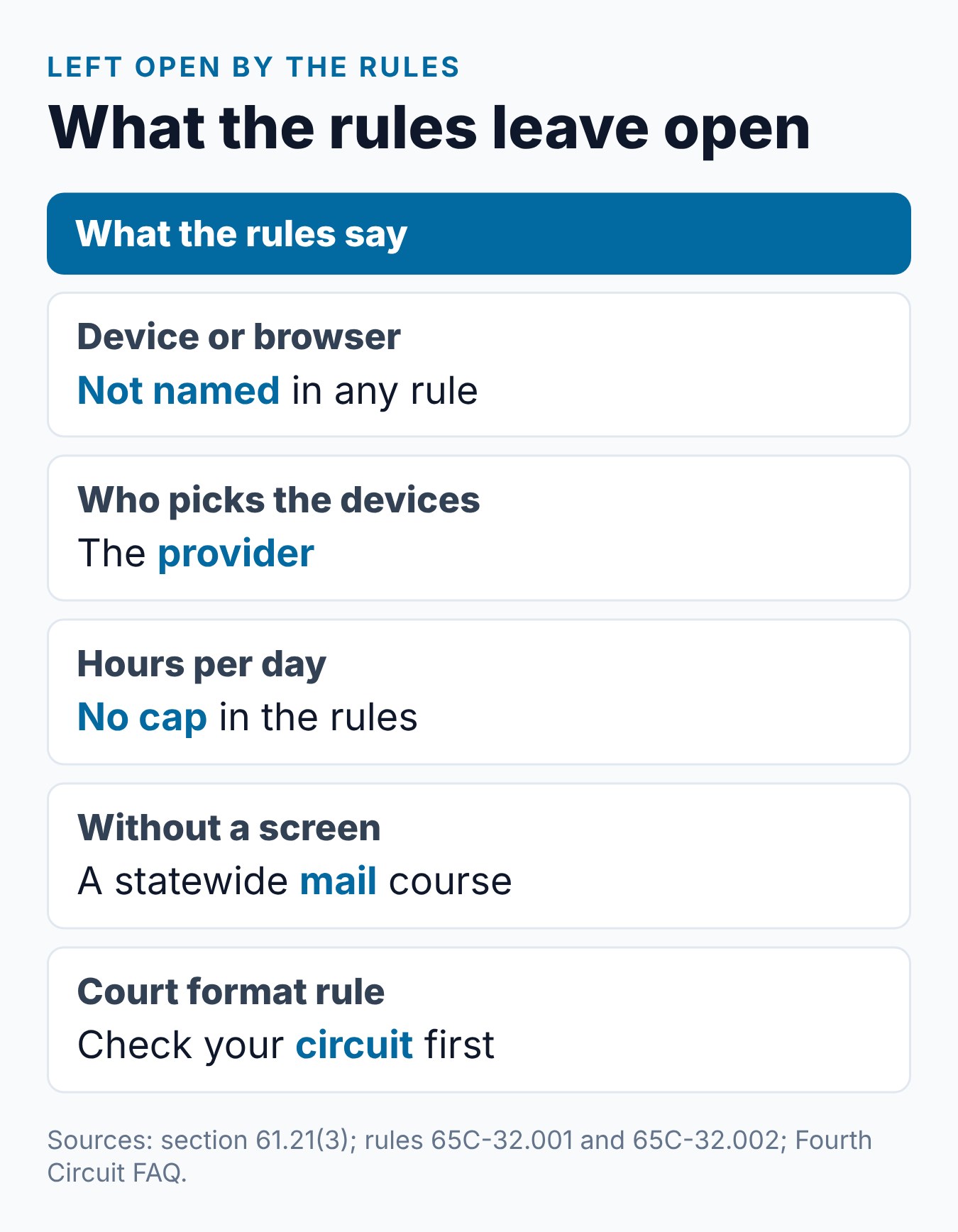
The short answer is that they say nothing. Section 61.21, Florida Statutes, requires DCF to approve at least one statewide course “provided through the Internet.” It does not mention phones, tablets or computers.
DCF’s rule for course delivery is rule 65C-32.002. It sets the length, the instructor rules and the identity check. It does not list devices, browsers or apps.
DCF’s definitions rule calls online and mail courses “distance learning.” It defines that as “instruction provided through correspondence or via the Internet.” Again, no device is named.
So a phone is not banned, and it is not promised either. Each provider decides what its course runs on.
What Every Online Course Must Do
The device is open, but the course rules are not. Here is what DCF rules require of every online course, and what that means on any screen:
| DCF rule | What it means on any device |
|---|---|
| At least 4 hours, including the test | The course takes the same time on a phone or a laptop |
| A lock against finishing in under 4 hours | You cannot speed through on a smaller screen |
| A way to verify identity | Expect a sign-in or identity step on every device |
| Instructor contact for distance courses | You can send content questions from where you study |
| Answers within one business day | A question may not be answered the same day |
| End-of-course test, 70 percent to pass | The test is the same wherever you take it |
The length rule says the four hours include “instruction, participant exercises and an end of course test.” The lock rule means the course itself must keep you from reaching the end before four hours pass.
Identity Checks on Any Device
Rule 65C-32.002 says, “All courses shall include a means of verifying the identity of participants.” That applies to classroom, online and mail courses alike.
The rule does not say which method a course must use. It could be a question, a sign-in step or something else the provider chose and DCF approved.
On a phone, plan for that step. Use a device you can keep with you for the whole course, and make sure you can reach your sign-in details.
Reaching the Instructor
Online and mail courses must let you contact an instructor. Under rule 65C-32.002, content questions must be answered “within one (1) business day.”
That timing matters if you study at night or on a weekend. A question asked on a Saturday may not get an answer until the next business day.
Instructors must meet DCF’s standards too. The rule asks for a related bachelor’s degree plus two years of experience, or four years of related experience.
The Content Is the Same on Every Screen
DCF’s content rule does not change with the device. Rule 65C-32.003 lists eight parts every course must teach, from divorce as a loss to parenting time.
Each parent also gets a written notice that the course is “intended for educational purposes only.” Abuse information and a list of local agencies are required in every course, under the statute. See what the course includes.
What the Course Will Not Do
Some limits apply no matter the device. The statute says the course is educational and “shall not be designed to provide individual mental health therapy.”
Providers also may not give individual legal advice. The course material must tell parents to “consult with a licensed attorney for answers to specific legal questions.” For questions about your own case, ask the court, the clerk or a Florida family law attorney.
The Final Test on a Small Screen
The test rules apply on every device. Under rule 65C-32.004, you need at least 70 percent to pass.
If you miss the mark, online courses must point you to the section you need to review. Then you try again, with no limit on attempts. Providers may not charge extra fees for the added time.
Reading long questions on a small screen can be harder. If that worries you, ask the provider whether you can switch to a larger screen partway through.
Questions to Ask a Provider About Devices
Since the rules are silent, the provider is your source on devices. Ask before you pay:
- Does the course work on a phone or tablet, or only on a computer?
- Which browsers or apps does it support?
- Can I start on one device and finish on another?
- How does the identity check work on a phone?
- Can I save or download my certificate from a phone?
Get the answers in writing if you can, such as an email or a help page.
Choosing a Florida Parenting Course Online for Your Device
Start with approval, not with the screen. Find the course on DCF’s provider list, and check that its approval date has not passed. Approvals last three years.
Then look at the details that matter for you:
- Delivery Method. The list shows how each course is given.
- Languages. Pick a course in a language you read well.
- Device support. Ask the provider, since the rules do not cover it.
- Special needs. If your children have special needs or emotional concerns, use DCF’s separate list.
A course that fits your phone but is not on DCF’s list does not meet section 61.21.
A Mail Option for Parents Without a Screen
A screen is not the only way to take a distance course. Section 61.21(3) requires DCF to approve at least one statewide course “through correspondence,” which means by mail.
DCF’s provider list has a Delivery Method column. Use it to find courses given by mail, online or in person.
Mail courses follow the same instructor rule. You must be able to contact an instructor, and content questions get an answer within one business day.
Check Your Court First
The device question comes second. The first question is whether your court takes an online class at all.
The Fourth Judicial Circuit (Duval, Clay and Nassau) requires an in-person class. The circuit’s standing family law order calls for “a similar qualified inperson program.” Its Family Court Services FAQ says parents must register for one of the in-class courses on its list.
The same FAQ answer also points parents to DCF’s list of local and online providers. So ask the circuit’s Family Court Services which class applies to your case.
Of the other court pages we read, only Miami-Dade’s mentioned format, and only for parents who live outside Florida. Check your circuit’s page or ask the clerk. See whether a court will accept an online class.
Where the Course Fits in Your Case
A phone can make it easier to start soon. That helps, because section 61.21(5) says each party “shall begin the course as expeditiously as possible.”
For a divorce, the filing parent has 45 days from the filing date. The other parent has 45 days from the date of service. Paternity cases use other starting points.
Only the court can excuse a parent from the course or the deadline, for good cause.
Each Parent on Their Own Device
Parents do not have to take the course together. Section 61.21(10) says the law does not require it, so each parent can enroll and study on their own device.
If there is a history of domestic violence, the court may bar the parents from taking it together. What you say in a course session also stays out of the case. Under section 61.21(8), it is not used to decide the case unless both parties agree in writing.
Saving and Filing the Certificate
Finishing the course and filing proof are two steps. A parent who finishes the four hours and scores at least 70 percent gets a certificate under rule 65C-32.004.
No official rule sets how fast the certificate must be issued. Ask the provider how it sends certificates, and keep a copy you can find later.
You then file proof with the court before the final judgment, under section 61.21(5). Your court’s page explains how. See how to get your certificate.
What We Found on the Official Pages
On the DCF and statute pages we checked on October 26, 2026, none named a device, browser or app for the course. DCF’s parent page linked to the provider list under “Local and Online Courses.”
Rule 65C-32.002 still set the four-hour lock, the identity check and the one-business-day reply. Its effective date was April 17, 2016.
The Fourth Circuit’s FAQ still told parents in Duval, Clay and Nassau to register for an in-class course. We found no court page that named a device either.
Common Mistakes to Avoid
Each item comes from Florida law, a DCF rule or an official court page:
- Assuming a phone is approved or banned. No rule addresses devices.
- Expecting to finish faster on mobile. The four-hour lock applies everywhere.
- Losing access to sign-in details. Every course must verify identity.
- Waiting on a same-day answer. Instructors have one business day.
- Enrolling online where in person is required. The Fourth Circuit requires an in-class course.
- Forgetting the filing step. Proof goes to the court before the final judgment.
How Requirements Can Vary
Section 61.21 of the Florida Statutes sets the course requirement for the whole state, and DCF approves the courses. Each judicial circuit can still add its own steps, such as how to file the certificate or which class formats it accepts. The Fourth Circuit (Duval, Clay and Nassau counties), for example, requires an in-person class.
Laws, court orders and local rules can change. Check your court’s instructions, your county clerk’s website and DCF’s provider list before you enroll or file.
Frequently Asked Questions
Can I take the Florida parenting class on my phone?
Possibly. Florida law and DCF rules do not name devices, so it depends on the provider. Ask the provider before you enroll.
Is the course shorter on a phone?
No. Online courses must last at least four hours and must block finishing sooner, on any device.
Can I switch between my phone and a computer?
The rules do not say. Ask the provider whether its course lets you start on one device and finish on another.
Do I need a camera for the identity check?
The rule requires a way to verify identity but does not name a method. The provider can tell you what its check involves.
Is there a way to take the course without a screen?
Yes. The statute requires DCF to approve at least one statewide correspondence course, which is taken by mail.
How do I know an online course is approved?
Look for it on DCF’s provider list. DCF rules also say approved course materials must include the notice of DCF approval.
Can you take parenting classes online in Florida?
DCF approves online courses, but not every court accepts them. The Fourth Circuit requires an in-person class, so check your court’s instructions first.
Conclusion
No Florida rule says which device you must use, so a phone or tablet depends on the provider. Every online course must still run at least four hours, check your identity and let you reach an instructor. Before you sign up for DivorceParentingClass.net’s online Florida parent education course, confirm that your court accepts an online course.
Related Articles
- Online Parenting Classes for Florida Divorce: DCF Rules
- Are Online Parenting Classes Court Approved in Florida?
- 4 Hour Parenting Class Online Florida: Finish in One Day?
- Parenting Classes Near Me or Online? Florida Divorce Guide
Sources
- Florida Statutes § 61.21 — Parenting course
- Fla. Admin. Code R. 65C-32.001 — Definitions
- Fla. Admin. Code R. 65C-32.002 — Course length and delivery
- Fla. Admin. Code R. 65C-32.003 — Required course content
- Fla. Admin. Code R. 65C-32.004 — Test and certificate
- Florida DCF — Parent Education and Family Stabilization Course
- Florida DCF — Approved course provider list
- Fourth Judicial Circuit — Family Court Services FAQ
- Fourth Judicial Circuit — Standing Family Law Order (PDF)
Billy Forte is the owner of DivorceParentingClass.net.
This article is general information, not legal advice. Court rules, local practice, and case facts can differ by county, judge, and case type in Florida. Use official court and state sources, and consult a qualified Florida family law attorney for legal guidance specific to your case.