
Updated October 2026 · Reviewed by Billy Forte
If you are comparing court approved parenting classes florida parents can take, the price does not decide whether a course counts. What matters is current DCF approval, a format your court accepts, a special-needs course if your family needs one, and a certificate with the items DCF requires. A low-cost course that meets those tests follows the same state rules as a costly one.
Key Facts
- Who approves: DCF approves the course and providers, not the courts. See what “court approved” means.
- Price is not a test: DCF must approve any application that meets the law and rules. See price is not one of the tests.
- Four checks: approval date, format, special needs and certificate items. See the four checks.
- Same floor: every approved course has the same minimum rules. See what every course must do.
- Wrong course risk: sanctions and delay, not savings. See the cost of the wrong course.
What “Court Approved” Means in Florida
In Florida, the Department of Children and Families (DCF) approves the Parent Education and Family Stabilization Course. Section 61.21(2) and (3), Florida Statutes give DCF that job for courses, providers and sites.
Courts used to approve courses at the circuit level. A 2003 change in the law removed that step. The Sixth Circuit’s Administrative Order 2003-039 rescinded its old approval order for that reason.
The statute still says “court-approved parenting course” in two subsections, which is why people search for it. In practice, the list that counts is DCF’s list.
Price Is Not One of the Tests
The law does not set a price. Section 61.21(7) says, “A reasonable fee may be charged to each parent attending the course.”
DCF does ask for fee details. Under rule 65C-32.005, an applicant reports “the amount charged to participants” and its options for parents with indigent status.
But approval turns on the course, not the price. DCF rule 65C-32.006 says DCF must approve every application that meets section 61.21(2) and the rules. So a low fee is not a sign of a weaker course, and a high fee is not a sign of a stronger one.
Court Approved Parenting Classes Florida: The Four Checks
Here is what decides whether a DCF-approved course works for your case:
| Check | Why it matters | How to check |
|---|---|---|
| Current DCF approval | Approvals last three years and must be renewed | Exp. Date on DCF’s provider list |
| Format your court accepts | Some circuits require in-person classes | Your circuit’s order or FAQ |
| Special-needs course, if needed | The statute requires it for some families | DCF’s special-needs list |
| Required certificate items | The certificate is your proof | DCF rule 65C-32.004 |
1. Current DCF Approval
DCF’s provider list says its providers “are approved by the Florida Department of Children and Families.” Its table has an Exp. Date column.
DCF’s provider page says approvals “are valid for 3 years and must be renewed.” Check the date before you pay any price.
2. A Format Your Court Accepts
DCF must approve at least one statewide internet course and one correspondence course. But not every court accepts them.
The Fourth Circuit’s standing family law order covers Duval, Clay and Nassau counties. It calls for a named course “or a similar qualified inperson program.” In that circuit, the lowest-priced online course would not fit the order.
3. A Special-Needs Course If Needed
If your children have identified special needs or emotional concerns, section 61.21(4)(a) says parents “must select” a course designed for that. DCF keeps a separate list.
For these families, the price comparison starts and ends on that list. A cheaper general course does not meet the rule.
4. Required Certificate Items
DCF rule 65C-32.004 says the certificate shows the course name, the provider’s name and contact information, the curriculum name if any, and the dates you began and finished. That paper is what you file with the court.
What the Lowest-Price Course Must Still Do
Every DCF-approved course follows the same minimum rules, whatever it costs. Under rules 65C-32.002 and 65C-32.004, each course must:
- Run at least four hours, including instruction, exercises and the end-of-course test.
- Block online users from finishing in under four hours.
- Include a way to verify identity.
- Let online and mail students contact an instructor, with content questions answered within one business day.
- Require 70 percent to pass, with unlimited attempts.
- Give a certificate with the required items, and keep copies for five years.
If a low-priced course skips any of these, the problem is the course, not the price.
Instructor Standards Do Not Change With Price
DCF rule 65C-32.002 also sets who may teach. An instructor needs a related bachelor’s degree plus two years of experience, or four years of related experience.
That standard applies to every approved provider. A provider with a low fee must meet it, too.
What Can Differ Between Approved Courses
Some things do vary from one approved course to the next. The fee is one; ask the provider. DCF’s list shows others as columns:
- Indigent Status.
- Languages offered.
- Delivery method, such as in person, online or by mail.
- City, for classroom courses.
The curriculum name can differ, too. DCF rule 65C-32.003 lets providers give their lessons a unique name, but the course itself is still the Parent Education and Family Stabilization Course. None of these differences changes whether the course counts.
Lower-Cost Routes Are Part of the System
A sliding-fee or waiver option is not a lesser course. The law treats it as part of the system. Section 61.21(3) says each circuit’s DCF list must include at least one sliding-fee site, “if available.”
DCF’s rule also names scholarships and acceptance of court waivers as indigent provisions. Those are built into the approved system, not outside it.
A Cost the Rules Rule Out
One possible add-on cost is barred by rule. DCF rule 65C-32.004 says, “Providers shall not require additional fees for any additional time or instruction.”
That covers the time and help needed to pass the test. Missed material is reviewed before a retake, and attempts are unlimited. So a low starting price should not climb because you needed a second try.
The Real Cost of the Wrong Course
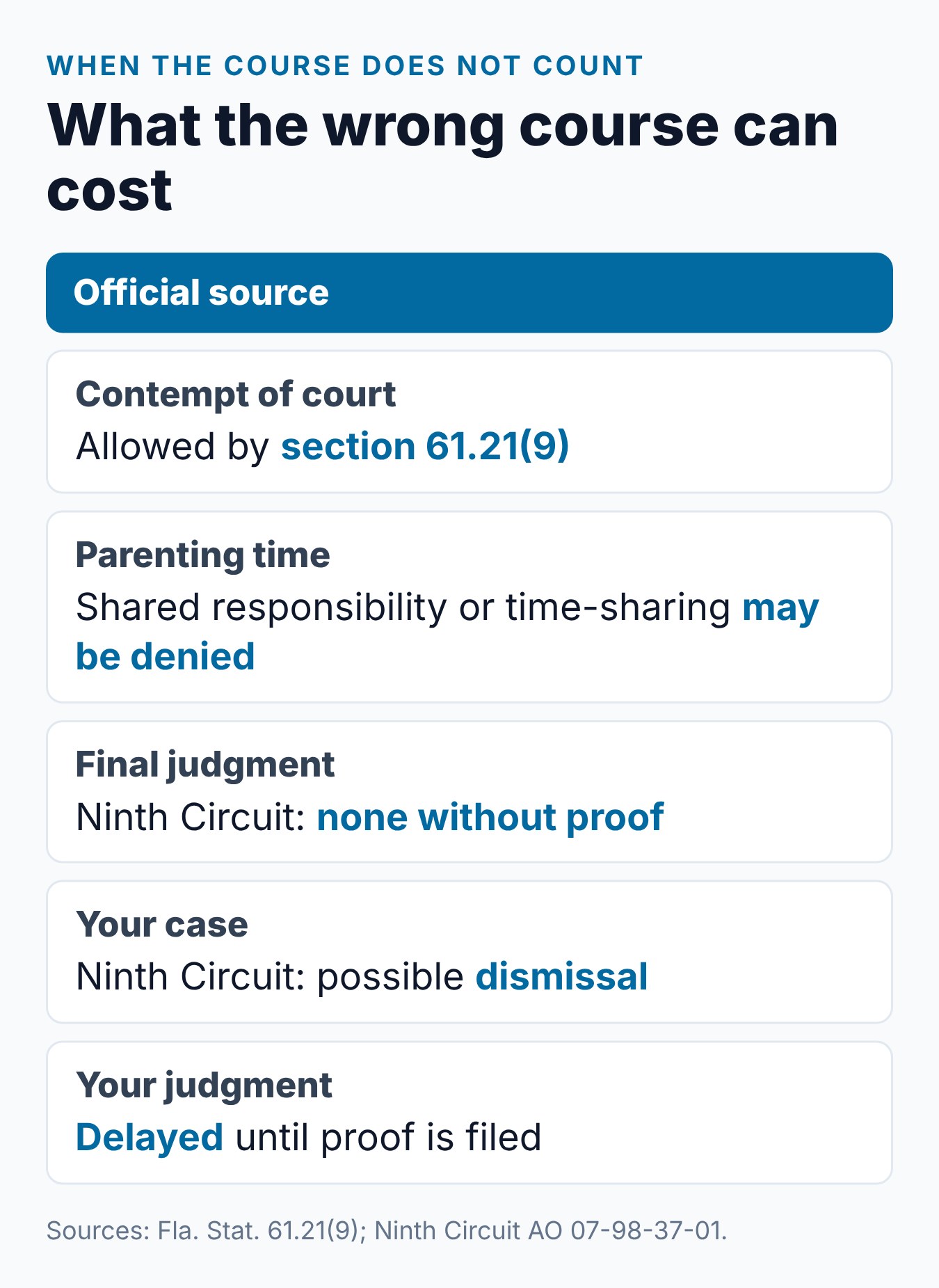
Saving money on a course that does not count can cost more later. Under section 61.21(9), a court may hold a parent who fails to attend a required course in contempt. It may also deny shared parental responsibility or time-sharing, or impose other sanctions.
Some circuits add their own steps. The Ninth Circuit’s parenting class order says no divorce or paternity judgment involving parental responsibility will be granted without proof. It adds that failure “may result in the Court’s dismissal of the action, striking of pleadings, and/or other appropriate sanctions.”
And if a court turns down a certificate, you may need to take another course. See what to do if the court rejects a certificate.
How to Compare Without Guessing
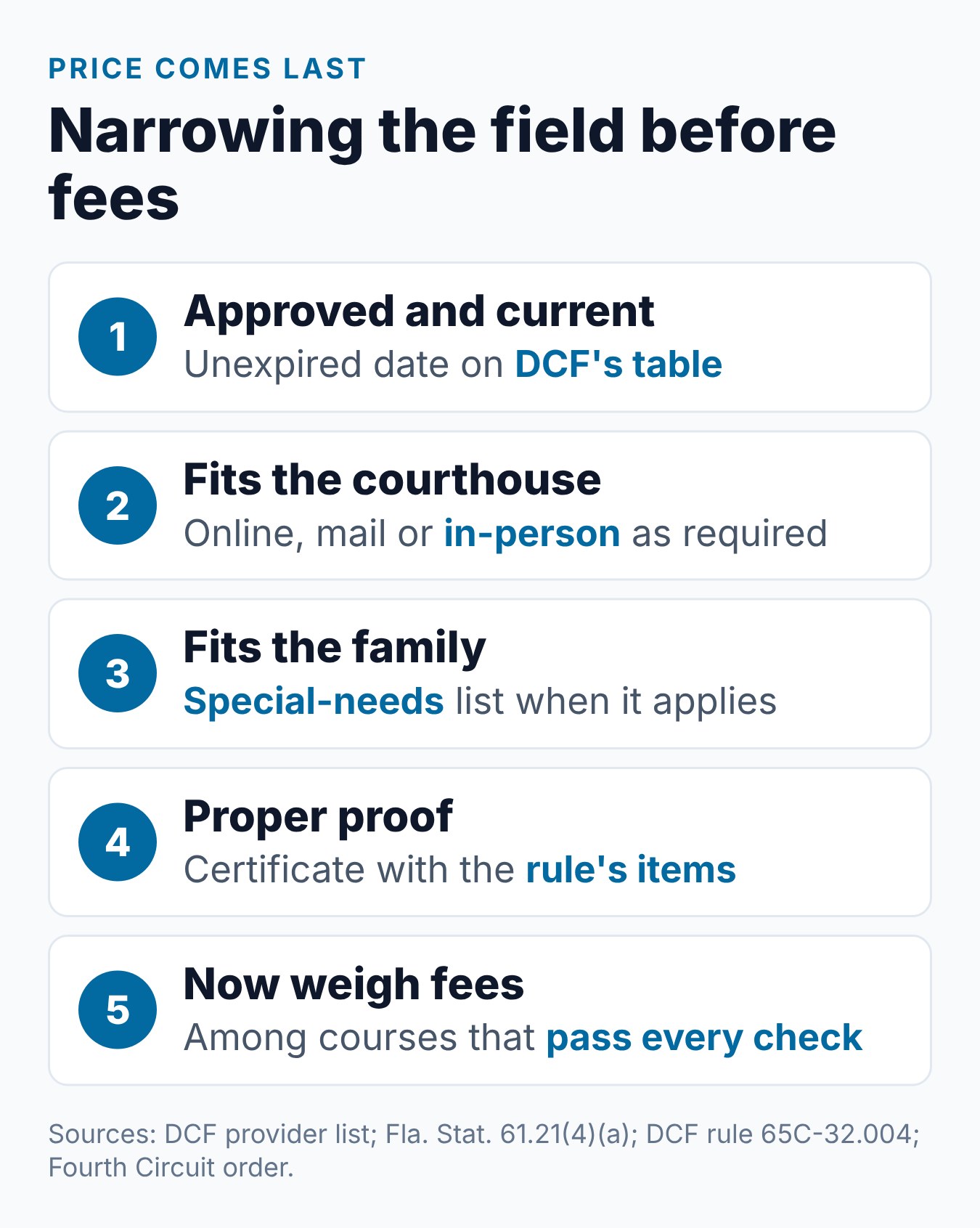
Price should be the last thing you compare, not the first. Use this order:
- List providers on DCF’s list with a current Exp. Date.
- Remove any whose format your court does not accept.
- If your family needs one, keep only special-needs courses.
- Check the languages you need in DCF’s Languages column.
- Ask about indigent options, such as sliding fees or scholarships.
- Then compare fees among the courses that remain.
Every course left on your list at step 6 meets the same state rules. Our guide to low-cost options covers sliding fees and indigent help in more depth.
Educational at Any Price
The course has the same purpose whatever it costs. Section 61.21(2) says it “shall be educational in nature” and is not individual mental health therapy. Providers may not give individual legal advice or recruit you as a private client.
Statements made during the course are also protected at any price. Under section 61.21(8), they are not used in your case unless both parties agree in writing.
Where This Fits
This page answers whether the lowest price is safe. For the full set of Florida fee rules, including local court fee notes, see our guide on how much parenting classes cost.
We Do Not Rank Providers
This page does not name or rank any provider by price. DCF’s list rows load by script, and we could not read each provider’s fee.
More to the point, price is not what makes a course count. DCF approval, the format your court accepts and the certificate items do that.
Each Parent Chooses a Course
Parents do not have to take the course together. The statute allows a fee for each parent who attends.
So each parent can run the checks above and pick a course on his or her own. A court can stop parents from taking the course together if there is a history of domestic violence.
What We Found on the Official Pages
On the DCF pages we checked on October 26, 2026, the provider list had an Exp. Date column, and the provider page said approvals last three years. We found no state price and no rule that links approval to price.
The rule we found on fees sets a “reasonable fee” standard, asks providers to report what they charge, and bars extra fees for added time to pass.
Common Mistakes to Avoid
Each item comes from section 61.21, a DCF rule or a court order above:
- Picking on price first. Check DCF approval and the date first.
- Trusting the word “approved” alone. DCF’s list is the place to check.
- Ignoring the format. The Fourth Circuit requires an in-person class.
- Skipping the special-needs rule. Some families must use DCF’s separate list.
- Paying extra to retake. The rule bars extra fees for added time to pass.
- Forgetting the filing step. Each party files proof before the final judgment.
How Requirements Can Vary
Section 61.21 of the Florida Statutes sets the course requirement for the whole state, and DCF approves the courses. Each judicial circuit can still add its own steps, such as how to file the certificate or which class formats it accepts. The Fourth Circuit (Duval, Clay and Nassau counties), for example, requires an in-person class.
Laws, court orders and local rules can change. Check your court’s instructions, your county clerk’s website and DCF’s provider list before you enroll or file.
Frequently Asked Questions
Is the cheapest parenting class safe to use in Florida?
It can be, if DCF approves it, its approval is current, your court accepts its format, and the certificate shows the required items. Price is not one of the tests.
Who approves parenting classes in Florida?
DCF approves the course, providers and sites under section 61.21. Your court decides what proof it accepts in your case.
Does a higher price mean a better course?
No official source says so. DCF must approve every application that meets the law and the rules, and all approved courses share the same minimum standards.
Can a low-cost provider charge me to retake the test?
No. DCF rule 65C-32.004 bars extra fees for added time or instruction needed to pass.
How do I check a provider’s approval date?
Look at the Exp. Date column on DCF’s provider list. Approvals last three years and must be renewed.
Will my court accept the lowest-priced online course?
Only if your court accepts online courses. The Fourth Circuit requires an in-person class, so check your court’s instructions.
Why does my course have a different name?
DCF rule 65C-32.003 lets providers give their curriculum a unique name. The course is still the Parent Education and Family Stabilization Course.
Is there a state price for the course?
No. Section 61.21(7) allows a reasonable fee for each parent, and providers set their own fees.
Conclusion
When you compare court approved parenting classes florida offers, price matters less than current DCF approval, the right format and a proper certificate. Run the four checks first, then compare fees.
To compare one option, see DivorceParentingClass.net’s online Florida parent education course. Before you enroll, confirm that your court accepts an online course.
Related Articles
- How Much Are Parenting Classes in Florida? Fees Explained
- Free Parenting Classes vs. Low Cost Options in Florida
- Free Online Parenting Classes With Certificate for Court?
- Parenting Classes for Court: Why Certificates Get Rejected
Sources
- Florida Statutes § 61.21 — Parenting course
- Fla. Admin. Code R. 65C-32.002 — Course length and delivery
- Fla. Admin. Code R. 65C-32.003 — Required course content
- Fla. Admin. Code R. 65C-32.004 — Test and certificate
- Fla. Admin. Code R. 65C-32.005 — Provider approval
- Fla. Admin. Code R. 65C-32.006 — Approval process
- Florida DCF — Approved course provider list
- Florida DCF — Courses for children with special needs or emotional concerns
- Florida DCF — Course provider process
- Fourth Judicial Circuit — Standing Family Law Order (PDF)
- Ninth Judicial Circuit — Administrative Order 07-98-37-01 (PDF)
Billy Forte is the owner of DivorceParentingClass.net.
This article is general information, not legal advice. Court rules, local practice, and case facts can differ by county, judge, and case type in Florida. Use official court and state sources, and consult a qualified Florida family law attorney for legal guidance specific to your case.