
Updated October 2026 · Reviewed by Billy Forte
In a Florida divorce or paternity case, a “parenting class” and a “parenting education course” are the same requirement. Both names point to one course that DCF approves: the Parent Education and Family Stabilization Course. Courts, clerks and providers use other labels too, so this guide matches each name to what it means.
Key Facts
- Official name: Parent Education and Family Stabilization Course, set by statute and DCF rule. See the official name.
- Curriculum names: providers may give their curriculum its own name. See curriculum names.
- Local labels: courts and clerks use their own words for the course and the proof. See names you may see.
- Different class: Miami-Dade’s children’s class is an extra, separate requirement. See the children’s class.
- How to match: check DCF’s list, then your court’s page. See how to match a name.
The Official Name
Florida law names the course. Section 61.21(2) calls it the “Parent Education and Family Stabilization Course” and gives DCF the job of approving it.
DCF’s rule repeats the name. Rule 65C-32.003 says courses must be named the Parent Education and Family Stabilization Course. DCF’s course page uses it as the page title.
The name is long, so people shorten it. Parents say “parenting class.” Searchers type “parenting course divorce.” The statute itself says “parenting course” in several places.
Is a Parenting Education Course Something Else?
No, not in a Florida divorce or paternity case. When a court or clerk asks for proof of a parenting education course, it means the course in section 61.21.
The statute requires it of all parties to a divorce with minor children. It also covers parties to a paternity case that involves parental responsibility. In a case to change a parenting plan or time-sharing schedule, the court may require it.
So the question is not which of two courses to take. The question is whether the course you pick is the DCF-approved one, in a format your court takes.
Names Inside the Statute
Even section 61.21 uses more than one name. Each one sits in a different subsection:
- Subsection (2). The full name, “Parent Education and Family Stabilization Course.”
- Subsection (4)(b). The court may excuse a party “from attending the parenting course.”
- Subsection (6). Parties to a modification “may be required to complete a court-approved parenting course,” which is still the one DCF approves.
- Subsection (10). Parties are not required “to attend a court-approved parenting course together,” and that course is also DCF-approved.
- Subsection (12). The court may add “educational courses” on children with special needs or emotional concerns.
All but the last point to the same course. The last one describes extra classes a court can order on top of it. DCF approves the course in every case.
What the Name Tells You
The statute does not define the words “family stabilization.” DCF’s course page says the courses are “designed to educate, train, and assist divorcing parents.”
The content rule shows what that means in practice. Every course covers eight parts, from divorce as a loss to parenting time, plus abuse information. See what the 4-hour course includes and what the course is.
Names You May See
Here is how official sources label the course and the proof:
| Name you see | Where it appears | What it refers to |
|---|---|---|
| Parent Education and Family Stabilization Course | Section 61.21 and DCF rule 65C-32.003 | The official course name |
| Parenting course | Section 61.21, in several subsections | Short form of the same course |
| Divorce Education Program for Parents | Miami-Dade circuit page | The local program for divorcing parents |
| Certificate of Attendance | Broward Clerk’s family page | Proof each party files in the court file |
| Certificate of completion | Ninth Circuit order (Orange, Osceola) | Proof each party gives the Clerk |
| Certificate of Completion of Parent Education Class | Palm Beach divorce checklist | Proof from the petitioner and respondent |
The words change from page to page. The requirement behind them stays the same.
One Name Across Case Types
The name does not change with the type of case. A divorce with minor children, a paternity case about parental responsibility and a court-ordered modification all use the same course.
What changes is the timing. In a divorce, the parent who files must finish within 45 days after filing, and the other parent within 45 days after service. In paternity cases, the clock for the other party starts at events such as an acknowledgment of paternity or an order on time-sharing or support.
In a modification, the course is up to the court. See who has to take the course.
Why the Names Differ
Each source wrote its own wording. The statute was written first and amended over time.
DCF’s rules came later, with the latest versions in effect since 2016. Each circuit then wrote its own pages and orders.
The history adds one more layer. Courts once approved parenting courses at the circuit level.
A 2003 change in the law removed that step, as the Sixth Circuit explained in Administrative Order 2003-039.
The statute still says “court-approved parenting course” in two places. Even so, DCF is the agency that approves the course now.
Curriculum Names on DCF’s List
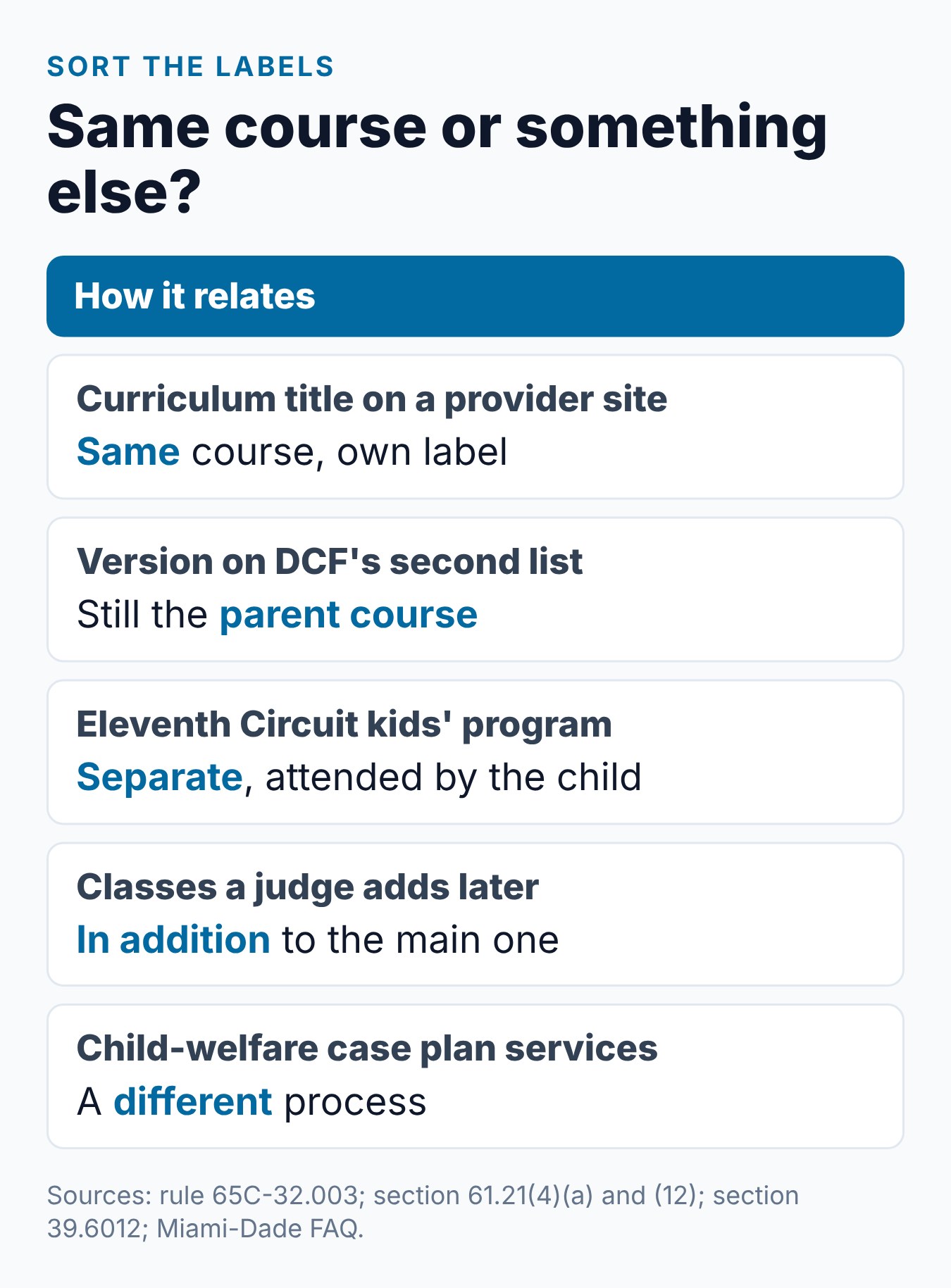
Rule 65C-32.003 lets a provider give its curriculum “a unique name.” That is why one approved course can carry two names: the official course name and the curriculum’s own title.
DCF’s provider list has a Course Name column. Use it to match the name on a provider’s site to an approved entry. If the site shows only a curriculum title, look for the provider’s name on the list as well.
The certificate follows the same pattern. Under rule 65C-32.004, it shows the name of the course and “the unique name of the curriculum, if applicable.”
Miami-Dade’s Children’s Class Is Separate
One local name does point to a different class. Miami-Dade’s Divorce Education Program for Parents page says divorcing parents must complete parenting education before a divorce is granted.
The circuit’s FAQ adds a rule for children. A child aged 6 to 17 “must attend a 3½ hour class for children of divorcing parents.”
That class is for the child, not the parent. It is an extra local requirement, not another name for the parent course. See the Miami-Dade guide.
The Special-Needs Version
Another name you may see is a course for children with special needs. Section 61.21(4)(a) says that when children “have identified special needs or emotional concerns,” parents must pick a course made for that.
It is still a DCF-approved parent course. DCF keeps these on a separate special-needs list. A court may also order more courses on these needs, on top of the main course, under section 61.21(12).
Classes That Share the Word “Parenting”
Not every parenting class meets section 61.21. A voluntary class you choose for your own growth is not the required course unless it is the DCF-approved one. See court-ordered vs voluntary classes.
Child-welfare cases are another area. In a dependency case, a parent’s case plan lists the tasks and services the parent must complete, under section 39.6012.
That is a separate process from the divorce course. See DCF-approved classes and the divorce class.
How to Match a Name to the Requirement
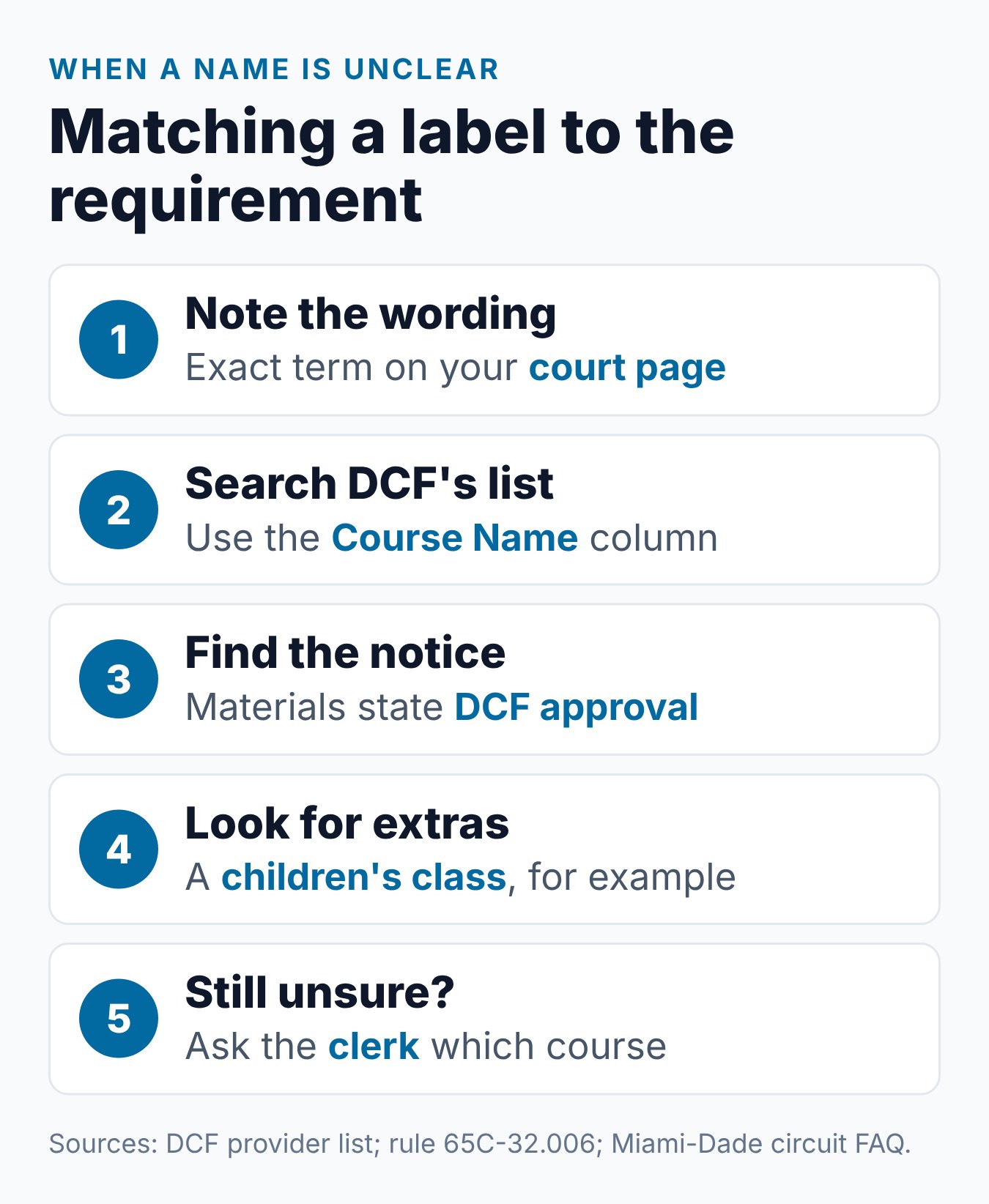
Use these steps when a name is not clear:
- Read your court’s page. Note the exact name it uses for the course and the proof.
- Find the course on DCF’s list. Match the provider and course name.
- Look for the DCF notice. Rule 65C-32.006 says approved course materials must state DCF approval.
- Check for extras. Some courts, like Miami-Dade, add a children’s class.
- Check the format. The Fourth Circuit requires an in-person class.
If a name still does not match, ask the clerk which course the court expects. Keep the answer with your case papers.
Names for the Format
Format labels add more words. DCF’s definitions rule calls internet and mail courses “distance learning.” The statute calls a mail course a “correspondence” course.
DCF’s list sorts courses with a Delivery Method column. A format label tells you how the course is given. It does not change which course it is.
Format does matter for your court. The Fourth Circuit (Duval, Clay and Nassau) requires an in-person class, so check before you pick a distance course.
Names Used for the Proof
The statute does not name the proof document. It says each party “shall file proof of compliance” with the court before the final judgment.
DCF’s rule calls it a “certificate of completion.” Local pages vary: Broward says Certificate of Attendance, and the Fourth Circuit’s standing order says Certificate of Completion. See how to get your certificate.
What We Found on the Official Pages
On the court and DCF pages we checked on October 26, 2026, we found at least five labels for the course or its proof. The statute and DCF rule used the official name, and local pages used their own terms.
The Miami-Dade pages used “Divorce Education Program for Parents” and named a separate class for children. The Broward Clerk said “Certificate of Attendance,” and the Ninth Circuit order said “certificate of completion.”
The Palm Beach divorce checklist listed a “Certificate of Completion of Parent Education Class” from both the petitioner and the respondent. The Fourth Circuit standing order, signed April 22, 2021, used “Certificate of Completion.” None of these pages created a second required parent course.
Common Mistakes to Avoid
Each item comes from Florida law or an official court page:
- Taking two parent courses. Different names do not mean two required courses.
- Picking any class with “parenting” in the name. It must be the DCF-approved course.
- Missing Miami-Dade’s children’s class. It is a separate local rule.
- Using the general course when special needs apply. The statute requires a course made for that.
- Mixing up the case plan and the divorce course. Dependency case plans are a separate process.
- Forgetting to file the proof. Whatever it is called, it goes to the court before the final judgment.
How Requirements Can Vary
Section 61.21 of the Florida Statutes sets the course requirement for the whole state, and DCF approves the courses. Each judicial circuit can still add its own steps, such as how to file the certificate or which class formats it accepts. The Fourth Circuit (Duval, Clay and Nassau counties), for example, requires an in-person class.
Laws, court orders and local rules can change. Check your court’s instructions, your county clerk’s website and DCF’s provider list before you enroll or file.
Frequently Asked Questions
Is a parenting class the same as a parenting education course?
Yes, in a Florida divorce or paternity case. Both mean the DCF-approved Parent Education and Family Stabilization Course.
Why does my provider use a different course name?
DCF rule 65C-32.003 lets providers give their curriculum a unique name. The course is still the Parent Education and Family Stabilization Course.
Do I need more than one course?
Each parent needs one approved course. Some courts add other rules, such as Miami-Dade’s class for children aged 6 to 17.
What is a Certificate of Attendance?
It is the Broward Clerk’s name for the proof each party files. Other courts call it a certificate of completion.
Is the special-needs course a different requirement?
It is a version of the same course, built for children with special needs or emotional concerns. Parents in that situation must pick one from DCF’s separate list.
What does “family stabilization” mean?
The statute does not define it. DCF says the courses are designed to educate, train and assist divorcing parents, and its rule lists the eight parts each course must teach.
Does a voluntary parenting class count?
Only if it is a DCF-approved Parent Education and Family Stabilization Course. Check DCF’s provider list.
Conclusion
Parenting class, parenting course and parenting education course all point to the same DCF-approved Florida requirement. Match the name on any site to DCF’s list, and check your court’s page for local extras. If you choose DivorceParentingClass.net’s online Florida parent education course, confirm first that your court accepts an online course.
Related Articles
- Online Parenting Classes for Florida Divorce: DCF Rules
- What Is the Parent Education and Family Stabilization Course in Florida?
- Parenting Classes Ordered by Court vs. Voluntary Classes
- Parenting Classes Miami: Miami-Dade Divorce Course Guide
Sources
- Florida Statutes § 61.21 — Parenting course
- Fla. Admin. Code R. 65C-32.003 — Required course content
- Florida DCF — Parent Education and Family Stabilization Course
- Florida DCF — Approved course provider list
- Eleventh Judicial Circuit — Divorce Education Program for Parents
- Eleventh Judicial Circuit — Divorce Education Program FAQ
- Broward County Clerk of Courts — Family
- Ninth Judicial Circuit — Administrative Order 07-98-37-01 (PDF)
- Fifteenth Judicial Circuit — Divorce with children checklist (PDF)
- Fourth Judicial Circuit — Standing Family Law Order (PDF)
- Florida Statutes § 39.6012 — Case plan tasks and services
Billy Forte is the owner of DivorceParentingClass.net.
This article is general information, not legal advice. Court rules, local practice, and case facts can differ by county, judge, and case type in Florida. Use official court and state sources, and consult a qualified Florida family law attorney for legal guidance specific to your case.