
Updated October 2026 · Reviewed by Billy Forte
If you are looking up parenting plan florida rules, the short answer is that the plan and the parent education course are two different things. A parenting plan is a document about how both parents will raise the child, and the course is a class of at least 4 hours that each parent must finish. Taking the course does not write, sign or file a plan for you.
Key Facts
- The plan: a document that governs decisions about your child, defined in section 61.046. See what a parenting plan is.
- What it must cover: daily tasks, a time-sharing schedule, health care, school and how you talk with your child. See required parts.
- The course: a DCF-approved class of at least 4 hours under section 61.21. See what the course is.
- The link: DCF requires the course to offer ideas for building a plan. See how they connect.
- Filing: the plan and the course certificate are separate papers. See side by side.
What a Parenting Plan Is
Florida law defines the plan in section 61.046. A parenting plan is “a document created to govern the relationship between the parents relating to decisions that must be made regarding the minor child.” In plain words, it is the rulebook both parents follow after the case.
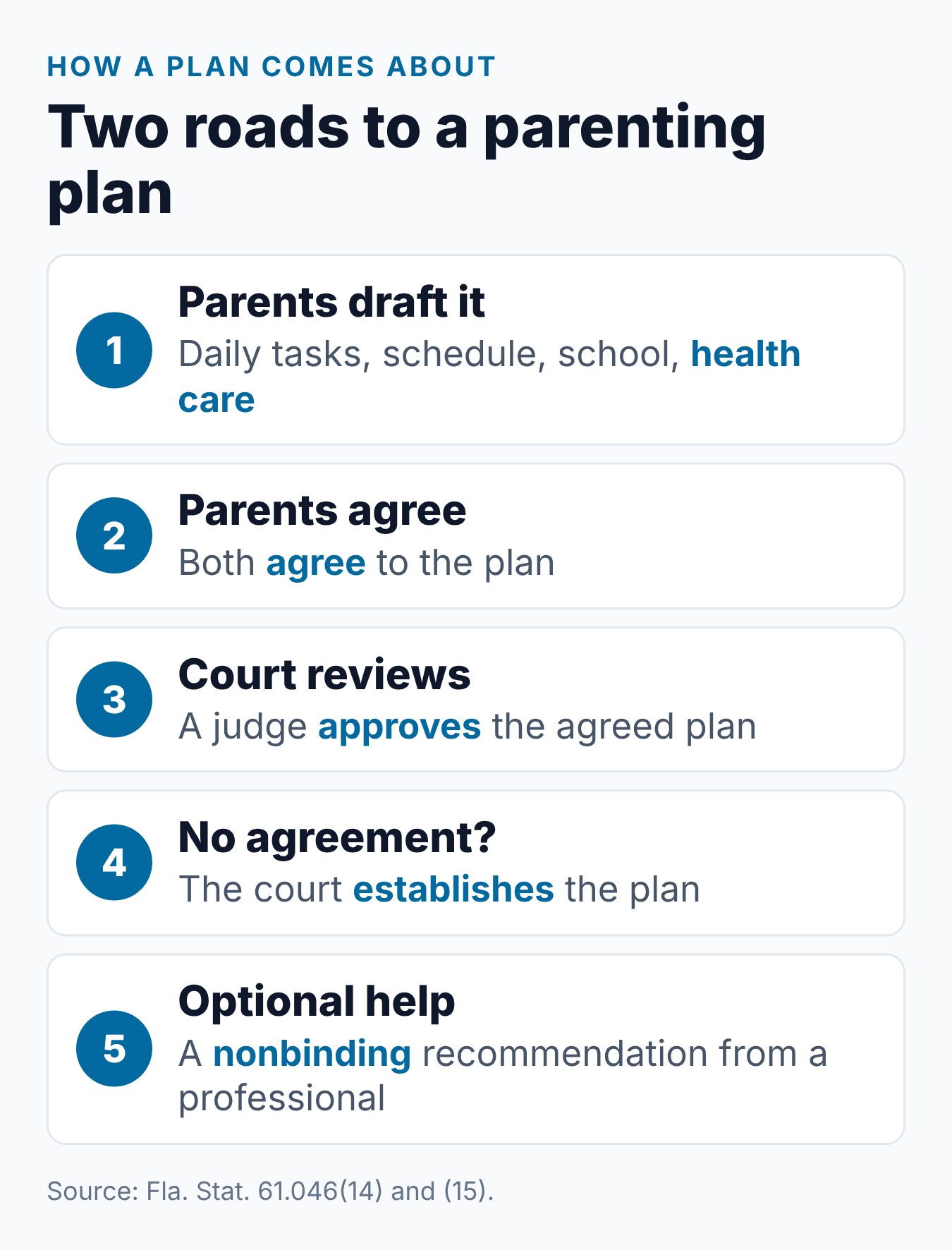
The same section says a plan can come about in two ways. Parents can develop and agree to it, and a court then approves it. Or the court can establish it, with or without a parenting plan recommendation.
A recommendation is not a plan. Section 61.046 calls it “a nonbinding recommendation” about parts of a plan. A court-appointed mental health practitioner or other professional makes it.
What a Plan Must Include
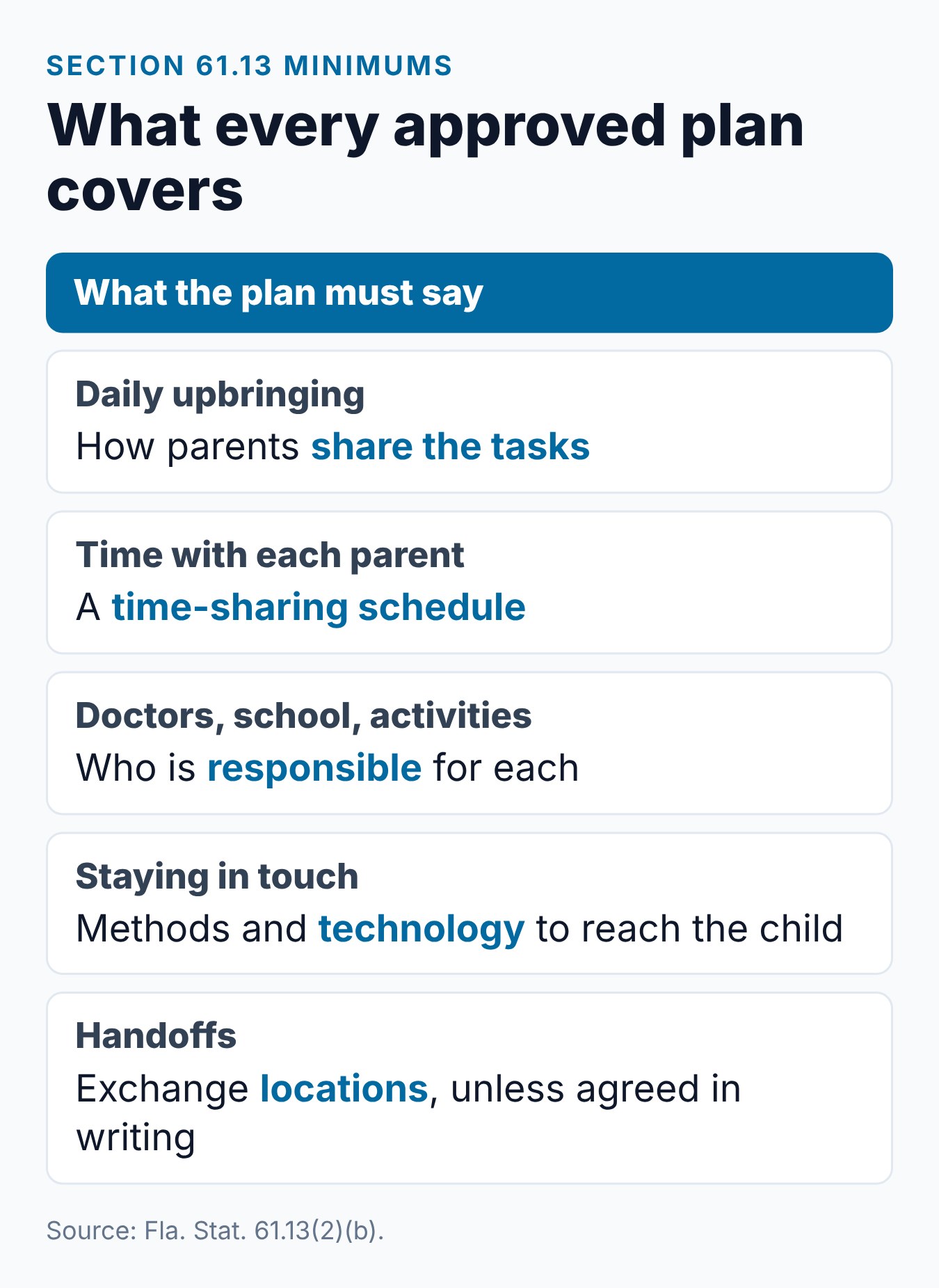
Section 61.13 lists the minimum parts of a plan the court approves. At a minimum, the plan must cover:
- Daily tasks. How parents will share the daily jobs of raising the child.
- Time-sharing schedule. The time the child spends with each parent.
- Health care, school and activities. Who is responsible for each, including the address used for school zones and sign-up.
- Communication. The methods and technology parents will use to talk with the child.
- Exchange spots. Where the child changes homes, unless both parents agree otherwise in writing.
The court may require a neutral, safe exchange spot or a supervised visitation site. Section 61.13 allows this when there is a risk or threat of harm and it serves the child’s best interests.
The Schedule Inside the Plan
Section 61.046 calls the time-sharing schedule “a timetable that must be included in the parenting plan.” It covers overnights and holidays. For how schedules are set and the equal time-sharing rule, see Florida time-sharing and the parent course.
Parental Responsibility in the Plan
A plan also shows who makes major choices for the child. Florida law uses two terms:
- Shared parental responsibility. Both parents keep full rights and duties. They confer so that major decisions are made together.
- Sole parental responsibility. One parent makes decisions about the child, under a court order.
Under section 61.13, the court orders shared parental responsibility unless it finds that would be “detrimental to the child.” Domestic violence is one of the factors the law names.
What the Course Is
The course is a class, not a document. Section 61.21 calls it the Parent Education and Family Stabilization Course. The Florida Department of Children and Families (DCF) approves it, and it runs at least 4 hours.
The law applies it to all parties to a divorce with minor children. It also covers parties to a paternity case involving parental responsibility. Each parent must finish it and file proof before the final judgment.
The statute says the course “shall be educational in nature.” It is not therapy, and providers may not give individual legal advice. For the full topic list, see what the course covers.
How the Course and Plan Connect
The two meet in one place. DCF rule 65C-32.003 lists eight required course parts. The last part is parenting time, including “suggestions about how to develop a parenting plan.”
Other required parts also touch the plan:
- The lasting parent role. Both parents stay parents, and the rule covers shared parenting.
- Talking with children. Ways to explain changes to your child.
- Talking with the other parent. Skills you will need to follow a schedule together.
- Legal concepts. Including financial responsibilities to the child.
So the course gives you ideas. You still create the plan through your case, by agreement or through the court. Course material must tell you to consult a licensed attorney for specific legal questions.
What You Say in Class Stays Out of the Case
Section 61.21(8) protects what you say in a session. Those statements are not considered in your case, and no session report goes into the record. The exception is when the parties agree in writing.
Side-by-Side Comparison
| Question | Parenting plan | Parent education course |
|---|---|---|
| What is it? | A document about decisions for the child | A class of at least 4 hours |
| Main law | Sections 61.046 and 61.13 | Section 61.21 and DCF rules 65C-32 |
| Who creates it? | The parents, or the court | A DCF-approved provider teaches it |
| Who approves it? | The court | DCF approves the course |
| What is filed? | The plan | Each parent’s proof of completion |
| Later changes | Need a substantial and material change | The court may require it again in a modification |
How One Circuit Lists Both Papers
The Fifteenth Circuit (Palm Beach) posts a checklist for a divorce with minor children. It shows the plan and the course as two separate items:
- Parenting Plan. Listed as required if agreed upon, and signed by both parties.
- Certificate of Completion of Parent Education Class. Filed by the petitioner and the respondent.
Other circuits may list papers in other ways. Ask your clerk which forms your court wants, and in what order. The checklist gives no due date for these two papers.
When Parents Agree, and When They Do Not
Agreement changes how a plan is reached, not whether the course applies. Under section 61.13, a time-sharing schedule the parties agree to and the court approves does not need written findings on every factor.
When parents cannot agree, section 61.046 says the court establishes the schedule. The best interests of the child are the main concern under section 61.13. Either way, each parent still needs the course in a divorce with minor children, because only the court can excuse a party, for good cause.
Parenting Plan Florida Basics: Who Does What
Several people and offices touch the plan and the course. Their roles do not overlap much:
- Parents. Draft and agree to a plan, if they can. Each parent also takes the course.
- The court. Approves an agreed plan, or establishes one when parents cannot agree. Only the court can excuse a party from the course.
- A court-appointed professional. May give a nonbinding parenting plan recommendation.
- DCF. Approves the course, its providers and its sites. DCF has no role in approving your plan.
- The course provider. Teaches the course and gives a certificate to each parent who finishes the 4 hours and scores at least 70 percent, under DCF rule 65C-32.004.
- The clerk. Keeps the court file where papers are filed.
Best Interests Shape the Plan
When the court approves or sets a plan, the child’s best interests come first. Section 61.13(3) lists 20 factors. Several of them look at how a plan will work in daily life:
- Honoring the schedule. Each parent’s capacity to support a close bond with the other parent and to follow the time-sharing schedule.
- Dividing duties. How parental duties will be split, including any handed to third parties.
- Distance. Whether the plan works given where each parent lives and the child’s travel time.
- Knowing the child. Each parent’s knowledge of the child’s life and circumstances.
The course does not grade you on these factors. What you say in class stays out of the case unless the parties agree in writing. Still, the skills it teaches, such as talking with the other parent, are the same skills a working plan needs.
Changing a Plan Later
A plan can be changed, but not just because one parent wants it. Section 61.13 says a parenting plan or time-sharing schedule may not be modified without “a substantial and material change” in circumstances. The change must also be in the child’s best interests.
The course can come back in that case. Section 61.21(6) says parties to a modification of a parenting plan or time-sharing schedule “may be required” to complete a parenting course. That choice belongs to the court.
Common Mistakes
Each point comes from Florida law or a DCF rule:
- Treating the certificate as your plan. The certificate shows you finished a class. It sets no schedule.
- Skipping the course because you agreed on a plan. The statute covers all parties to a divorce with minor children.
- Expecting the provider to draft your plan. Courses are educational, and providers may not give individual legal advice.
- Leaving out exchange spots. The plan needs them unless both parents agree otherwise in writing.
- Fearing class comments will be used. Statements stay out of the case unless the parties agree in writing.
What We Found on the Official Pages
On the official pages we checked on October 26, 2026, the Florida Legislature’s site showed the 2026 text of sections 61.046, 61.13 and 61.21. Section 61.13 was last amended in 2025, and section 61.21 in 2021.
DCF rule 65C-32.003, effective April 17, 2016, still listed the parenting plan suggestions in part (h). The Palm Beach checklist listed the plan and the course certificate as separate items. That checklist page shows no date.
How Requirements Can Vary
Section 61.21 of the Florida Statutes sets the course requirement for the whole state, and DCF approves the courses. Each judicial circuit can still add its own steps, such as how to file the certificate or which class formats it accepts. The Fourth Circuit (Duval, Clay and Nassau counties), for example, requires an in-person class.
Laws, court orders and local rules can change. Check your court’s instructions, your county clerk’s website and DCF’s provider list before you enroll or file.
Frequently Asked Questions
Is the parent course the same as a parenting plan?
No. The plan is a document about decisions and time-sharing. The course is a DCF-approved class of at least 4 hours.
Do I need both?
In a divorce with minor children, each parent must take the course under section 61.21. Section 61.13 sets what a plan must contain when the court approves one. Ask the court or a family law attorney what your own case needs.
Does the course write my parenting plan?
No. DCF requires the course to give suggestions about how to develop a plan. You and the other parent, or the court, create the plan itself.
Can the court make a plan if we cannot agree?
Yes. Section 61.046 says a plan can be established by the court. The court may use a parenting plan recommendation, which is nonbinding.
Will what I say in the course affect my plan?
Not unless the parties agree in writing. Section 61.21(8) keeps session statements out of the case.
Can a plan be changed later?
Yes, with a substantial and material change in circumstances and a finding that the change serves the child. The court may also require a parenting course in that case.
Conclusion
A parenting plan and the parent education course do different jobs in a Florida divorce. The plan sets how you will share decisions and time, while the course teaches skills and ideas for building that plan. When you are ready, you can take DivorceParentingClass.net’s online Florida parent education course, but first confirm that your court accepts an online course.
Related Articles
- How to File for Divorce in Florida With Minor Children: The Parent Course Step
- Florida Custody Laws: Time Sharing and the Parenting Course
- Florida Divorce Checklist for Parents With Minor Children
- What Are Parenting Classes? Florida Course Topics Explained
Sources
- Florida Statutes § 61.046 — Definitions
- Florida Statutes § 61.13 — Parenting plans and time-sharing
- Florida Statutes § 61.21 — Parenting course
- Fla. Admin. Code R. 65C-32.003 — Required course content
- Fla. Admin. Code R. 65C-32.004 — Test and certificate
- Fifteenth Judicial Circuit — Divorce with children checklist (PDF)
- Florida DCF — Parent Education and Family Stabilization Course
Billy Forte is the owner of DivorceParentingClass.net.
This article is general information, not legal advice. Court rules, local practice, and case facts can differ by county, judge, and case type in Florida. Use official court and state sources, and consult a qualified Florida family law attorney for legal guidance specific to your case.