
Updated October 2026 · Reviewed by Billy Forte
In a divorce in Florida with minor children, the parent course comes right after the case opens: the parent who files has 45 days from filing to finish it, and the other parent has 45 days from service. Proof of the course must then reach the court file before the judge enters the final judgment. The course runs next to the parenting plan and the financial papers, but it replaces neither one.
Key Facts
- Before filing: one spouse must have lived in Florida for 6 months. See before the case starts.
- Course clock: filing starts the petitioner’s 45 days, and service starts the other parent’s. See the course window.
- Proof: each parent’s proof goes in the court file before the final judgment. See the certificate and proof.
- Local orders: one circuit wants the course done before mediation. See local orders.
- Separate papers: the course does not stand in for the parenting plan or financial disclosure. See other papers.
Where the Course Fits in a Divorce in Florida
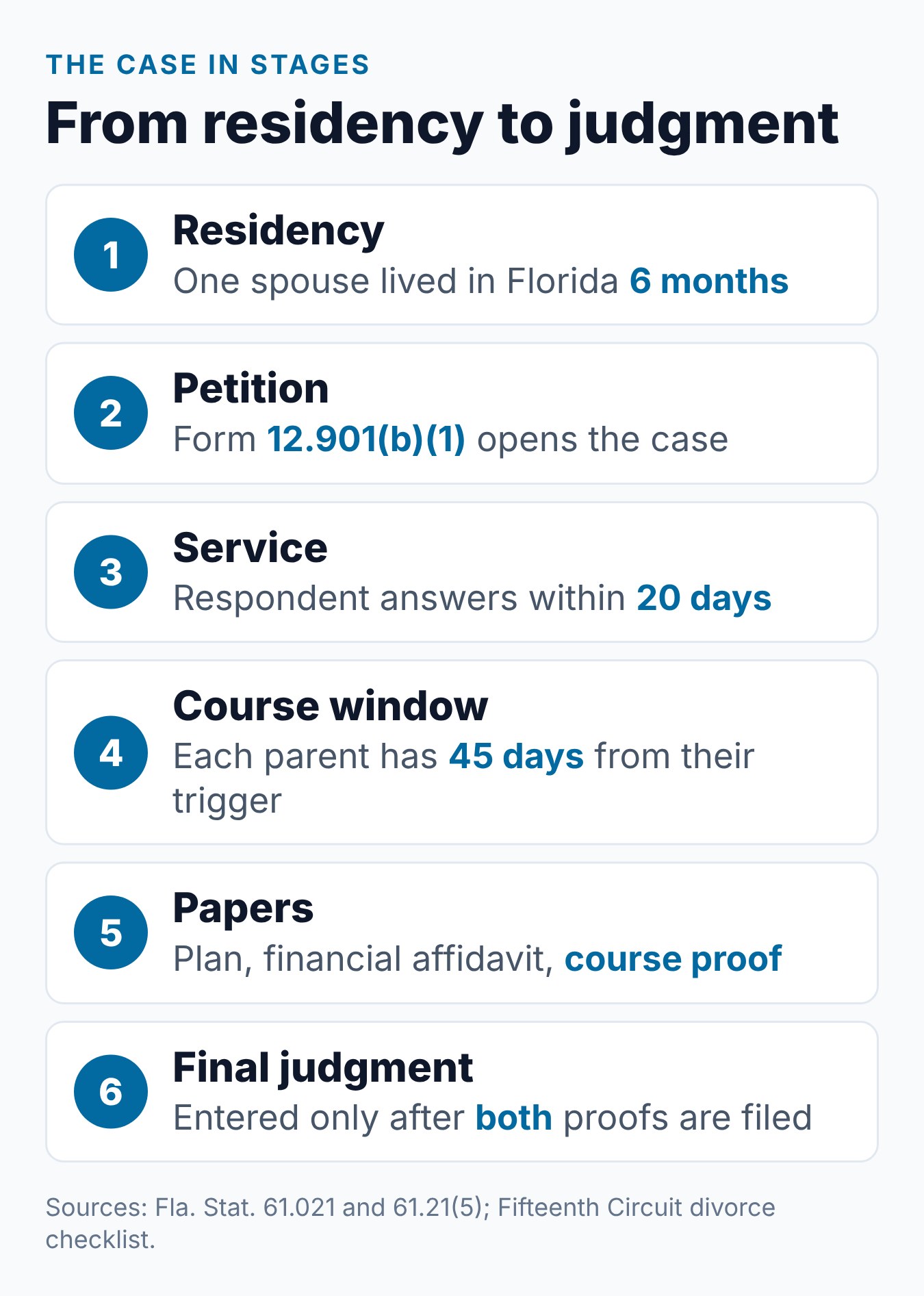
A Florida divorce with children moves through a few broad stages. The parent course sits in the middle, inside a 45-day window:
- Before filing. Residency and grounds are set by statute.
- Filing. The petition opens the case and starts the petitioner’s course clock.
- Service. Delivering the papers starts the other parent’s course clock.
- The course window. Each parent takes a DCF-approved course and earns a certificate.
- Papers. The parenting plan, financial papers and course proof are filed.
- Final judgment. The court cannot enter it until each parent’s course proof is filed.
The course rule covers “all parties to a dissolution of marriage proceeding with minor children.” That includes uncontested cases and parents who agree on everything. A divorce with no minor children is outside this rule.
This page explains each stage only as it relates to the course. It is not a full guide to filing, and it is not legal advice.
Before the Case Starts
Two statutes come first. Section 61.021 says one of the spouses must “reside 6 months in the state” before the petition is filed.
Section 61.052 sets the grounds. A divorce may be granted when “the marriage is irretrievably broken,” or for mental incapacity under strict conditions.
When there is a minor child, the court may order counseling. It may also pause the case for up to 3 months so the spouses can try to reconcile.
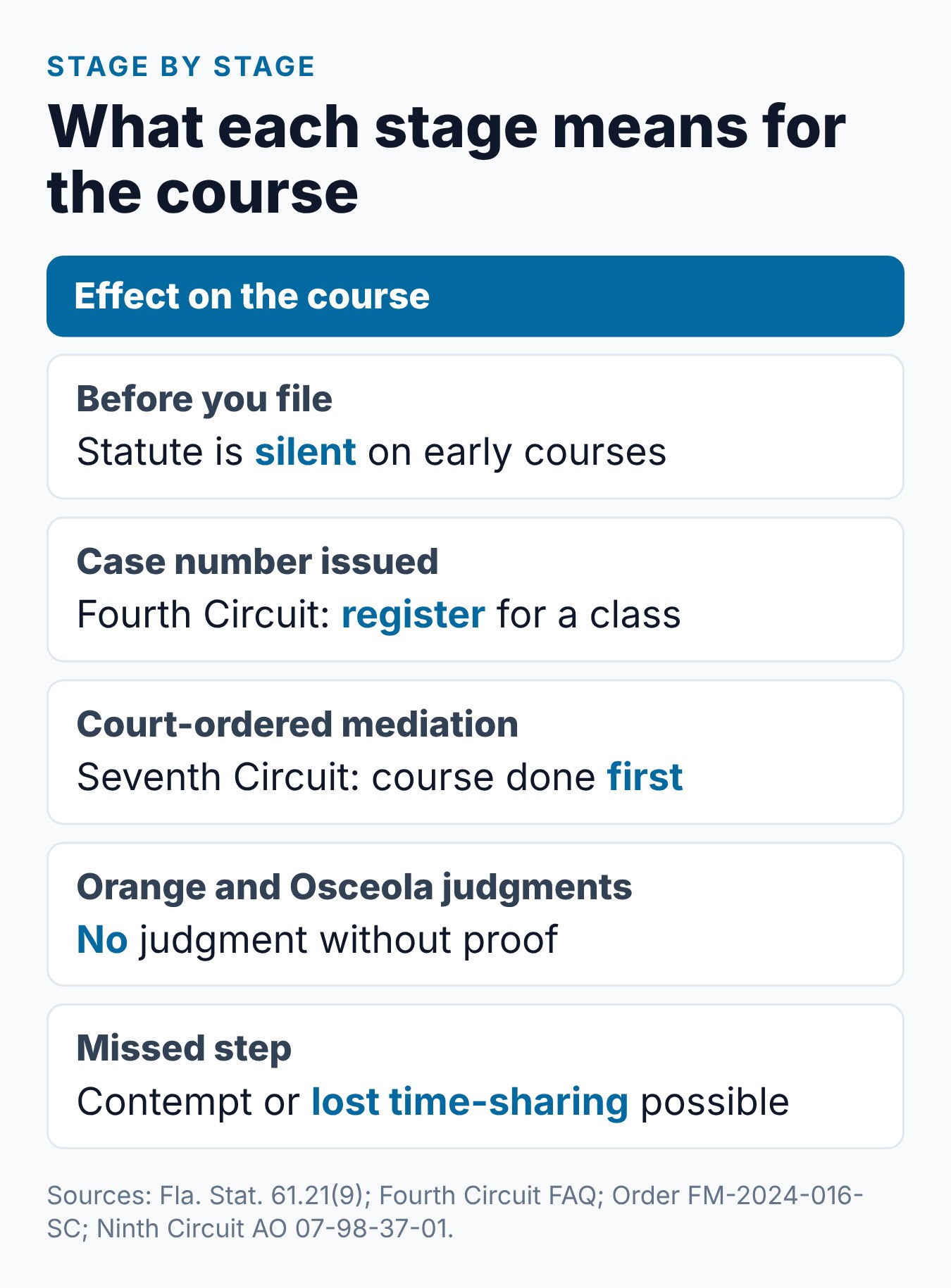
What about taking the course before you file? Section 61.21 does not say whether an early course counts, and local practice differs. See taking the class before filing.
Filing the Petition
The case starts with a petition. The Fifteenth Circuit’s checklist for divorce with minor children names the form: Family Law Form 12.901(b)(1), the Petition for Dissolution of Marriage with Dependent or Minor Children.
The filing date matters for the course. Under section 61.21(5), the petitioner “must complete the course within 45 days after the filing of the petition.”
Some courts tie sign-up to the case number. The Fourth Circuit’s FAQ says that when you have your case number, you may register for one of its classes.
Service and the Answer
Next, the other spouse gets the papers. The Palm Beach checklist describes this stage:
- Summons. The Clerk issues it at the petitioner’s request, unless the respondent files an Answer and Waiver of Service.
- Proof of service. The Sheriff’s Office or a process server files it for the petitioner.
- Answer. The respondent files an answer within 20 days of service.
If the respondent does not answer within 20 days, the checklist says the Clerk acts on the petitioner’s motion for default. That is a separate court step from the course.
Service also starts a clock for the course. Section 61.21(5) says all other parties must finish “within 45 days after service of the petition.” So the two parents can have different due dates.
The Course Window
Each parent takes the Parent Education and Family Stabilization Course. The Florida Department of Children and Families (DCF) approves it, and its provider list shows each approved course.
Key rules for this stage:
- Start soon. The law says to begin “as expeditiously as possible.”
- At least 4 hours. DCF rule 65C-32.002 counts instruction, exercises and the test. Online courses must block finishing in under 4 hours.
- Special needs. If the children have special needs or emotional concerns, parents must select a course made for that. DCF keeps a separate list.
- Not together. Parents may take it apart. The court can bar a joint class if there is a history of domestic violence.
For the full deadline table, see deadlines, course and certificate.
The Certificate and Proof
Passing the course and filing proof are two separate tasks. Under DCF rule 65C-32.004, the provider gives a certificate to each parent who completes the 4 hours and scores at least 70 percent. Attempts are unlimited.
Then each party must file proof with the court before the final judgment. The Ninth Circuit’s order for Orange and Osceola is direct about it. No divorce judgment involving parental responsibility will be granted there without proof.
Local Orders Can Move the Course Earlier
The statute sets the outer limit. A circuit can ask for more. Three examples from official pages:
- Seventh Circuit. Its order FM-2024-016-SC requires the course before court-ordered mediation or trial, whichever is sooner. Parties must enroll within 20 days.
- Fourth Circuit. Its standing order for Duval, Clay and Nassau calls for “a similar qualified inperson program.”
- Miami-Dade. The court’s FAQ adds a 3½-hour class for children aged 6 to 17.
Follow your own circuit’s order. If you cannot find one, ask the clerk.
The Course Is Separate From Other Papers
The course certificate is one paper among several. The Palm Beach (Fifteenth Circuit) checklist, for example, lists it next to the parenting plan, both parties’ financial affidavits, the certificate of compliance with mandatory disclosure, the UCCJEA affidavit and the child support guidelines worksheet. Our Palm Beach County parenting class guide shows who the checklist says files each one.
That is one circuit’s list, and it may change. The point is simple: finishing the course does not fill in any of the other papers. Each paper still has to be completed and filed on its own, and section 61.21 requires proof of the course before the final judgment.
The parenting plan has its own rules under section 61.13. See the parenting plan vs the parent course and time-sharing and the course.
Paying for the Course
Florida sets no state price. Section 61.21(7) lets providers charge “a reasonable fee” for each parent who attends. DCF must list at least one sliding-fee site in each circuit, if one is available.
Retakes should not add to the bill. DCF rule 65C-32.004 says providers may not charge more for the extra time or instruction needed to pass.
What You Say in the Course
The course is a class, not a hearing. Section 61.21(8) says statements made in a session are not considered in the case. No session report enters the record unless the parties agree in writing.
If the Course Step Is Missed
The final judgment waits for proof. Beyond that, section 61.21(9) lets the court hold a parent in contempt. It may also deny that parent shared parental responsibility or time-sharing, or order other sanctions.
Only the court can excuse a party from the course or its deadline, for good cause. The Ninth Circuit’s order says such waivers “shall not be liberally provided.”
After the Divorce: Changes and Paternity Cases
The course can come up again. In a case to modify a parenting plan or time-sharing schedule, section 61.21(6) says the parties “may be required” to take a parenting course. Section 61.13 also requires a substantial and material change in circumstances before a plan can be changed.
Parents who were never married follow a similar path in a paternity case that involves parental responsibility. The petitioner still has 45 days after filing. The other party’s 45 days start at an acknowledgment or adjudication of paternity, or an order granting time-sharing or support.
Guides in This Series
Each guide covers one part of the divorce process in depth:
- Parenting plan vs the parent course: what each one is and how they connect.
- Time-sharing and the parent course: Florida’s terms for custody, and what the course does not decide.
- Deadlines, course and certificate: the full deadline table and date math.
- Divorce checklist for parents: ten items to track, with a done point for each.
- Parent course FAQs: short answers that link to full guides.
Common Mistakes
Each item rests on a statute, a DCF rule or a court page:
- Waiting for the final hearing. Proof must be filed before the final judgment.
- Using one date for both parents. Filing and service start separate clocks.
- Ignoring a mediation date. The Seventh Circuit wants the course done first.
- Treating the certificate as a parenting plan. They are separate papers with separate rules.
- Choosing an online class in Duval, Clay or Nassau. That circuit calls for an in-person program.
What We Found on the Official Pages
On the official pages we checked on October 26, 2026, sections 61.021, 61.052 and 61.21 appeared in the 2026 Florida Statutes. Section 61.21 had last changed in 2021.
The Palm Beach checklist listed the course certificate for both the petitioner and the respondent, and it showed no date. The Seventh Circuit order was dated April 3, 2024.
How Requirements Can Vary
Section 61.21 of the Florida Statutes sets the course requirement for the whole state, and DCF approves the courses. Each judicial circuit can still add its own steps, such as how to file the certificate or which class formats it accepts. The Fourth Circuit (Duval, Clay and Nassau counties), for example, requires an in-person class.
Laws, court orders and local rules can change. Check your court’s instructions, your county clerk’s website and DCF’s provider list before you enroll or file.
Frequently Asked Questions
Where does the parenting class fit in a Florida divorce?
Right after the case opens. The petitioner has 45 days from filing, and the other parent has 45 days from service. Proof goes in the court file before the final judgment.
Do both parents have to take the course?
Yes, in a divorce with minor children. Section 61.21 covers all parties, and only the court can excuse one, for good cause.
Does the course replace the parenting plan?
No. The plan is a separate paper under section 61.13. The course only gives ideas for building one.
How long does the other spouse have to answer?
The Palm Beach checklist says the respondent answers within 20 days of service. Ask your clerk about your own court.
Can a local court set an earlier course date?
Yes. The Seventh Circuit requires completion before court-ordered mediation or trial, whichever comes first.
Is an online course accepted in every county?
No official source says so. The Fourth Circuit requires an in-person program, so check your court’s instructions first.
What if we cannot afford the course?
Florida sets no price, and DCF must list a sliding-fee site in each circuit, if available. DCF’s provider list also shows each course’s indigent status.
Is what I say in the course used in my divorce?
No, unless the parties agree in writing. Section 61.21(8) keeps session statements out of the case.
Conclusion
The parent course is a short, fixed step inside a Florida divorce with children: 45 days from filing or service, then proof before the final judgment. Keep it on track next to your parenting plan and financial papers, and follow your circuit’s order. When you are ready, DivorceParentingClass.net’s online Florida parent education course is one choice, but first confirm that your court accepts an online course.
Related Articles
- Parenting Plan Florida Rules vs. the Parent Education Course
- Florida Custody Laws: Time Sharing and the Parenting Course
- Divorce in Florida With Kids: Deadlines, Course, and Certificate
- Florida Divorce Checklist for Parents With Minor Children
- Florida Divorce Parenting Class FAQs for Family Court
Sources
- Florida Statutes § 61.21 — Parenting course
- Florida Statutes § 61.13 — Parenting plans and time-sharing
- Fla. Admin. Code R. 65C-32.002 — Course length and delivery
- Fla. Admin. Code R. 65C-32.004 — Test and certificate
- Florida DCF — Approved course provider list
- Florida DCF — Courses for children with special needs or emotional concerns
- Fifteenth Judicial Circuit — Divorce with children checklist (PDF)
- Ninth Judicial Circuit — Administrative Order 07-98-37-01 (PDF)
- Seventh Judicial Circuit — Order FM-2024-016-SC
- Fourth Judicial Circuit — Standing Family Law Order (PDF)
- Fourth Judicial Circuit — Family Court Services FAQ
- Eleventh Judicial Circuit — Divorce Education Program FAQ
Billy Forte is the owner of DivorceParentingClass.net.
This article is general information, not legal advice. Court rules, local practice, and case facts can differ by county, judge, and case type in Florida. Use official court and state sources, and consult a qualified Florida family law attorney for legal guidance specific to your case.