
Updated October 2026 · Reviewed by Billy Forte
If you are wondering how long are parenting classes for a Florida divorce, the answer is at least 4 hours, counting the lessons, the exercises and the final test. That minimum comes from Florida law and DCF rules, and online courses must stop anyone from finishing in less time. A retake of the test, a classroom schedule or a local extra class can add time beyond the 4 hours.
Key Facts
- Minimum length: at least 4 hours, not exactly 4. See how long the class is.
- What counts: instruction, participant exercises and the end-of-course test. See what counts.
- Online lock: an online course must block a finish in under 4 hours. See online courses.
- Extra time: retakes, instructor questions and local extras can add time. See what can add time.
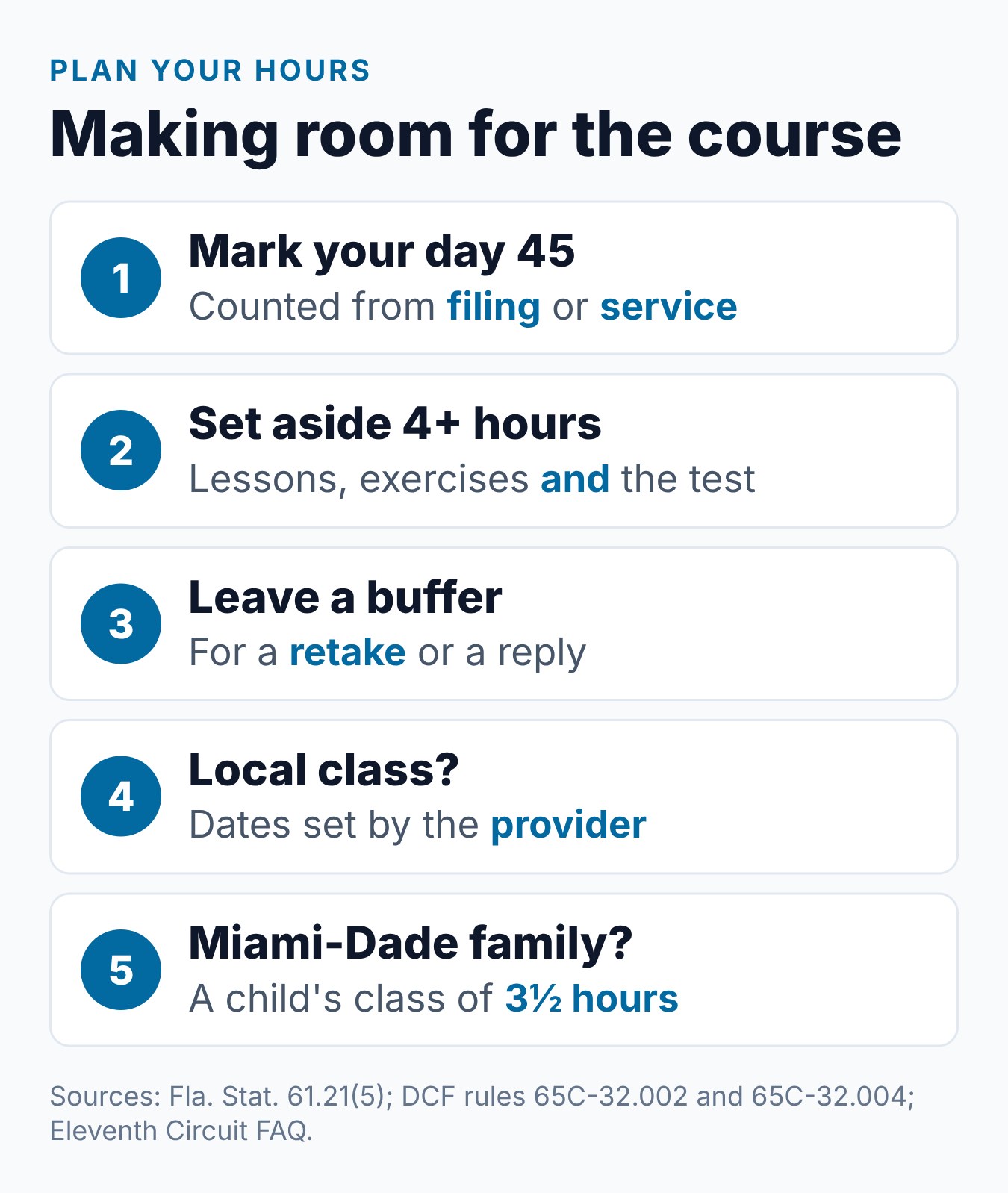
- Deadline: finish within 45 days after filing or service. See the 45-day window.
How Long Are Parenting Classes in Florida?
The required class is the Parent Education and Family Stabilization Course. Section 61.21(2), Florida Statutes says the Florida Department of Children and Families (DCF) approves a course “which must be a minimum of 4 hours.”
DCF’s course page says the same: “The courses are a minimum of 4 hours.” So 4 hours is the floor, not a fixed length. A course may run longer.
The rule applies to all parties to a divorce with minor children. It also applies to the parties to a paternity case involving parental responsibility. In a case to change a parenting plan or time-sharing schedule, the judge may require it.
Why the Law Sets a Minimum
The Legislature explained its reasons in section 61.21(1). Children of divorcing parents can suffer lasting harm, more so when parents stay in long legal conflict. Parents gain from early, general education on the court process, emotional adjustment and local resources.
A minimum length makes room for that education in every course. The 4 hours must cover the eight required parts, plus abuse and neglect information and a list of local help agencies.
What Counts Toward the 4 Hours
DCF rule 65C-32.002 defines the time. A course is at least 4 hours of course instruction, “including the time required for instruction, participant exercises and an end of course test.”
So three things fill the hours:
- Instruction. The rule calls for a mix of methods, such as lectures, group talks, role-plays and videos.
- Exercises. Activities you do as part of the lessons.
- The final test. It sits inside the 4 hours, not after them.
The lessons follow eight parts set by rule 65C-32.003. See what the course covers, or for a short view, what the 4-hour class includes.
Online Courses: The 4-Hour Lock
Rule 65C-32.002 adds a rule just for online courses. They “shall have a mechanism that prevents participants from completing the course in less than four (4) hours.”
That means no approved online course can be finished in under 4 hours, however you pace it. The rules set no daily limit, so the course itself decides whether you may finish in one sitting. See finishing in one day.
Online and correspondence providers must also let you reach an instructor. Questions about content must be answered within one business day.
Not every court accepts online courses. The Fourth Judicial Circuit (Duval, Clay and Nassau) requires an in-person class, so check your court’s rules first.
Classroom Courses Run on the Provider’s Schedule
In-person classes meet the same 4-hour minimum. When they meet is up to the provider. A class might run in one session or across more than one; ask before you sign up.
The Fourth Circuit’s standing family law order calls for “a four-hour parenting course” from an in-person program. Its Family Court Services FAQ names three local programs. Their dates come from those programs, not from the state.
The same FAQ answer also points parents to DCF’s list of local and online providers. So ask the circuit’s Family Court Services which class applies to your case.
Find local classes on DCF’s provider list, which shows each course’s city and delivery method.
Correspondence Courses and Your Time
Florida law requires DCF to approve at least one statewide course by correspondence, as well as one by internet. The same 4-hour minimum applies to it. You must also be able to reach an instructor, who answers content questions within one business day.
The rules do not say how long mailing takes. If you choose this format, ask the provider how it handles the test and the certificate, and build that into your plan.
How the Course Checks Your Time and Identity
Every course must include “a means of verifying the identity of participants.” That way the hours count for the parent who did them. The method is up to the provider.
Online, the 4-hour lock keeps the course from ending early. In a classroom, the instructor runs the session. Either way, the certificate records the date you began and the date you finished.
Courses in Other Languages
The 4-hour minimum is the same in any language. DCF’s provider list shows a “Languages” column for each course. Miami-Dade’s court FAQ says its classes are offered in English and Spanish.
What Can Add Time
The 4 hours is a minimum. These things can stretch the total:
- A retake. Below 70 percent, you review the missed material and try again. Rule 65C-32.004 says providers may not charge for the extra time or teaching.
- Waiting on an answer. An instructor has up to one business day to reply to a content question.
- A special-needs course. If your children have special needs or emotional concerns, you must pick a course built for that. DCF keeps a separate list.
- Extra courses. The judge may order more courses on children with special needs, on top of the main course.
- A local children’s class. Miami-Dade’s court FAQ says a child aged 6 to 17 must attend a 3½-hour class for children of divorcing parents.
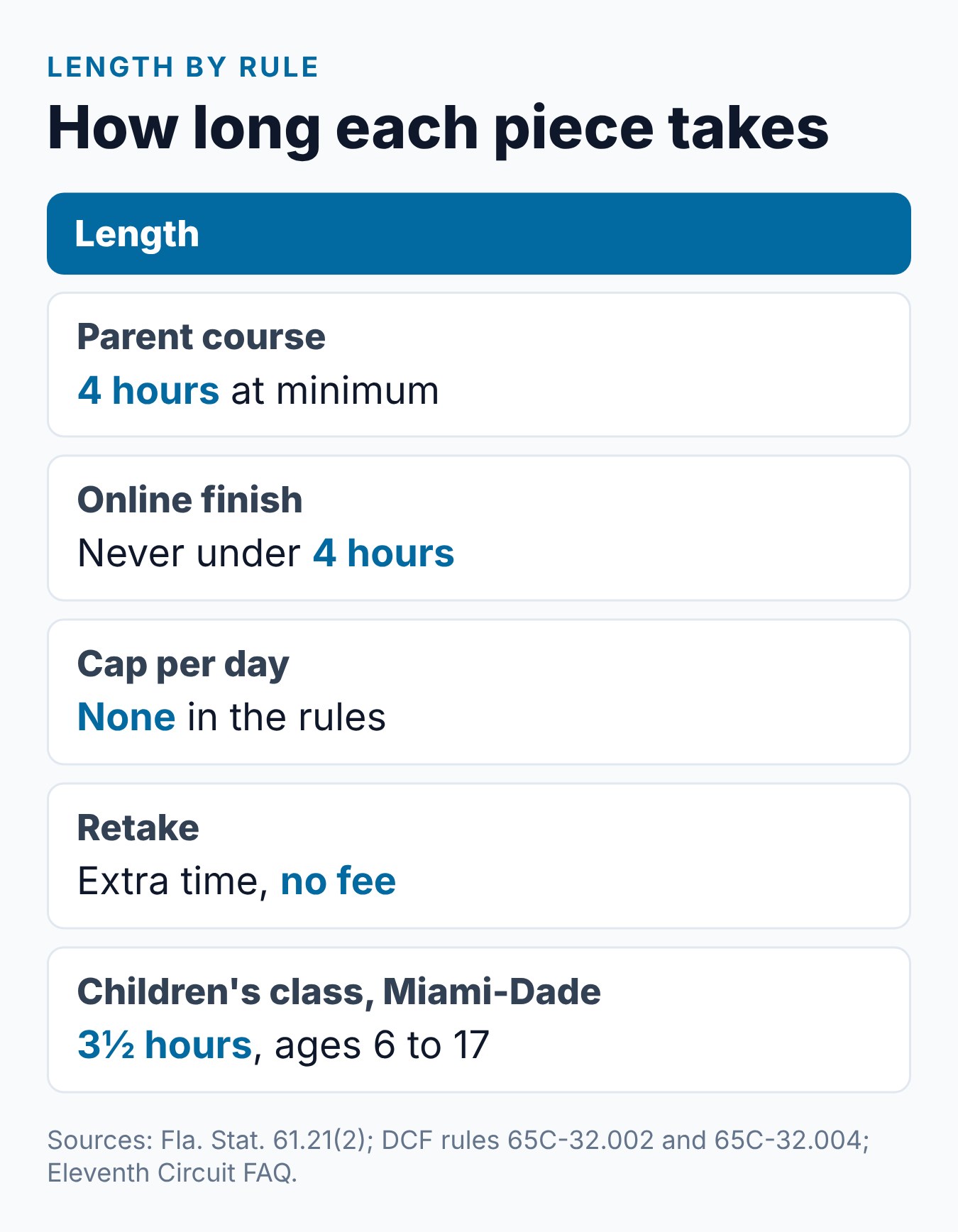
Time Rules at a Glance
| Piece of the requirement | How long, by rule | Source |
|---|---|---|
| Parent course | At least 4 hours | Section 61.21(2) |
| What the 4 hours include | Instruction, exercises and the final test | Rule 65C-32.002 |
| Online course | Cannot be finished in under 4 hours | Rule 65C-32.002 |
| Daily limit | None set in the rules | Rules 65C-32.002 to .004 |
| Test retakes | No limit; extra time has no added fee | Rule 65C-32.004 |
| Miami-Dade children’s class | 3½ hours, ages 6 to 17 | Eleventh Circuit FAQ |
The Test Inside the 4 Hours
The end-of-course test is part of the course time. You need 70 percent or more to get a certificate, and attempts are unlimited.
No official source sets the number of questions, says whether the test is open book, or requires quizzes. Each of those is a provider choice. Our test guides cover them:
- Is the final test open book?
- How many questions are on the test?
- Can you fail, and how do retakes work?
- Are there quizzes along the way?
How Length Fits the 45-Day Window
The course is short, but the deadline is firm. Under section 61.21(5), the petitioner must finish within 45 days after filing the petition. The other party must finish within 45 days after service.
Each party then files proof with the court before the final judgment. The law also says to begin “as expeditiously as possible.” Only the court can excuse a party from finishing on time, for good cause.
So the real planning question is when, not how long. See how to finish on time for a step plan.
The Certificate Shows Your Dates
When you finish at least 4 hours and pass the test, you get a certificate of completion. Rule 65C-32.004 says it shows the date you began and the date you finished. It also shows the course name, the provider’s name and contact information, and the curriculum name if any.
No rule sets how fast a provider must issue it. Providers must be able to verify certificates and keep copies for five years.
Florida Parenting Class Guides in This Series
Each guide covers one part of the course in depth:
- What the course covers: the law’s topic list and DCF’s eight required parts.
- Is the final test open book?: no state rule, and what the test is for.
- How many questions?: no set count, and what DCF does fix.
- Can you fail?: the 70 percent mark and unlimited retakes.
- Quizzes and identity checks: what is required and what is optional.
- Finishing on time: a plan for the 45-day window.
What We Found on the Official Pages
On the statute, DCF and court pages we checked on October 26, 2026, section 61.21 still said “a minimum of 4 hours.” DCF’s course page, updated April 8, 2026, said “The courses are a minimum of 4 hours.”
Rule 65C-32.002, last amended effective April 17, 2016, still required the online 4-hour lock. Miami-Dade’s FAQ, which carries no date, still listed the 3½-hour children’s class.
Common Mistakes to Avoid
Each point comes from section 61.21, a DCF rule or a court page:
- Treating 4 hours as exact. It is a minimum.
- Looking for a shorter online course. Online courses must block a finish under 4 hours.
- Forgetting the test is inside the time. Plan for it, and for a possible retake.
- Assuming online works everywhere. Duval, Clay and Nassau require an in-person class.
- Missing a local extra. Miami-Dade adds a children’s class for ages 6 to 17.
- Leaving it to the last week. The window is 45 days from filing or service.
How Requirements Can Vary
Section 61.21 of the Florida Statutes sets the course requirement for the whole state, and DCF approves the courses. Each judicial circuit can still add its own steps, such as how to file the certificate or which class formats it accepts. The Fourth Circuit (Duval, Clay and Nassau counties), for example, requires an in-person class.
Laws, court orders and local rules can change. Check your court’s instructions, your county clerk’s website and DCF’s provider list before you enroll or file.
Frequently Asked Questions
How long is the parenting class for divorce in Florida?
At least 4 hours. Section 61.21 and DCF rule 65C-32.002 set that minimum, and it includes the end-of-course test.
Can I finish an online course in less than 4 hours?
No. DCF rule 65C-32.002 requires online courses to have a way to stop anyone from finishing in less than 4 hours.
Is there a daily time limit?
The DCF rules do not set one. Whether you may finish in one sitting depends on the course.
Does a retake add time?
It can. You review the missed material before you try again. Providers may not charge an added fee for that extra time.
How long is the Miami-Dade children’s class?
Miami-Dade’s court FAQ says a child aged 6 to 17 must attend a 3½-hour class for children of divorcing parents. It is separate from the parents’ course.
Do both parents spend 4 hours?
Yes. Each parent who must take the course completes at least 4 hours and passes the test. Parents do not have to take it together.
How long do I have to finish?
The petitioner has 45 days after filing, and the other party has 45 days after service. Proof goes to the court before the final judgment.
Is the length the same in a paternity case?
Yes. Section 61.21 covers paternity cases that involve parental responsibility, and the same course and 4-hour minimum apply. The other party’s 45 days start from different events in those cases.
Conclusion
So how long are parenting classes for a Florida divorce? At least 4 hours, with the test inside that time and possible extra time for a retake.
You can plan your hours with DivorceParentingClass.net’s online Florida parent education course. Before you enroll, confirm that your court accepts an online course.
Related Articles
- What Are Parenting Classes? Florida Course Topics Explained
- Is the Florida Parenting Course Final Test Open Book?
- Florida Parenting Course End of Course Test: How Many Questions?
- Can You Fail a Parenting Class? Florida Retake Rules
- Is There a 4 Hour Co Parenting Class Quiz in Florida?
- How to Finish a Florida Online Parenting Class on Time
Sources
- Florida Statutes § 61.21 — Parenting course
- Fla. Admin. Code R. 65C-32.002 — Course length and delivery
- Fla. Admin. Code R. 65C-32.003 — Required course content
- Fla. Admin. Code R. 65C-32.004 — Test and certificate
- Florida DCF — Parent Education and Family Stabilization Course
- Florida DCF — Approved course provider list
- Florida DCF — Courses for children with special needs or emotional concerns
- Eleventh Judicial Circuit — Divorce Education Program FAQ
- Fourth Judicial Circuit — Standing Family Law Order (PDF)
- Fourth Judicial Circuit — Family Court Services FAQ
Billy Forte is the owner of DivorceParentingClass.net.
This article is general information, not legal advice. Court rules, local practice, and case facts can differ by county, judge, and case type in Florida. Use official court and state sources, and consult a qualified Florida family law attorney for legal guidance specific to your case.