
Updated October 2026 · Reviewed by Billy Forte
If you are looking up parenting classes Florida courts require in your county, start with one fact: section 61.21 sets the same core rules statewide, but each judicial circuit can add its own steps. This guide compares what eight counties’ official court and clerk pages say, and it links to a full guide for each one. It also shows how to find your own circuit’s family court page, your clerk and DCF’s list of approved courses.
Key Facts
- One state law: section 61.21 applies in every county. See the statewide core.
- Local extras: Miami-Dade adds a children’s class; Duval, Clay and Nassau require an in-person class. See what circuits add.
- County table: eight counties side by side. See the comparison.
- Certificates: filing wording differs by county. See certificate rules.
- Your court: find your circuit’s page, your clerk and DCF’s list. See how to find your rules.
One State Law, Local Steps on Top
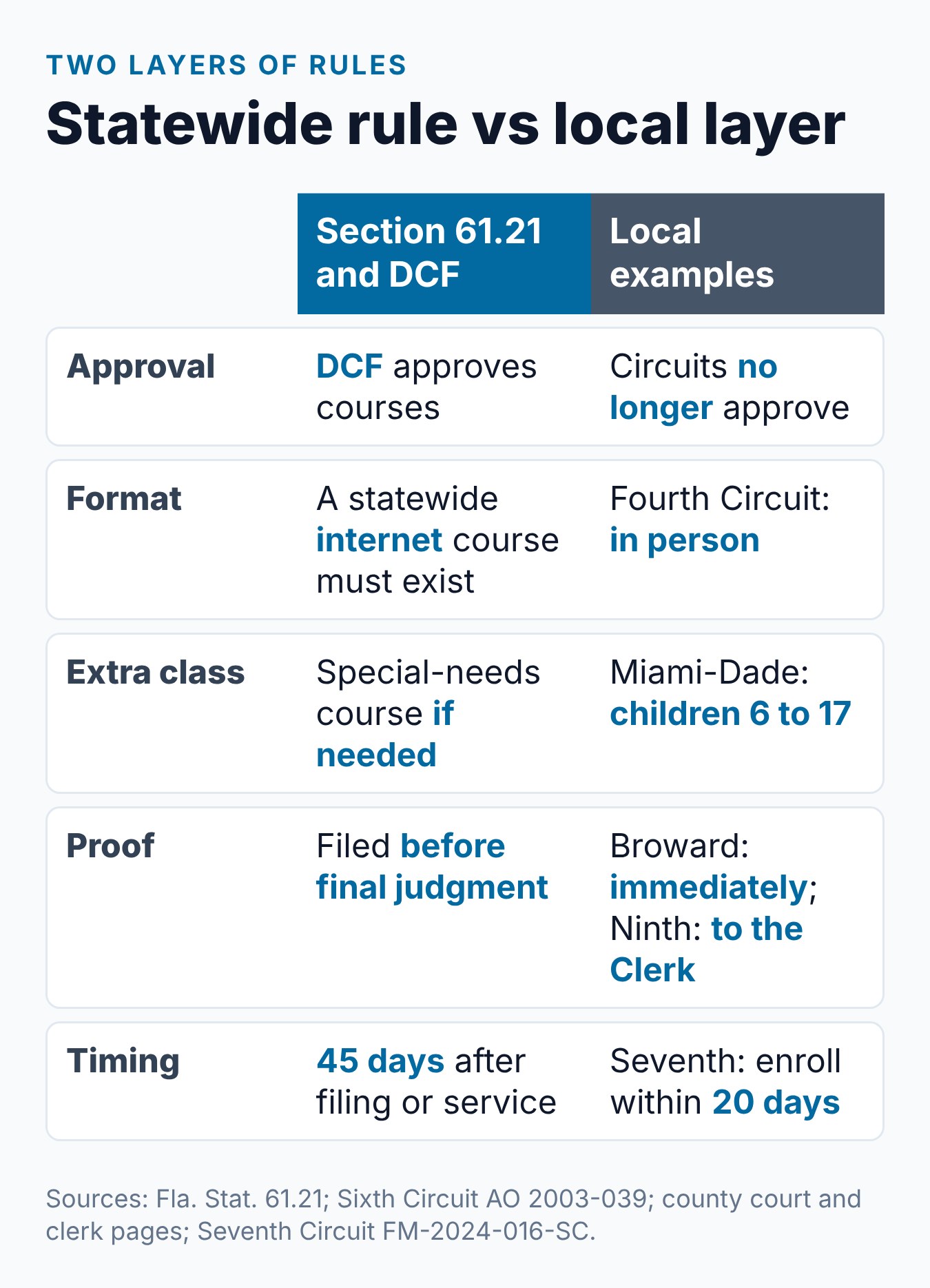
Section 61.21 of the Florida Statutes is the base rule everywhere in Florida. It requires the Parent Education and Family Stabilization Course in two kinds of cases.
One is a divorce with minor children; the other is a paternity case that involves parental responsibility. In a case that changes a parenting plan or time-sharing schedule, the court may require it.
The statewide core looks like this:
- Approval: the Florida Department of Children and Families (DCF) approves the courses, providers and sites.
- Length: at least four hours, including the end-of-course test, under DCF rule 65C-32.002.
- Timing: the petitioner finishes within 45 days after filing; the other party within 45 days after service.
- Proof: each party files proof with the court before the final judgment.
- Excusal: only the court can excuse a party, for good cause.
Those rules travel with you to any county. What changes is the local layer on top.
What Circuits Add
Florida’s courts are grouped into judicial circuits. A circuit can issue orders and post instructions for its own counties. The official pages we read show four kinds of local additions:
- An extra class. Miami-Dade’s court says a child aged 6 to 17 must attend a 3½-hour class for children of divorcing parents.
- A required format. The Fourth Circuit (Duval, Clay and Nassau) calls for an in-person class from a named local list.
- A filing method. The Ninth Circuit (Orange and Osceola) says each party gives the certificate to the Clerk. Broward’s Clerk says to file the Certificate of Attendance immediately.
- A stricter tone on waivers. The Ninth Circuit’s order says waivers need good cause in writing and “shall not be liberally provided.”
An Example From Outside These Eight Counties
The Seventh Circuit (Flagler, Putnam, Saint Johns and Volusia) shows how far local rules can reach. Its order FM-2024-016-SC, dated April 3, 2024, sets these points:
- enroll within 20 days and complete within 45 days
- finish before court-ordered mediation or trial, whichever comes first
- file a Certificate of Completion supplied by the program provider
- parents who already completed a course and filed certificates are exempt
None of those points appear in section 61.21. That is why the local page matters.
Parenting Classes Florida Counties Compared
This table sums up what each county’s official source said when we checked it. Follow the link in the next section for the full guide.
| County (circuit) | Official source we read | Local point it adds | Online class addressed? |
|---|---|---|---|
| Miami-Dade (11th) | Program page and FAQ | 3½-hour class for children aged 6 to 17 | Not stated |
| Broward (17th) | Clerk’s Family page and circuit FAQ | Attend separately; file the Certificate of Attendance immediately | Not stated |
| Hillsborough (13th) | Case management unit page | Each affected parent; link to DCF | Not stated |
| Orange and Osceola (9th) | Order 07-98-37-01 | Certificate to the Clerk; waivers rarely given | Not addressed |
| Palm Beach (15th) | Divorce-with-children checklist | Both spouses file the certificate | Not stated |
| Pinellas and Pasco (6th) | Family Law page | “Required by statute”; some forms “Pasco Only” | Not stated |
| Duval, Clay and Nassau (4th) | Standing order and FAQ | In-person class from a named list | In-person required |
| Lee (20th) | None found | State law only | No local source |
“Not stated” means the page we read did not answer the question. It does not mean an online class is accepted there.
How Each County Handles the Certificate
Every county shares the state rule: proof is filed before the final judgment. The wording on local pages differs:
- Broward: “Each party is responsible for immediately filing his/her Certificate of Attendance in the court file,” says the Broward Clerk.
- Orange and Osceola: each party gives a certificate of completion to the Clerk, under order 07-98-37-01.
- Duval, Clay and Nassau: “Parties shall file the Certificate of Completion in the Court file promptly,” says the standing order.
- Palm Beach: the Fifteenth Circuit checklist lists the certificate for the petitioner and the respondent.
- Miami-Dade, Hillsborough, Pinellas and Lee: the pages we read do not describe filing, so the state rule and the clerk’s instructions apply.
The certificate itself is the same type of paper everywhere. Under DCF rule 65C-32.004, it shows the course name, the provider’s name and contact details, the curriculum name if any, and the start and finish dates. It goes to each parent who finishes and scores at least 70 percent.
Local Names for the Same Paper
Counties do not all use the same words. Broward’s Clerk uses the name “Certificate of Attendance” for the proof. The Fourth Circuit, the Ninth Circuit and the Palm Beach checklist use “Certificate of Completion” instead.
Miami-Dade calls its program the Divorce Education Program for Parents.
The official course name is the same in every county: the Parent Education and Family Stabilization Course. See why the course has different names.
Online vs In-Person by County
Florida law requires DCF to approve at least one statewide internet course and one correspondence course. But not every court accepts them.
Of the eight counties here, only the Fourth Circuit’s pages address format. Its standing order calls for “a similar qualified inperson program” as the class. Its Family Court Services FAQ says, “YOU MUST REGISTER FOR ONE OF THE FOLLOWING IN-CLASS PARENTING CLASSES.”
The same FAQ answer also points parents to DCF’s list of local and online providers. So ask the circuit’s Family Court Services which class applies to your case.
The other pages are silent on format. So before you choose an online class, ask your court or clerk whether it accepts one in your case.
How to Find Your Circuit’s Rules
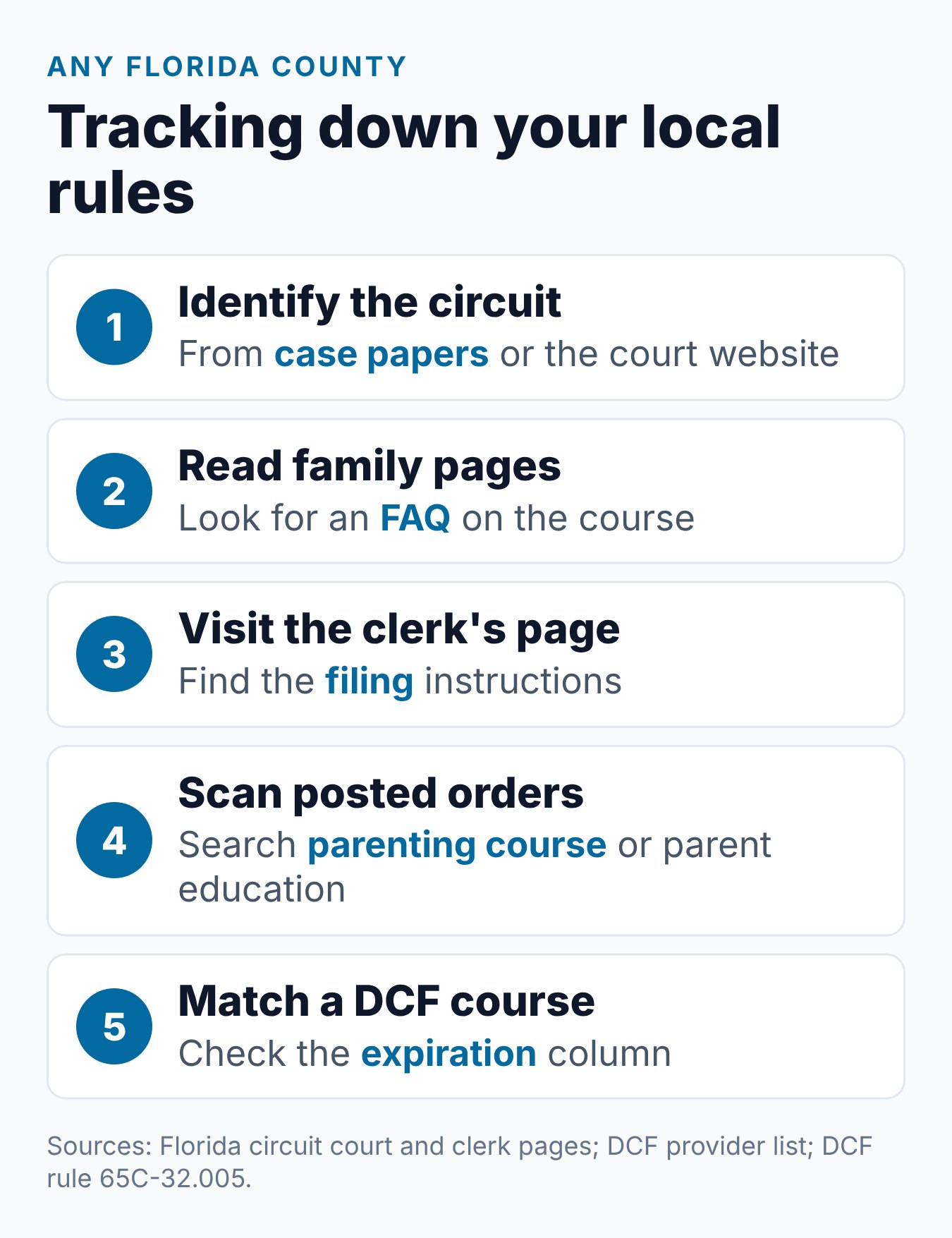
If your county is not one of these eight, you can still find its rules. Work through these steps:
- Find your circuit. Your case papers or the circuit court’s website show which circuit covers your county.
- Open the family pages. Look for a family court, family law or self-help page, and read any FAQ on the parenting course.
- Check the clerk. Your county clerk’s family division page may explain how to file the certificate.
- Search the orders. If your circuit posts its administrative orders, look for “parenting course” or “parent education.”
- Call if unsure. Ask the clerk or family court staff about local steps, and ask a Florida family law attorney about your own case.
Using DCF’s Provider List
Wherever you live, the course itself must be on DCF’s approved provider list. Its columns include provider, languages, city, delivery method, indigent status and expiration date.
Miami-Dade’s court FAQ tells parents to view DCF’s list and select the 11th Circuit. Hillsborough’s case management page and Broward’s Clerk also link to DCF.
A few rules help you use the list well:
- Check the date. Under rule 65C-32.005, DCF approval lasts three years.
- Look for fee help. Each circuit must have at least one sliding-fee site listed, if one is available.
- Special needs. If your children have special needs or emotional concerns, choose a course from DCF’s special-needs list.
County Guides in This Series
Each county guide covers its own official pages in depth:
- Miami-Dade: the 4-hour parent course, the children’s class, languages and the fee waiver.
- Broward: separate attendance, fees and the Certificate of Attendance.
- Hillsborough: who is covered and the Community Partners listing.
- Orange and Osceola: the Ninth Circuit order, paragraph by paragraph.
- Palm Beach: the Fifteenth Circuit divorce checklist.
- Pinellas: the Sixth Circuit page and the 2003 approval change.
- Duval, Clay and Nassau: the in-person rule and the named programs.
- Lee: the statewide rules and what to ask the Clerk.
If a Parent Does Not Finish
The state penalties apply in every county. Under section 61.21(9), a parent who fails to attend may be held in contempt, denied shared parental responsibility or time-sharing, or otherwise sanctioned.
Local pages add their own warnings. Miami-Dade’s FAQ says the judge may choose not to grant the divorce. The Ninth Circuit’s order allows dismissal of the action or striking of pleadings.
What We Found on the Official Pages
On the court and clerk pages we checked on October 26, 2026, seven of the eight counties had an official page or order that mentions the course. Lee County was the exception; the Twentieth Circuit’s order list had no order on the course.
Only the Fourth Circuit’s pages addressed class format. Miami-Dade’s pages were undated, and the Palm Beach checklist showed no revision date.
Common Mistakes to Avoid
Each point comes from section 61.21 or the county sources above:
- Assuming every county works the same. Local steps differ, from children’s classes to class format.
- Reading silence as permission. A page that does not mention online classes has not approved them.
- Skipping the clerk. Filing wording differs by county.
- Choosing a course off DCF’s list. Only DCF-approved courses meet section 61.21.
- Using an old county rule. Check the date on any order you rely on.
How Requirements Can Vary
Section 61.21 of the Florida Statutes sets the course requirement for the whole state, and DCF approves the courses. Each judicial circuit can still add its own steps, such as how to file the certificate or which class formats it accepts. The Fourth Circuit (Duval, Clay and Nassau counties), for example, requires an in-person class.
Laws, court orders and local rules can change. Check your court’s instructions, your county clerk’s website and DCF’s provider list before you enroll or file.
Frequently Asked Questions
Are parenting class rules the same in every Florida county?
The core rules are the same, because section 61.21 applies statewide. Each circuit can add local steps, such as Miami-Dade’s children’s class or the Fourth Circuit’s in-person rule.
Which Florida counties require an in-person class?
Of the eight counties we checked, the Fourth Circuit (Duval, Clay and Nassau) requires one. The other pages did not address format, so ask your own court.
Where do I file my certificate?
With the court, before the final judgment. Some counties say more: Broward says file it immediately, and the Ninth Circuit says give it to the Clerk.
How do I find my county’s rules?
Check your circuit court’s family pages, your clerk’s family division page and the circuit’s administrative orders. Then call the clerk if anything is unclear.
Does any county require a class for children?
Miami-Dade does. Its court FAQ says a child aged 6 to 17 must attend a 3½-hour class for children of divorcing parents.
What if my county has no page on the course?
The state law still applies. Follow section 61.21 and ask the clerk about local filing and format.
Who approves the courses in every county?
DCF. Circuits no longer approve courses; the Sixth Circuit’s 2003 order notes the law change that removed that role.
Conclusion
Start with the state rules, then check your circuit’s family pages and your clerk for local steps such as a children’s class, an in-person format or a filing method. If you are thinking about DivorceParentingClass.net’s online Florida parent education course, first confirm that your court accepts an online course for your case. The county guides above show what each official page said when we checked it.
Related Articles
- Parenting Classes Miami: Miami-Dade Divorce Course Guide
- Parenting Classes Fort Lauderdale: Broward County Guide
- Hillsborough County Parenting Class for Divorce
- Parenting Classes Orlando: Orange County Divorce Guide
- Parenting Classes West Palm Beach: Palm Beach County Guide
- Pinellas County Parenting Class Guide
- Parenting Classes Jacksonville FL: Duval County Rules
- Parenting Classes Fort Myers: Lee County Divorce Guide
Sources
- Florida Statutes § 61.21 — Parenting course
- Fla. Admin. Code R. 65C-32.002 — Course length and delivery
- Fla. Admin. Code R. 65C-32.004 — Test and certificate
- Fla. Admin. Code R. 65C-32.005 — Provider approval
- Florida DCF — Parent Education and Family Stabilization Course
- Florida DCF — Approved course provider list
- Florida DCF — Courses for children with special needs or emotional concerns
- Eleventh Judicial Circuit — Divorce Education Program FAQ
- Broward County Clerk of Courts — Family
- Thirteenth Judicial Circuit — Domestic Relations Case Management Unit
- Ninth Judicial Circuit — Administrative Order 07-98-37-01 (PDF)
- Fifteenth Judicial Circuit — Divorce with children checklist (PDF)
- Sixth Judicial Circuit — Family Law
- Fourth Judicial Circuit — Standing Family Law Order (PDF)
- Fourth Judicial Circuit — Family Court Services FAQ
- Seventh Judicial Circuit — Order FM-2024-016-SC
Billy Forte is the owner of DivorceParentingClass.net.
This article is general information, not legal advice. Court rules, local practice, and case facts can differ by county, judge, and case type in Florida. Use official court and state sources, and consult a qualified Florida family law attorney for legal guidance specific to your case.